Author: Nobenaa Ahsan

  • Olympic National Park Glaciers and a Changing Climate

    Olympic National Park Glaciers and a Changing Climate

    The Olympic National Park glaciers are some of the most closely watched ice in the country, and the news from them is hard. From the Blue Glacier on Mount Olympus to small ice fields tucked under the high ridges, the park’s glaciers are shrinking as the climate warms. Here is what scientists have measured, why it matters for rivers and salmon, and what the rest of us can do.

    Quick answer

    How many glaciers are in Olympic National Park, and are they shrinking?

    Olympic National Park had 184 glaciers in 2009, down from 266 in the early 1980s, and their combined area fell by 34% in about 30 years. The largest, the Blue Glacier on Mount Olympus, is 2.6 miles long and thinning. Researchers expect the Olympic Mountains glaciers to largely disappear by 2070.

    • 184 glaciers in 2009, down from 266 in the early 1980s
    • Glacier area fell 34% in about 30 years
    • Blue Glacier: 2.6 miles long, up to 900 feet thick
    • Glacier melt is 18 to 30% of the Hoh River’s late summer flow
    • Glaciers expected to largely disappear by 2070

    How many glaciers are in Olympic National Park?

    According to the park’s National Park Service glacier page, Olympic had 266 glaciers in 1982 and 184 in 2009. Comparing aerial photos from the late 1970s with 2009, park scientists found that glacier area had fallen by 34%. Ice volume dropped by at least 15% between 1987 and 2009.

    A later study counted again using 2015 images and a wider definition that includes perennial snowfields. Because the methods differ, the counts below aren’t a straight line, but every survey points the same way.

    Olympic glacier surveys compared

    SurveyWhat was countedCombined area
    1980 inventory266 glaciers45.9 km² (about 17.7 sq mi)
    Riedel and others, 2015184 glaciers over 0.01 km²30.2 km² (about 11.7 sq mi)
    Fountain and others, 2022 (2015 images)255 glaciers and perennial snowfields25.34 km² (about 9.8 sq mi)

    The 2022 study by Andrew Fountain and colleagues found that the 2015 ice cover was about half of what it was in 1900. Since 1980, 35 glaciers and 16 perennial snowfields have disappeared altogether. Its models suggest the Olympic Mountains glaciers will largely disappear by 2070.
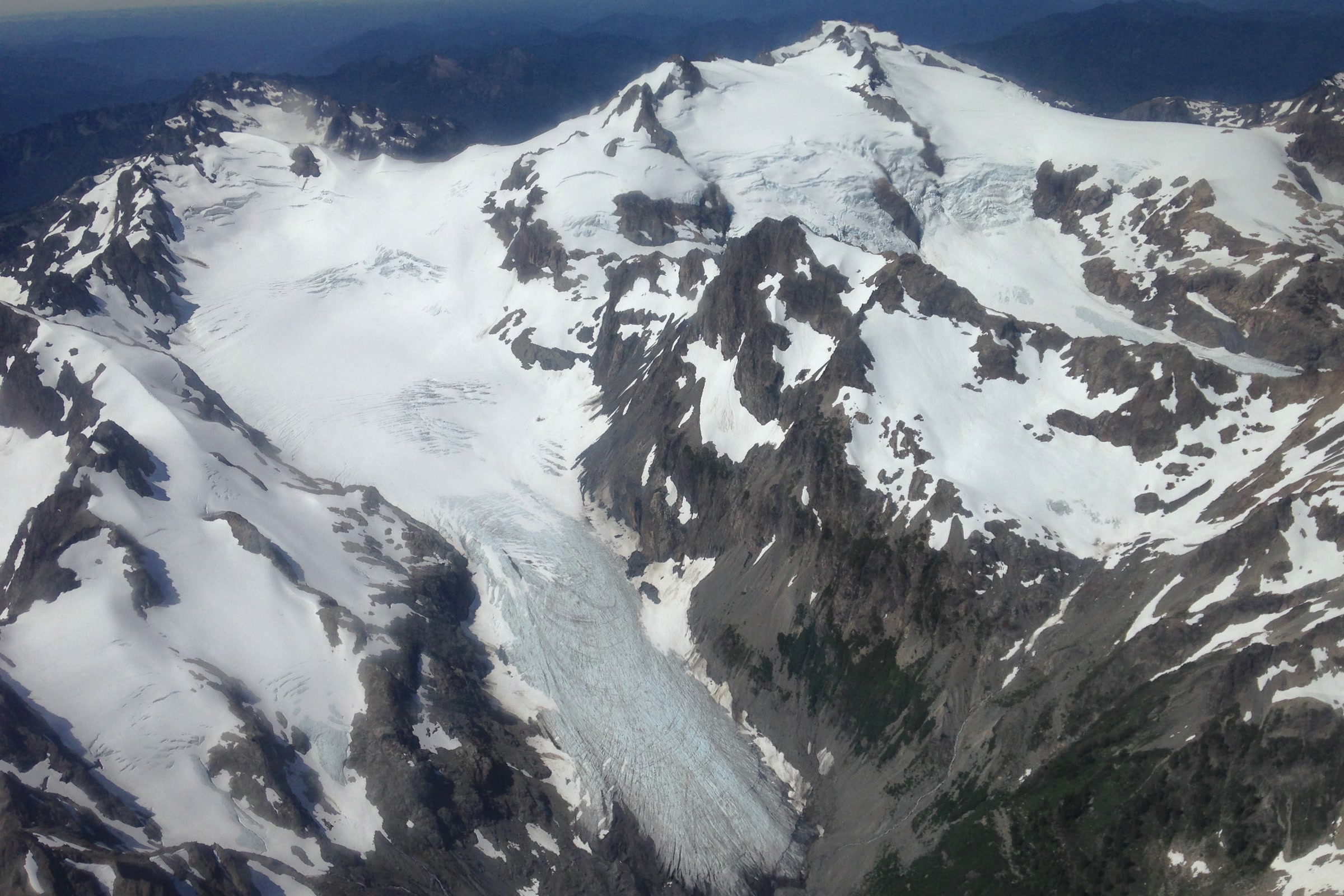
    Aerial view of Mount Olympus in July with snowfields and a broad glacier tongue flowing down between dark rock ridges
    Mount Olympus from the air, July 2016. Photo: Justin Hof, USDA Forest Service Region 6 (public domain)

    The Blue Glacier on Mount Olympus

    Mount Olympus rises to 7,980 feet, the highest peak in the Olympic Mountains, and catches 50 to 70 feet of snow a year. That snow feeds the Blue Glacier, the park’s best known river of ice. It runs 2.6 miles, is up to 900 feet thick, and moves about 3 feet a day in its fastest parts.

    Decades of measurement make the Blue Glacier one of the most studied glaciers in the world. That record shows steady loss. Its end retreated about 325 feet between 1995 and 2006, and the lower glacier thinned by 178 feet from 1987 to 2009.

    A century of change in photos

    Some of the clearest evidence comes from repeat photography: the same view, shot decades apart. The park pairs an 1899 photo of the Blue Glacier with one from 2008, and the difference is striking. Old Forest Service photos like the one below help fill in the story.
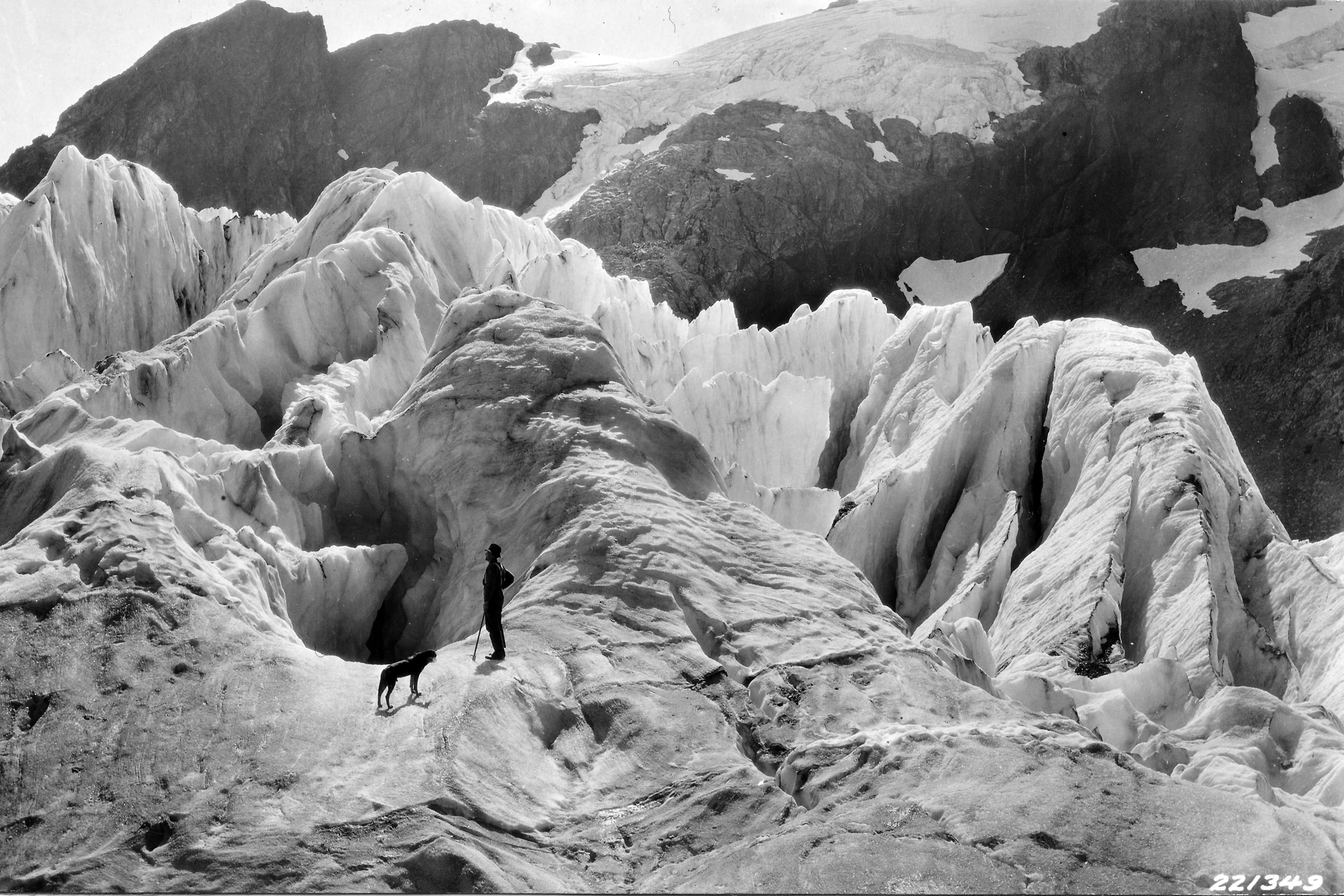
    Black and white 1927 photo of a person and a dog standing among tall ice ridges and crevasses on the Blue Glacier
    Crevasses on the Blue Glacier near Mount Olympus in 1927. Photo: U.S. Forest Service, Pacific Northwest Region (public domain)

    Glaciers melting in the Olympic Mountains

    Some glaciers are already gone. The Anderson Glacier on Mount Anderson shrank to less than 10% of its former size between 1927 and 2009, and was essentially gone by 2015. The Lillian Glacier vanished completely between 1905 and 2010.

    Why so fast? Olympic glaciers sit close to the Pacific, and the 2022 study found they respond mainly to air temperature rather than to how much falls from the sky. Warmer winters turn more snow to rain, and warmer summers melt more ice.
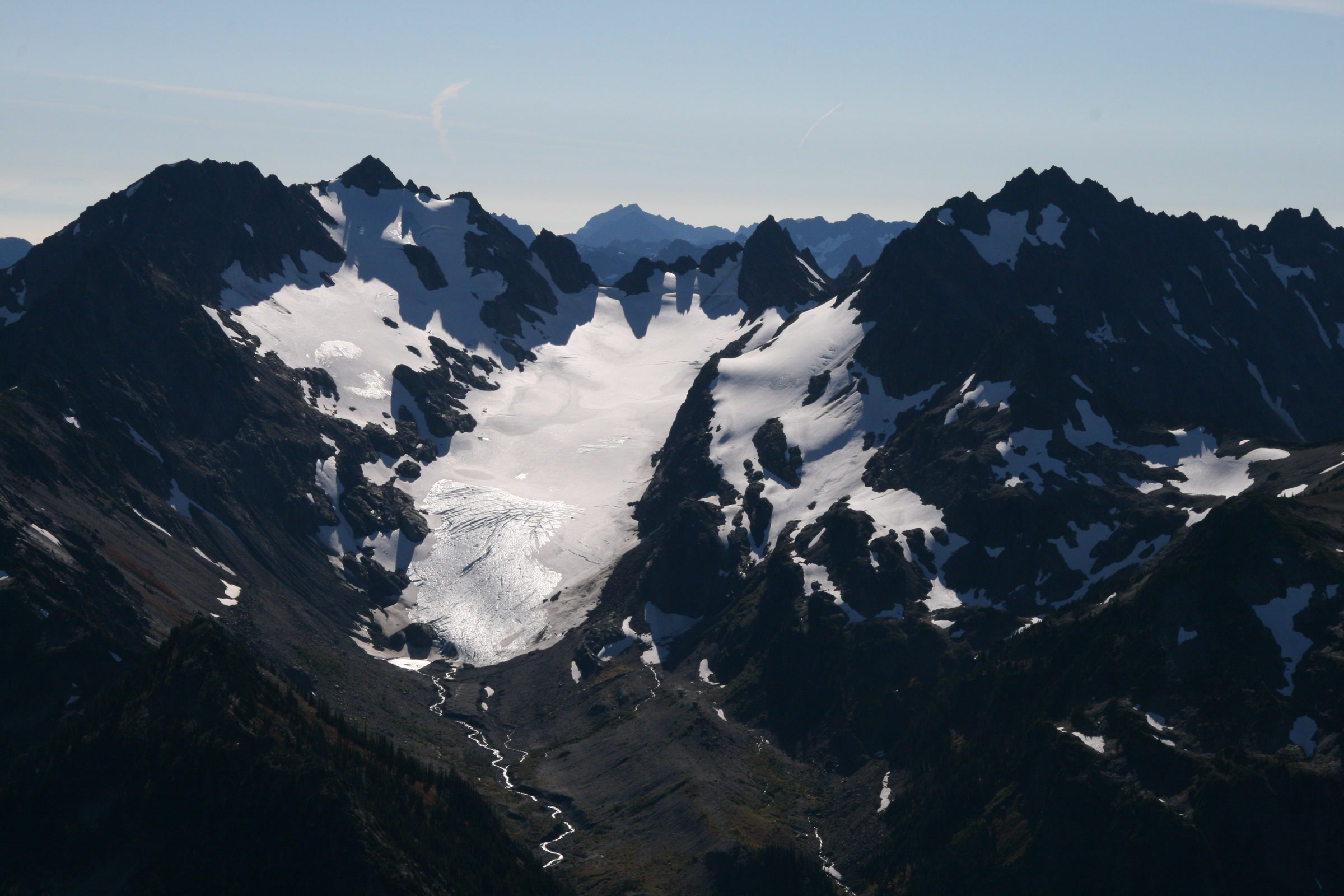
    Eel Glacier on Mount Anderson in October 2010, a small white ice field between jagged dark peaks, photographed on a park glacier monitoring flight
    Eel Glacier on Mount Anderson, seen on a glacier monitoring flight in October 2010. NPS Photo / Janis Burger

    Why the glaciers matter: rivers, salmon and summer

    Olympic summers are surprisingly dry. Glacier melt helps keep rivers running and cold when the rain stops, which matters for salmon, steelhead and bull trout.

    The Hoh River depends on ice the most. A 2015 study in the Journal of Glaciology by Jon Riedel and colleagues estimated that glacier melt makes up 9 to 15% of the Hoh’s flow from May through September. In August and September that share rises to 18 to 30%.
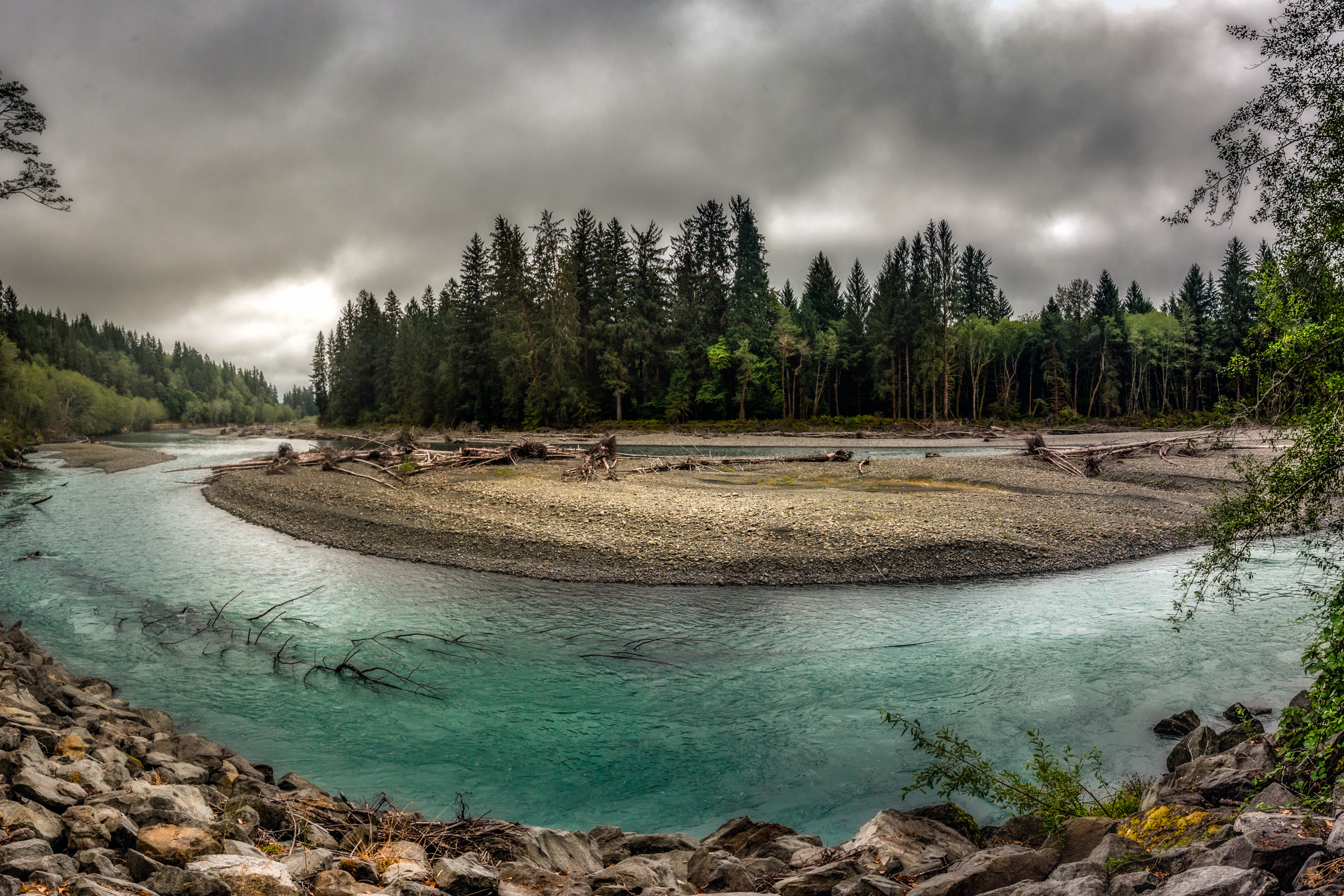
    The blue-green Hoh River curving around a wide gravel bar lined with driftwood and tall conifers under grey skies
    The Hoh River, fed in part by glaciers on Mount Olympus. Photo: Bernd Thaller / Wikimedia Commons, CC BY 2.0

    Other rivers lean on ice less. The same study put glacier melt at 2.5 to 4% of the Elwha’s summer flow. You can read how that river is healing in our story on Elwha River dam removal and restoration.
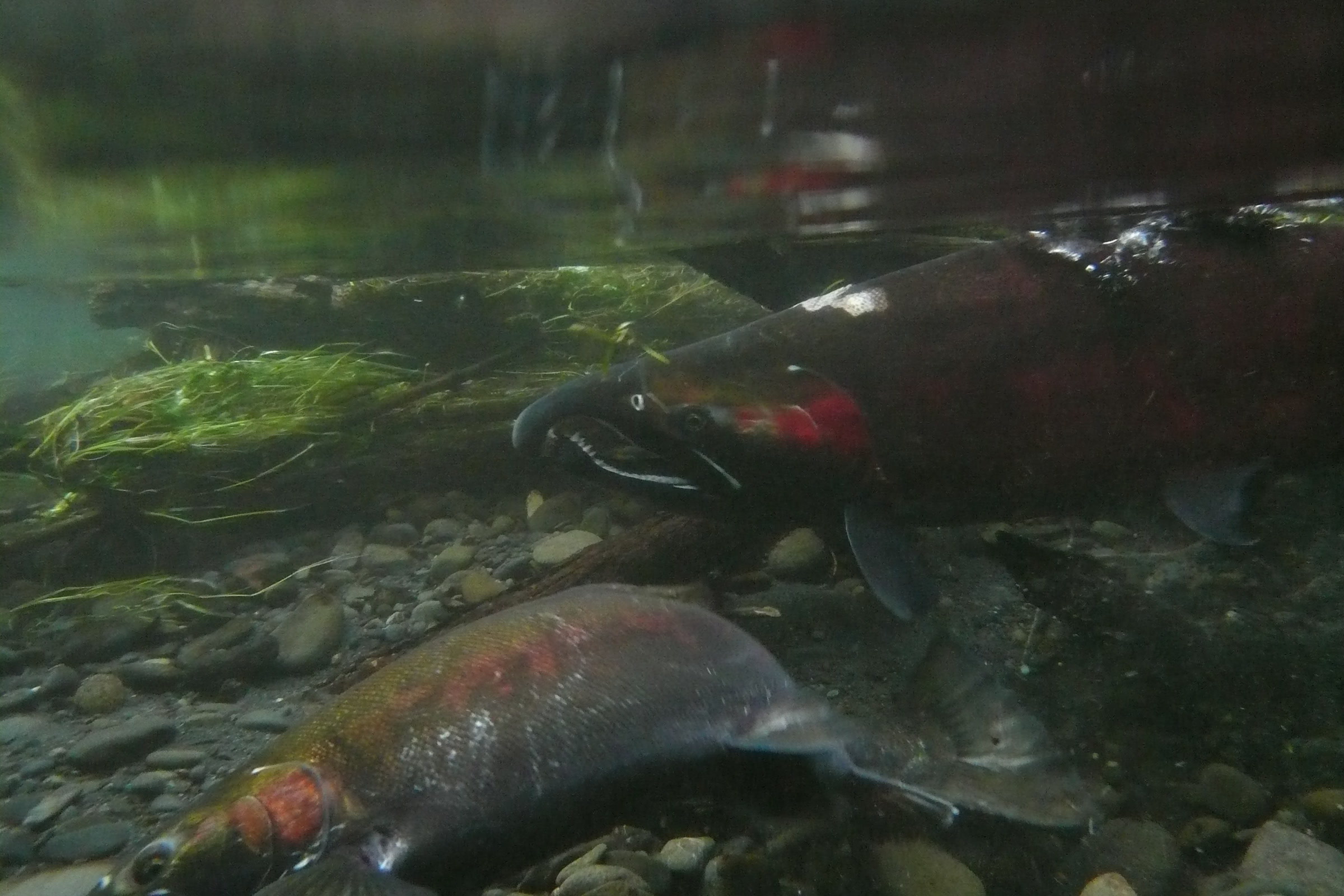
    Underwater view of two red and green spawning salmon over a pebbled streambed in the Hoh River
    Spawning salmon in the Hoh River. NPS Photo

    Seeing glaciers from Hurricane Ridge

    You don’t need to climb to see the ice. Hurricane Ridge sits 17 miles south of Port Angeles, and on a clear day the view south and southwest takes in the snowy interior of the park, with Mount Olympus and the Bailey Range on the skyline. Binoculars help.

    Summer visitors come for the meadows too, so pair a glacier view with our guide to Hurricane Ridge wildflower season. Reaching the Blue Glacier itself is a long wilderness trip up the Hoh valley, so check park rules and permits first.
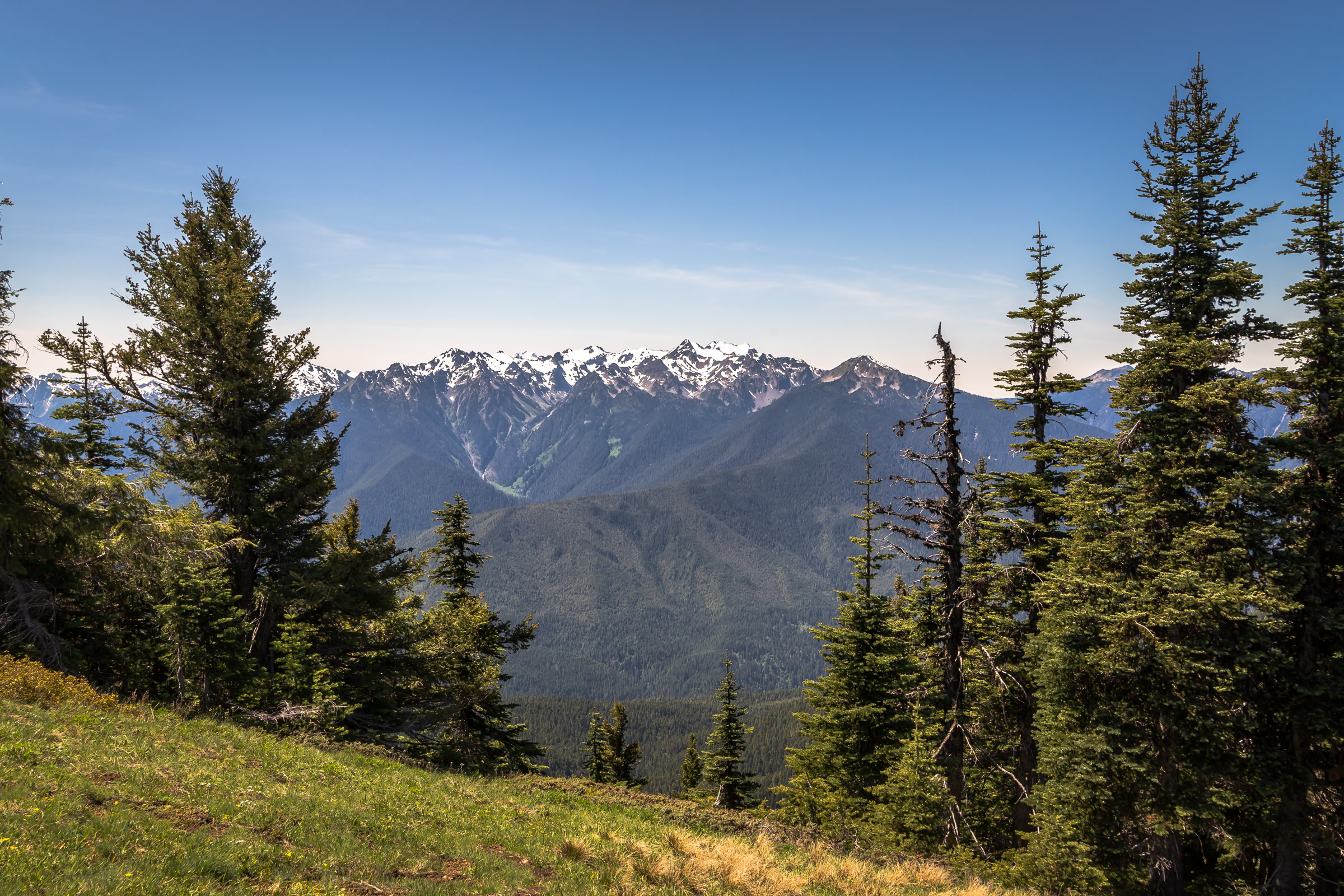
    Snowy Mount Olympus and the interior Olympic peaks seen past subalpine firs from a grassy trail near Hurricane Ridge
    Mount Olympus from a trail at Hurricane Ridge. Photo: Jonathan Miske / Wikimedia Commons, CC BY-SA 2.0

    Climate change in Olympic National Park: how you can help

    No one person can save a glacier, but we can all help the park cope with change. A few ways to start:

    • Learn from the scientists. Glaciers have been a topic in the park’s Winter Perspectives lecture series, which we support.
    • Tread lightly. Fragile meadows near snow and ice heal slowly, so follow the same Leave No Trace habits we use on the coast.
    • Take a repeat photo. Photograph a favourite viewpoint each year from the same spot and note the date. Over time, your own pictures tell the story.
    • Support the park and its research. Membership in a friends group keeps local people involved in the park’s future.

    The glaciers are one reason Olympic is recognised around the world. Read why in our post on Olympic National Park as a World Heritage Site, and if you’d like to stand with the park, become a member of Friends of Olympic National Park.

    Frequently asked questions

    How many glaciers are in Olympic National Park?

    The National Park Service counted 184 glaciers in 2009, down from 266 in 1982. A 2022 study that also counted perennial snowfields found 255 ice bodies in 2015.

    How big is the Blue Glacier on Mount Olympus?

    The Blue Glacier is about 2.6 miles long and up to 900 feet thick, and it moves about 3 feet a day in its fastest parts.

    Are the glaciers in the Olympic Mountains melting?

    Yes. Glacier area fell by 34% in about 30 years up to 2009, the Anderson and Lillian glaciers are essentially gone, and researchers expect the glaciers to largely disappear by 2070.

    Can you see glaciers from Hurricane Ridge?

    On a clear day you can see the snowy interior of the park, with Mount Olympus and the Bailey Range on the skyline. Binoculars help.

    Why do glaciers matter for salmon?

    Glacier melt keeps rivers flowing and cold in dry summers. In August and September it makes up an estimated 18 to 30% of the Hoh River’s flow.
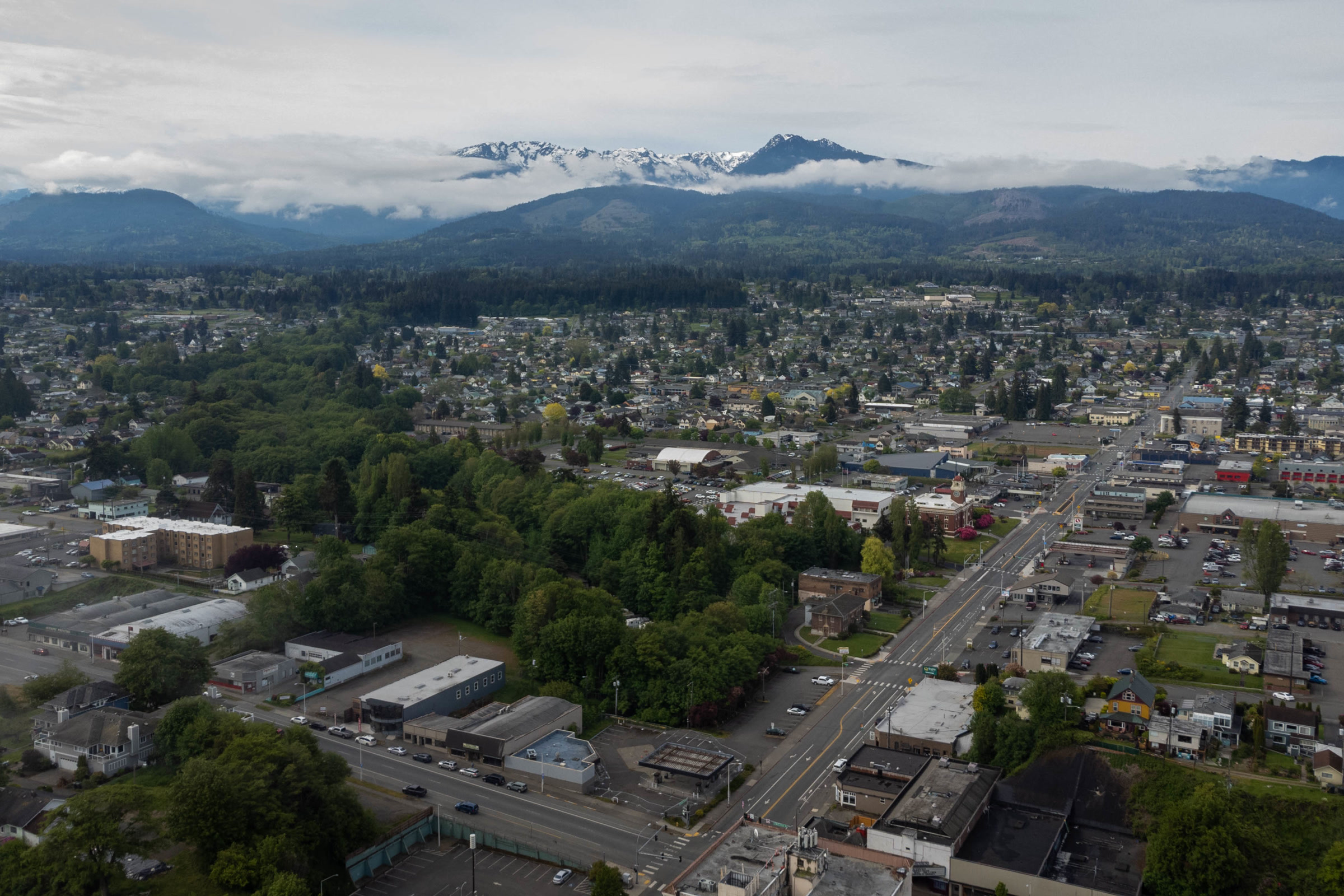
  • How Local Businesses Support Olympic National Park

    How Local Businesses Support Olympic National Park

    Local business support matters a great deal to a small national park nonprofit like ours. Friends of Olympic National Park is a volunteer-led 501(c)(3) in Port Angeles, and the shops, breweries and companies around us help in ways big and small. Here is what that support looks like, what it has already done for FONP, and how your business can take part.

    Quick answer

    How can local businesses support a national park nonprofit?

    Local businesses can support a national park nonprofit by hosting a giveback night, giving a grant, donating goods or services, sending staff on a volunteer day, or matching employee gifts. For Friends of Olympic National Park, Mighty Pine Brewing gave 15% of all sales on April 22, 2026, and Extreme Terrain awarded a $250 trail grant.

    • Worthy Wednesday at Mighty Pine Brewing: 15% of all sales to FONP
    • $250 Clean Trail Program Grant from Extreme Terrain, February 2025
    • FONP is a registered 501(c)(3), Tax ID 02-0619892
    • No set sponsorship tiers: email fonp2020@gmail.com to start

    Why local businesses matter to a park friends group

    We are a small, volunteer-led group. Our volunteer board of 12 community members runs cleanups, guided walks, Junior Ranger Day and the Winter Perspectives Series, and funds park activities the National Park Service budget doesn’t cover. Every dollar and every pair of hands goes a long way.

    Businesses on the North Olympic Peninsula also have a stake in a healthy park. Visitors who come for Hurricane Ridge, the Hoh or the coast eat, sleep and shop in our towns. When a business helps the park, it helps the place its customers came to see.

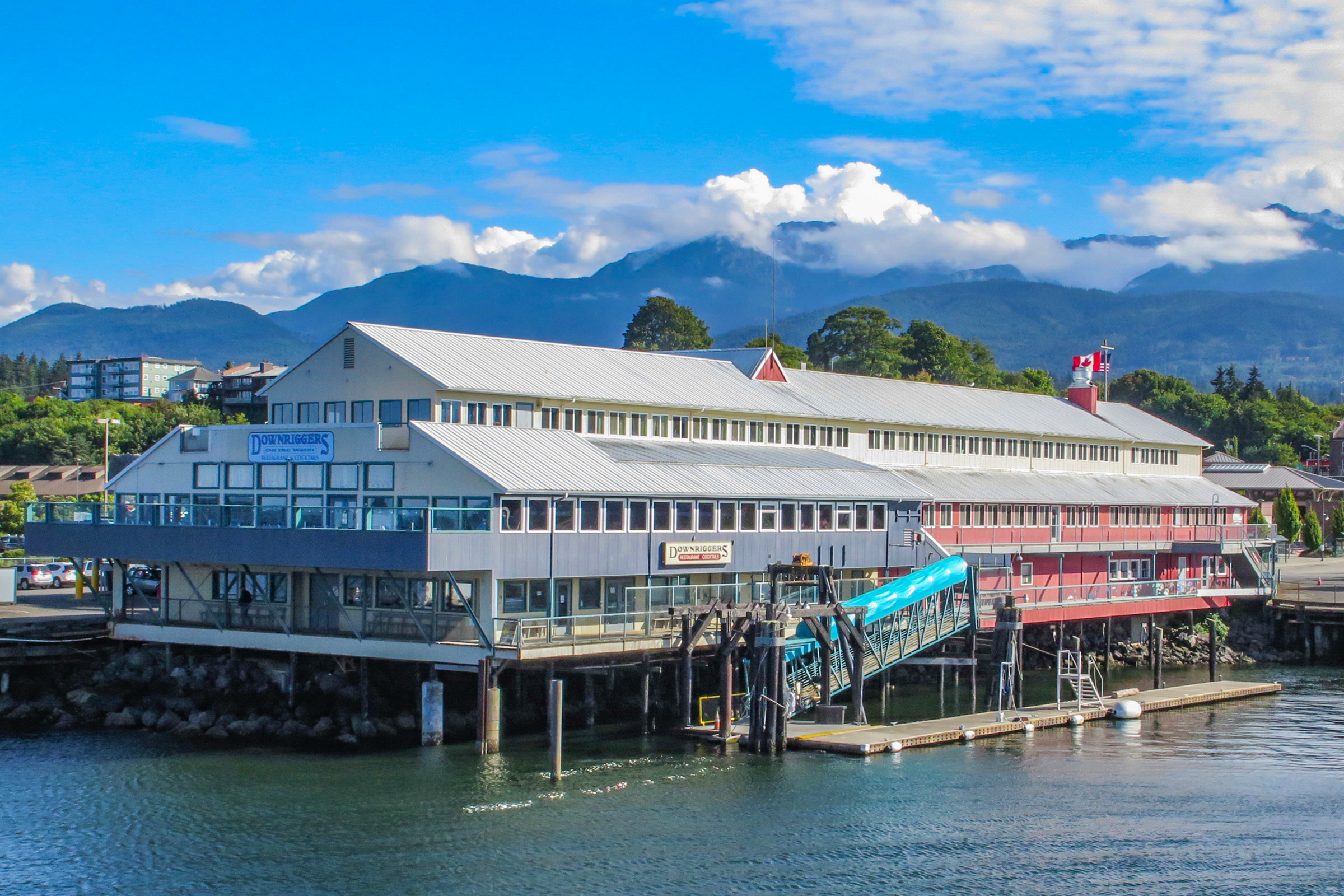
    The ferry terminal building on the Port Angeles waterfront, with green foothills and cloud-topped Olympic peaks behind
    The Port Angeles waterfront, with the Olympics behind. Photo: Burley Packwood / Wikimedia Commons, CC BY-SA 4.0

    Host a giveback night: a Port Angeles business fundraiser

    A giveback night is the simplest Port Angeles business fundraiser there is. A business picks a day, shares a portion of its sales with a nonprofit, and both sides invite their friends. Customers do what they would do anyway, and the park benefits.

    Our own example is Worthy Wednesday at Mighty Pine Brewing. On Earth Day, April 22, 2026, the brewery at 540 E 8th St in Port Angeles gave 15% of all sales from 2 PM to 9 PM to Friends of Olympic National Park. Thank you, Mighty Pine.

    What makes a giveback night work

    • A clear share of sales, announced ahead of time
    • A date with a hook, such as Earth Day or the start of summer
    • Both partners sharing the event with their own customers and members
    • A few volunteers on hand to say thank you and talk about the park
    Close-up of a row of metal beer taps in a dim, warmly lit bar
    Beer taps, shown for illustration only. Photo: cottonbro studio / Pexels

    Corporate giving: small grants go a long way

    Corporate giving for a national park doesn’t have to mean a big check. On February 20, 2025, FONP was awarded a $250 Clean Trail Program Grant from Extreme Terrain. The funds are for trail maintenance, as needed and directed by trail crews working in the park.

    You can read about it on our Extreme Terrain Clean Trail grant page. Trail work is close to our hearts, from park crews to our own Heart O’ the Forest adopt-a-trail crew. If your company runs a community grant program, we would be glad to apply.

    A pair of yellow leather work gloves tucked into the back pocket of someone's jeans beside a wire fence
    Work gloves ready for a day outdoors, shown for illustration. Photo: RDNE Stock project / Pexels

    In-kind gifts: goods and services

    Not every gift is cash. A café might bring coffee to a cleanup morning, a print shop might print flyers for a talk, or a hardware store might offer gloves and bags. Skills count too, from photography to bookkeeping.

    Before you box anything up, please email us. We are a small group with no warehouse, so we’ll tell you honestly what we can use right now.

    A weathered blue and cream Come In We're Open sign hanging in a shop's glass door
    A shop sign, shown for illustration only. Photo: Kevin Bidwell / Pexels

    Employee volunteer days

    A morning outdoors together is good for a team. Our public work days include beach cleanups, Visitor Center grounds cleanups and invasive plant pulls, and a group from one workplace is welcome to join. Volunteers register through Volunteer.gov.

    Start with our guide to beach cleanups in Olympic National Park and the list of upcoming events. Then email us with your group’s size, and we’ll suggest a work day that fits.

    A volunteer in gloves, shown from the chest down, picking up litter with a grabber on riverside rocks and holding a trash bag
    A litter pickup, shown for illustration; not an FONP event. Photo: Lara Jameson / Pexels

    Matching gifts and volunteer grants

    Many employers match the gifts their staff make to charities, and some also give a grant when an employee volunteers a set number of hours. The rules differ from company to company, so check with your HR or giving team.

    If your employer offers a match, you’ll usually need our legal name and Tax ID. We are Friends of Olympic National Park, a registered 501(c)(3), Tax ID 02-0619892. A matched gift on Giving Tuesday for Olympic National Park doubles what you give.

    Ways a business can help, compared

    OptionWhat it involvesGood fit for
    Giveback nightShare of one day’s salesBreweries, restaurants, cafés
    GrantA set amount for a projectCompanies with giving programs
    In-kind giftGoods, printing or skillsShops and service firms
    Volunteer dayStaff join a public work dayTeams that want time outdoors
    Matching giftEmployer matches staff giftsEmployers of any size
    Direct giftA one-time or yearly donationAny business owner
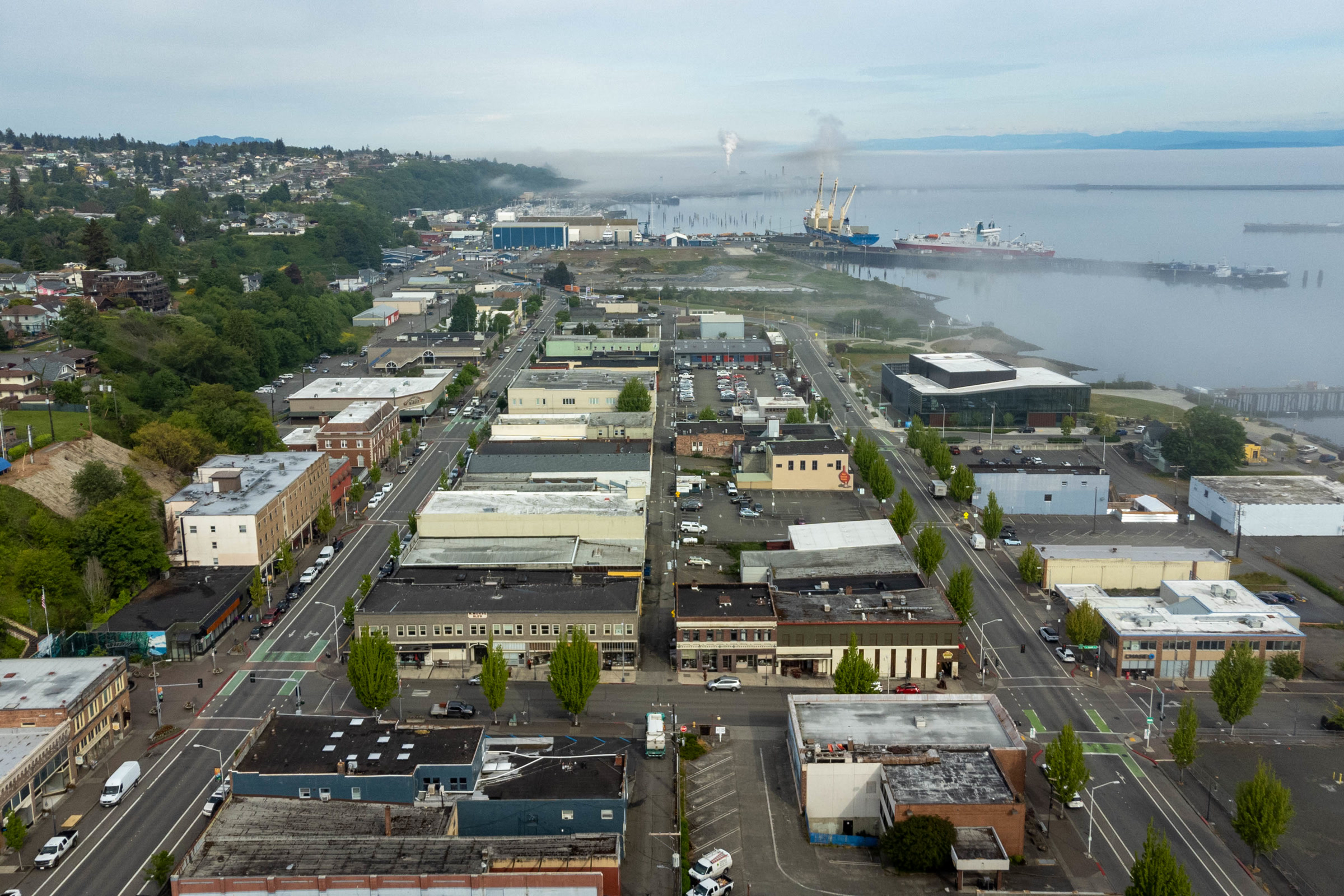
    Aerial view of downtown Port Angeles looking northwest toward the harbor and morning fog
    Downtown Port Angeles and the harbor. Photo: Sea Cow / Wikimedia Commons, CC BY-SA 4.0

    Business sponsorship and how we say thank you

    We don’t publish sponsorship tiers or benefit packages. Each partnership is worked out with our board, and we keep thanks simple and honest, such as a mention on our events page or at the event itself.

    Under IRS rules on advertising and qualified sponsorship payments, a charity naming a sponsor or showing its logo counts as an acknowledgment, not advertising. Endorsements or price information would cross that line. How a gift counts on your own return is a question for your accountant.

    Inside the park itself, the rules are stricter. National Park Service policy (Director’s Order 21) notes that federal law bars advertising, endorsements and the sale of naming rights in parks. We are a local friends group, not the park, so we never promise a logo on a park sign.

    How to get started

    1. Pick the kind of help that suits your business from the table above.
    2. Email fonp2020@gmail.com with your idea and a few dates.
    3. Agree on the details with our board, then tell your customers.

    Prefer to give directly? Visit our page to support Olympic National Park, or contact our volunteer board. To see how we fit alongside the park’s other partners, read our guide to Olympic National Park support organizations.

    Frequently asked questions

    How can a small business support Olympic National Park?

    Host a giveback night, give a grant, donate goods or services, bring your team to a volunteer work day, or match employee gifts to Friends of Olympic National Park. Email fonp2020@gmail.com to start.

    Does Friends of Olympic National Park have sponsorship levels?

    No. We do not publish sponsorship tiers. Each business partnership is worked out with our volunteer board.

    Is a business donation to FONP tax deductible?

    Friends of Olympic National Park is a registered 501(c)(3) with Tax ID 02-0619892. Ask your accountant how a gift or sponsorship counts for your business.

    Can my company put its logo in the park?

    No. National Park Service policy notes that federal law bars advertising, endorsements and the sale of naming rights in parks, and we are a friends group, not the park.

    Can our staff volunteer together?

    Yes. Groups are welcome at our public work days, such as beach and Visitor Center cleanups. Volunteers register through Volunteer.gov, and you can email us to pick a date.

  • Legacy Gifts: Including Olympic National Park in Your Will

    Legacy Gifts: Including Olympic National Park in Your Will

    Support · Planned Giving · Legacy

    A legacy gift to a national park nonprofit is a gift you plan now that reaches the park later, usually through your will or a beneficiary form. For people who have walked Olympic’s beaches and forests for decades, it is a way to pass that love on. Here is how the common options work, in plain terms, and what to tell your attorney about Friends of Olympic National Park.

    Quick answer

    How do you leave a legacy gift to a national park nonprofit?

    You can leave a legacy gift to a national park nonprofit by naming it in your will or trust, by listing it as a beneficiary on a retirement account or life insurance policy, or, at 70½ or older, through an IRA qualified charitable distribution. For Friends of Olympic National Park, use our legal name and Tax ID 02-0619892.

    • Legal name: Friends of Olympic National Park
    • A 501(c)(3) nonprofit, Tax ID 02-0619892
    • Mail: P.O. Box 3238, Port Angeles, WA 98362
    • Qualified charitable distributions start at age 70½
    Sunlight falls on moss-draped trees and ferns in the Hoh Rain Forest of Olympic National Park
    The Hoh Rain Forest, Olympic National Park. Photo: Wei Liang / Unsplash

    What a legacy gift is, and what it is not

    Planned giving simply means arranging a gift now that is made later, often after your lifetime. It costs nothing today, and you can usually change your mind as long as you live.

    It is different from a memorial gift, which honors someone who has already died. If that is what you have in mind, our guide to memorial gifts for Olympic National Park covers it.

    We should be clear about one thing. Friends of Olympic National Park is a small, volunteer-led group with no formal legacy society or planned giving office. What we can offer is a direct, personal conversation, and the accurate details below.
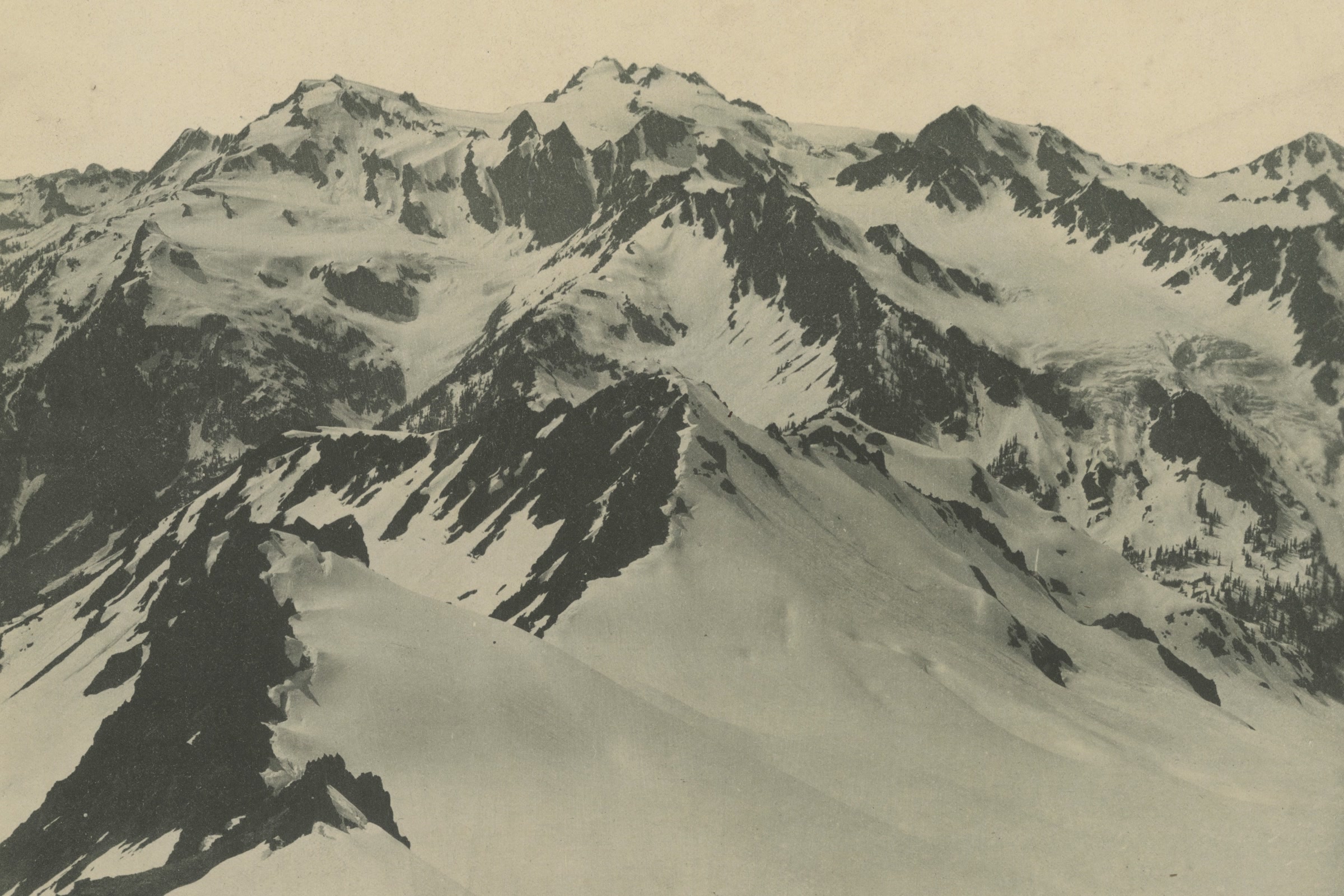
    Three common ways to leave a gift

    1. A bequest in your will or trust

    A bequest is a gift written into your will or living trust. It can be a set dollar amount, a percentage of your estate, or what remains after other gifts are paid (often called the residue).

    Some people make a contingent bequest instead, which takes effect only if another beneficiary is no longer living. Your attorney can draft whichever form fits your plans and your state’s rules.

    A hand writes with a black pen on a lined notebook page in soft light
    Photo: Khoiru Abdan / Unsplash

    2. A beneficiary designation

    Retirement accounts and life insurance policies generally pass by the beneficiary form you file with the plan or insurer, not by your will. You can name a charity as a full, partial or backup beneficiary on that form.

    This is often the simplest legacy gift to set up, because it usually needs only the company’s form. Ask your plan administrator or insurer for the right one, and ask your advisor how leaving retirement money to a charity compares with leaving it to family.

    3. A qualified charitable distribution from an IRA

    This one happens during your lifetime. If you are at least 70½, your IRA trustee can send money straight to a qualified charity. According to IRS Publication 526 on charitable contributions, the total for 2025 can’t be more than $108,000, and ongoing SEP and SIMPLE IRAs don’t qualify.

    A nontaxable QCD can’t also be claimed as a charitable deduction. The IRS updates the limit, so check the current figure with your tax preparer before you give.

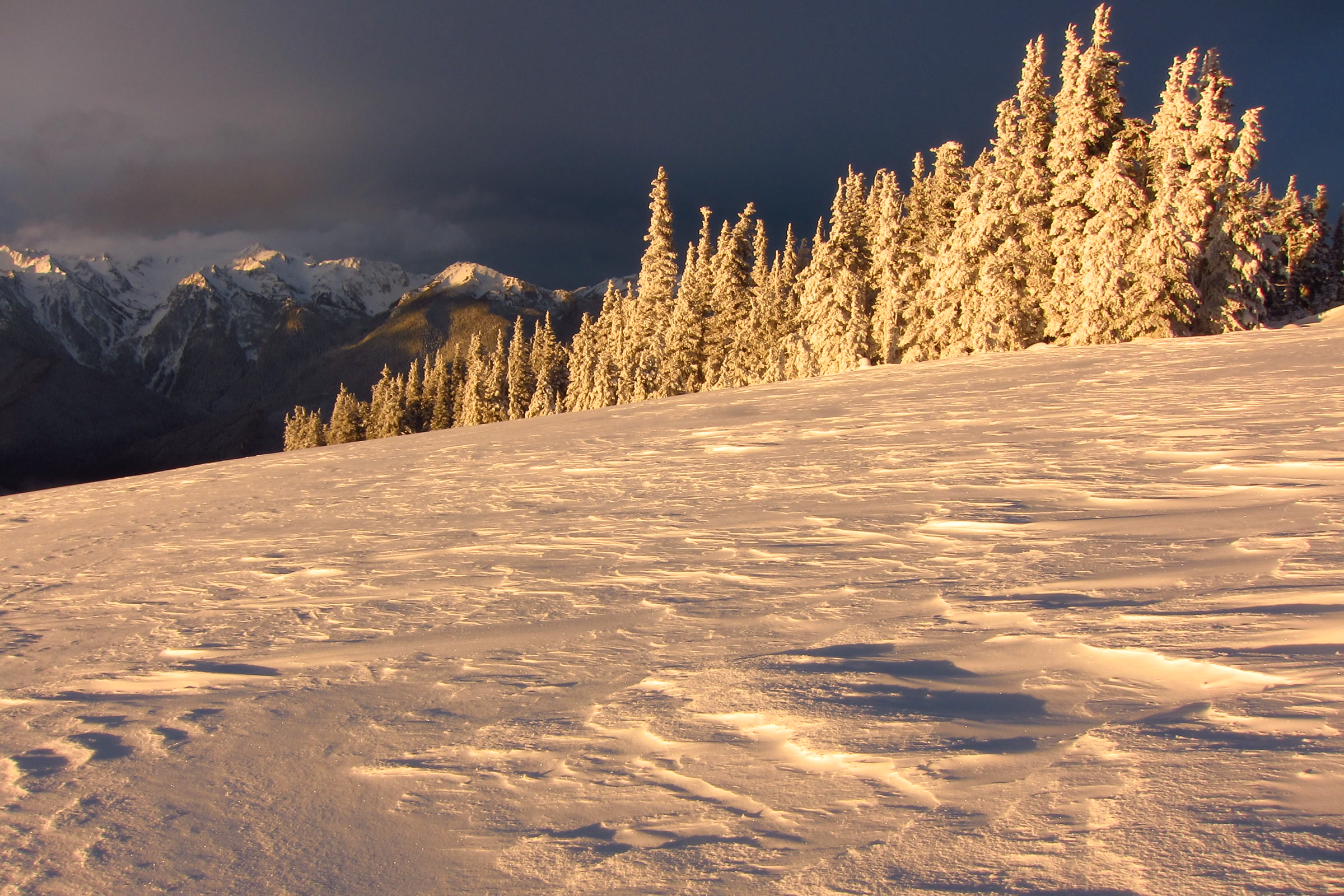
    Golden sunrise light on frosted subalpine firs and wind-carved snow at Hurricane Ridge, with snowy Olympic peaks under dark clouds
    Winter sunrise at Hurricane Ridge. NPS Photo / Dave Turner

    Legacy gift options compared

    OptionHow you set it upWhen the gift arrives
    BequestWording in your will or trustAfter your lifetime
    Retirement account beneficiaryThe plan’s beneficiary formAfter your lifetime
    Life insurance beneficiaryThe insurer’s beneficiary formAfter your lifetime
    Qualified charitable distributionAsk your IRA trustee, age 70½ or olderNow, during your lifetime

    How to make a bequest to Friends of Olympic National Park

    Your attorney or financial institution will need our exact details. Please use them as written, so your gift reaches us and not a similarly named group.

    • Legal name: Friends of Olympic National Park
    • Status: 501(c)(3) nonprofit, founded 2002
    • Tax ID (EIN): 02-0619892
    • Address: P.O. Box 3238, Port Angeles, WA 98362
    • Email: fonp2020@gmail.com
    Hands holding a pen fill in a printed form on a dark wooden desk, face not shown
    Photo: Leon Seibert / Unsplash

    Sample wording to share with your attorney

    Your attorney will adapt this, but a simple bequest often reads like this: “I give [a sum, a percentage of my estate, or the residue of my estate] to Friends of Olympic National Park, a 501(c)(3) nonprofit organization, Tax ID 02-0619892, P.O. Box 3238, Port Angeles, WA 98362, for its general purposes.”

    “General purposes” lets our volunteer board use the gift where it is most needed when it arrives. If you would like to support a particular kind of work, email us first so we can talk about what is realistic for a small, all-volunteer group.

    What a gift in your will supports

    Our mission is to “preserve Olympic National Park’s natural, cultural and recreational resources for the benefit of present and future generations.” We do that four ways: we educate, volunteer, fund and honor.

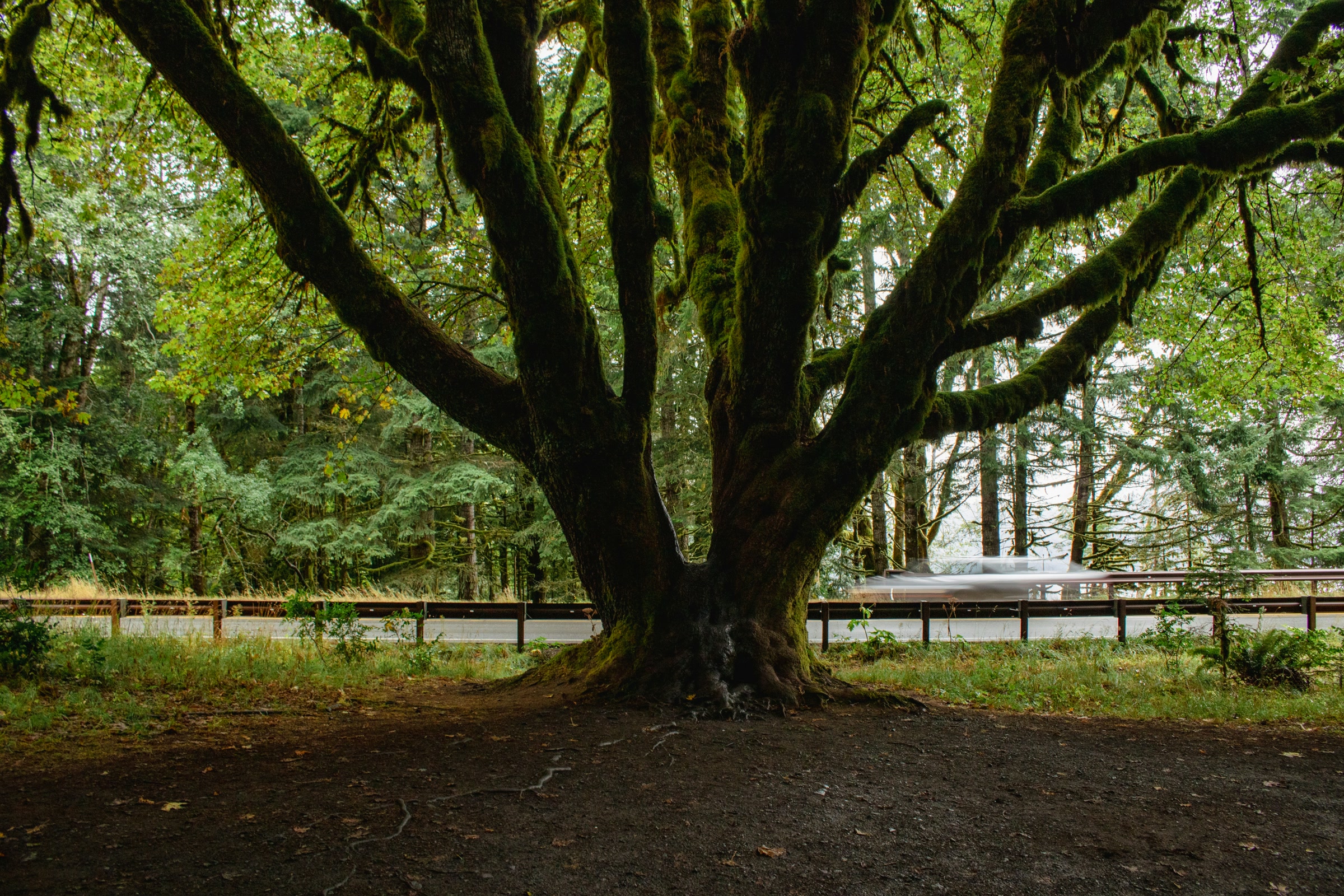
    A huge moss-covered bigleaf maple spreads its limbs near the Marymere Falls trailhead at Lake Crescent
    A bigleaf maple near the Marymere Falls trailhead, Lake Crescent. Photo: Zoshua Colah / Unsplash

    Gifts to us fund educational programs, trail maintenance and restoration efforts throughout the park. Our seven projects include the Heart O’ the Forest adopt-a-trail crew, beach and Visitor Center cleanups, the Children’s Discovery Room, graffiti removal, guided nature walks, National Junior Ranger Day and the Winter Perspectives Series.

    Our guide to ways to support Olympic National Park explains how we differ from the other groups that support the park, which helps if you are choosing between them.

    Tell us, if you would like to

    You never have to tell us about a legacy gift. If you choose to, email fonp2020@gmail.com so we can thank you and make sure our details in your documents are right. There is no form to fill in and no obligation.

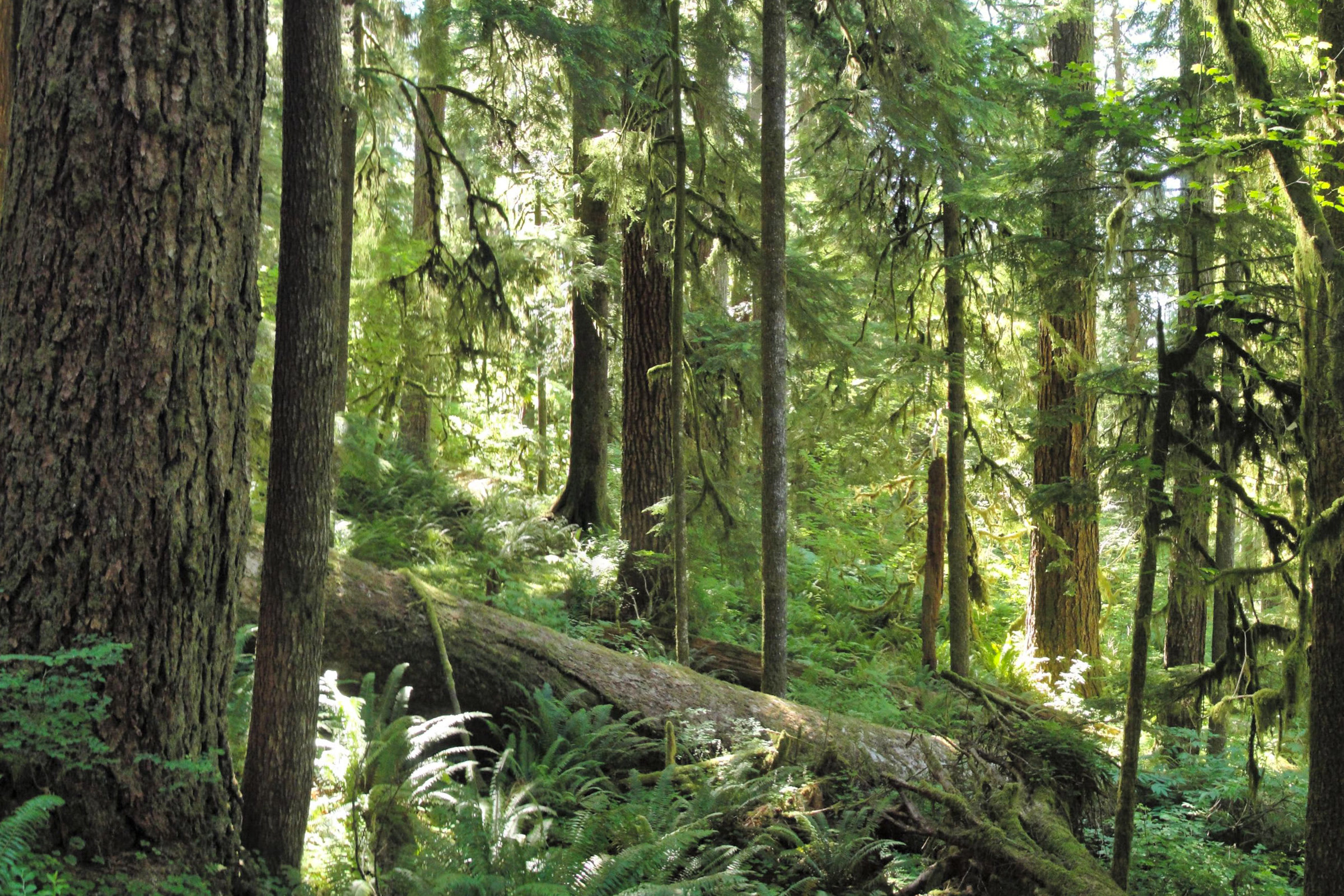
    Tall old-growth Douglas-fir, western redcedar and hemlock trunks rise above ferns on the Three Lakes Trail in Olympic National Park
    Old-growth forest on the Three Lakes Trail. Photo: Miguel.v / Wikimedia Commons (public domain)

    This is not legal or tax advice

    This page explains common options in general terms only. Estate and tax rules depend on your state and your situation, so please talk with an estate attorney or financial advisor before you change your will or beneficiary forms.

    Ways to give now, too

    Many people pair a future gift with support today. You can make a gift to support Olympic National Park by mail or email, at any amount, one time or yearly. You can also become a member from $15 a year and get our friends-only newsletter.

    Frequently asked questions

    How do I leave money to Friends of Olympic National Park in my will?

    Ask your attorney to name Friends of Olympic National Park, a 501(c)(3) nonprofit, Tax ID 02-0619892, P.O. Box 3238, Port Angeles, WA 98362. The gift can be a set amount, a percentage or the residue of your estate.

    Can I name a charity as beneficiary of my IRA or life insurance?

    Generally yes. These accounts usually pass by the beneficiary form on file with the plan or insurer, not by your will. Ask the company for its form and check with your advisor.

    What is a qualified charitable distribution?

    A transfer made directly from your IRA trustee to a qualified charity when you are at least 70 and a half. IRS Publication 526 caps the 2025 total at 108,000 dollars, and a nontaxable QCD cannot also be deducted.

    Does Friends of Olympic National Park have a legacy society?

    No. We are a small, volunteer-led group without a formal planned giving program. Email fonp2020@gmail.com if you would like to talk about a future gift.

    Do I have to tell you about a gift in my will?

    No. Telling us is optional, but it lets us thank you and confirm that our legal name and Tax ID are correct in your documents.

  • Teen Volunteer Opportunities in Olympic National Park

    Teen Volunteer Opportunities in Olympic National Park

    Volunteer · Youth · Families

    Teen volunteer opportunities in a national park are closer than many Port Angeles families think. Olympic National Park runs a trail program for high school groups, lets teens join summer marmot surveys with an adult, and offers youth pathways toward park careers. Our own volunteer days are a friendly first step.

    Quick answer

    What teen volunteer opportunities does Olympic National Park offer?

    Olympic National Park offers teens the Adopt-A-Trail Youth Crew for local high school groups (at least three work days a year), Olympic marmot surveys for ages 13 to 17 with a responsible adult, and youth pathway programs. Every volunteer under 18 needs a parent or guardian to sign the NPS volunteer agreement.

    • Adopt-A-Trail Youth Crew: high school groups, three days a year minimum
    • Marmot surveys: ages 13 to 17 with an adult, July or August
    • Under 18: parent or guardian signs form OF-301a
    • Trail work can earn school credit through the Skills Center
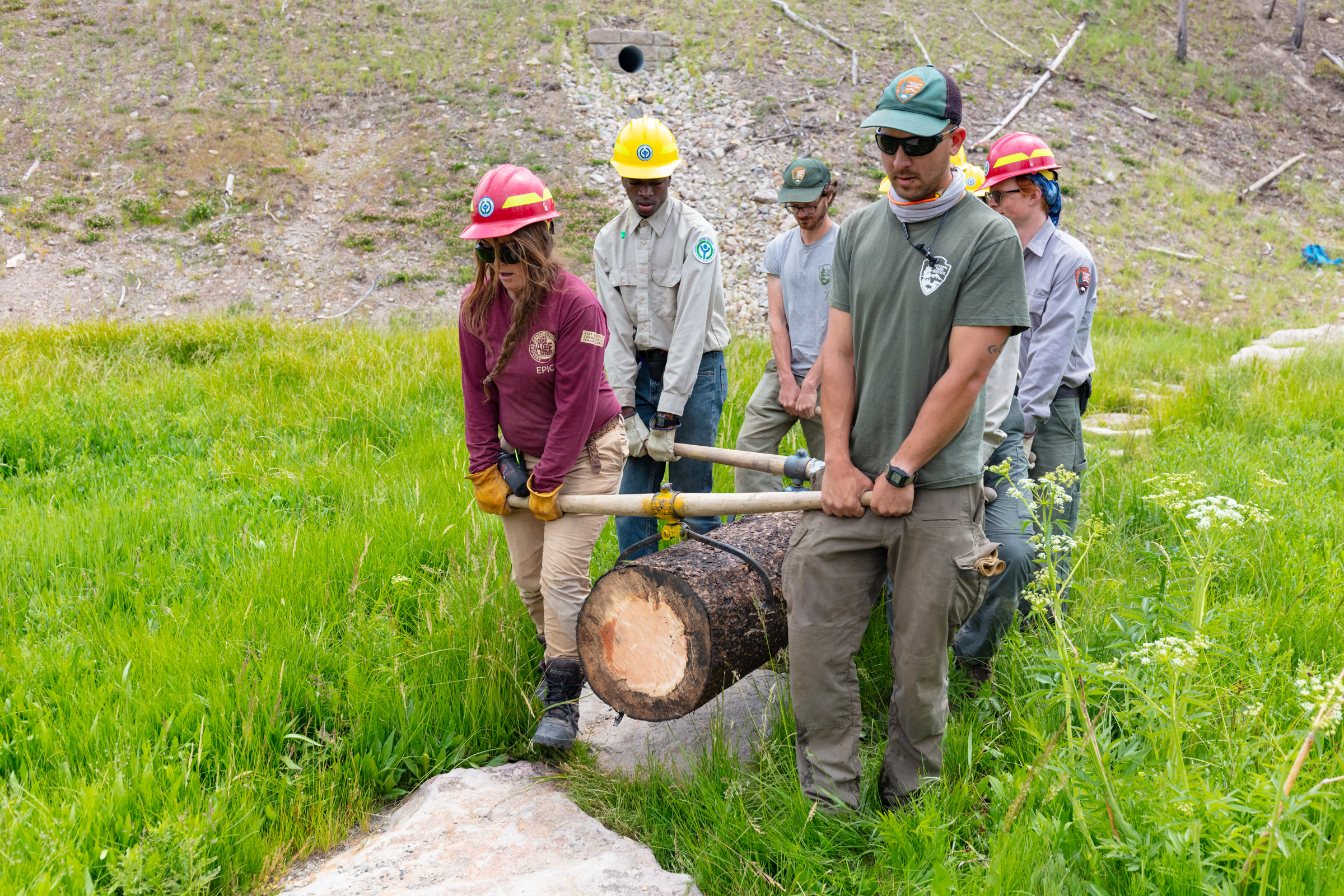
    A youth crew in hard hats carries a heavy log on timber carriers across a green meadow beside a park trail crew leader
    A Youth Conservation Corps crew helps build a footbridge at Yellowstone National Park. NPS Photo / Jacob W. Frank

    Youth volunteer programs at Olympic National Park

    The park’s Volunteer and Youth Office in Port Angeles looks after these programs. Details change from year to year, so treat this as a map and confirm the current season with the park before you plan around it.

    Adopt-A-Trail Youth Crew for high school groups

    This is the park’s main high school volunteer program near Port Angeles. Motivated groups of high school students from communities around the park adopt a trail, attend a training on basic trail maintenance, trail etiquette and tools, and then report trail conditions to the park’s trail crew.

    Each group commits to at least three work days a year. According to the park’s Adopt-A-Trail Youth Crew page, the work can count for science, English or career and technical credit through the North Olympic Peninsula Skills Center natural resources class. With extra commitment it can also become a senior culminating project.

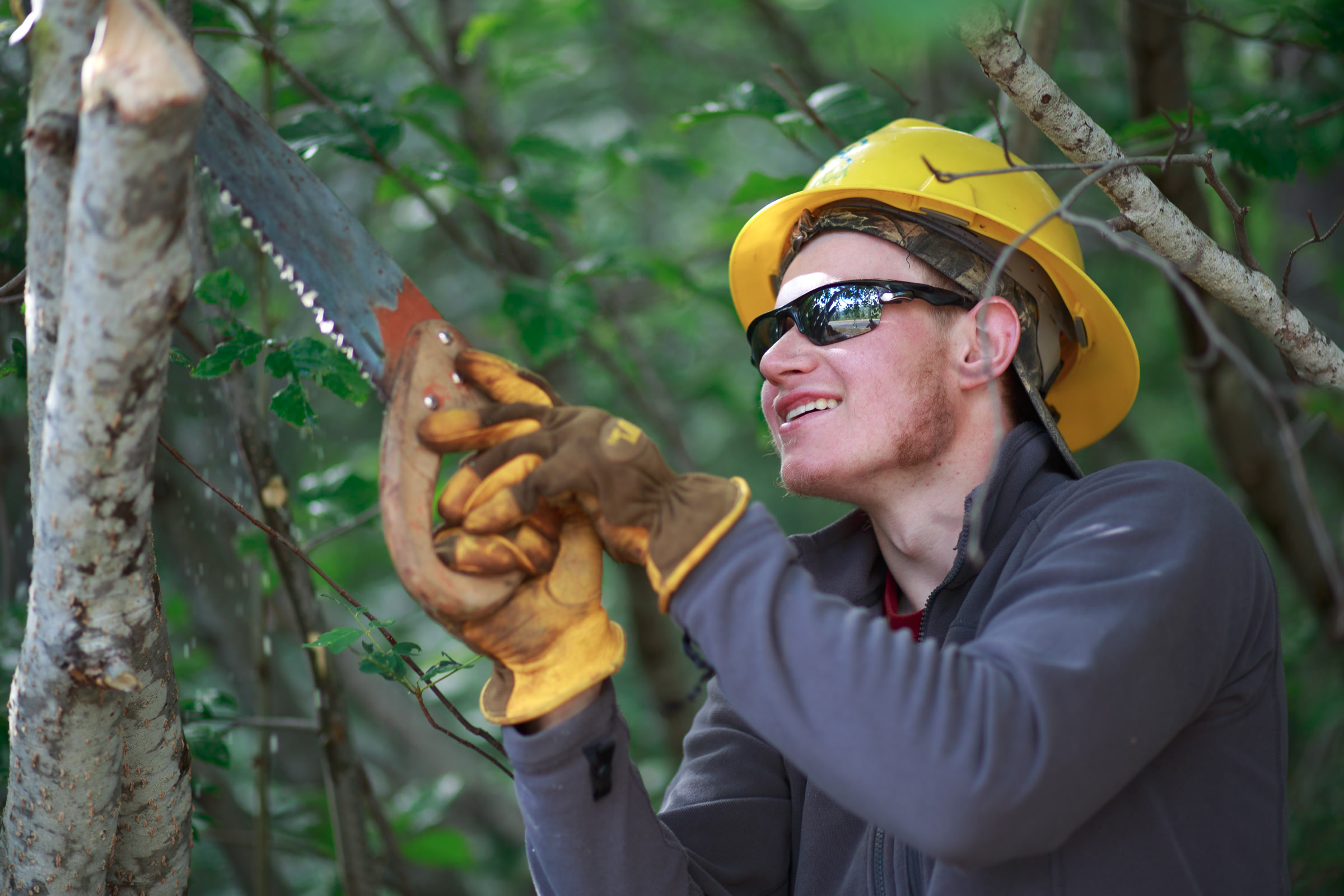
    A young crew member in a yellow hard hat, sunglasses and leather gloves trims a branch with a pruning saw in a green forest
    A Student Conservation Association crew member brushing the Snow Lake Trail, Mount Rainier National Park. NPS Photo / Kevin Bacher (CC BY 2.0)

    Olympic marmot surveys for ages 13 to 17

    The park says children aged 13 to 17 can join the summer marmot surveys when a responsible adult comes along. It’s a big trip for a parent and teen together: 5 or 8 days in July or August, backpacking 5 to 20 miles with real elevation gain and moving off trail on steep, loose ground.

    Applications typically open in mid-January and run through June 1, and they can close early if teams fill. To meet the animal you’d be counting, read our profile of the Olympic marmot at Hurricane Ridge.

    Pathways for youth and older teens

    The park’s Pathways for Youth page aims to connect young people with careers in the National Park Service. It lists senior culminating projects, the Adopt-A-Trail crew and volunteer internships designed for recent high school graduates and college students.

    It also describes a two-week summer Wilderness School for high school youth with NatureBridge and the Student Conservation Association. The park calls it a work in progress that depends on funding, so ask whether it’s running before you count on it.

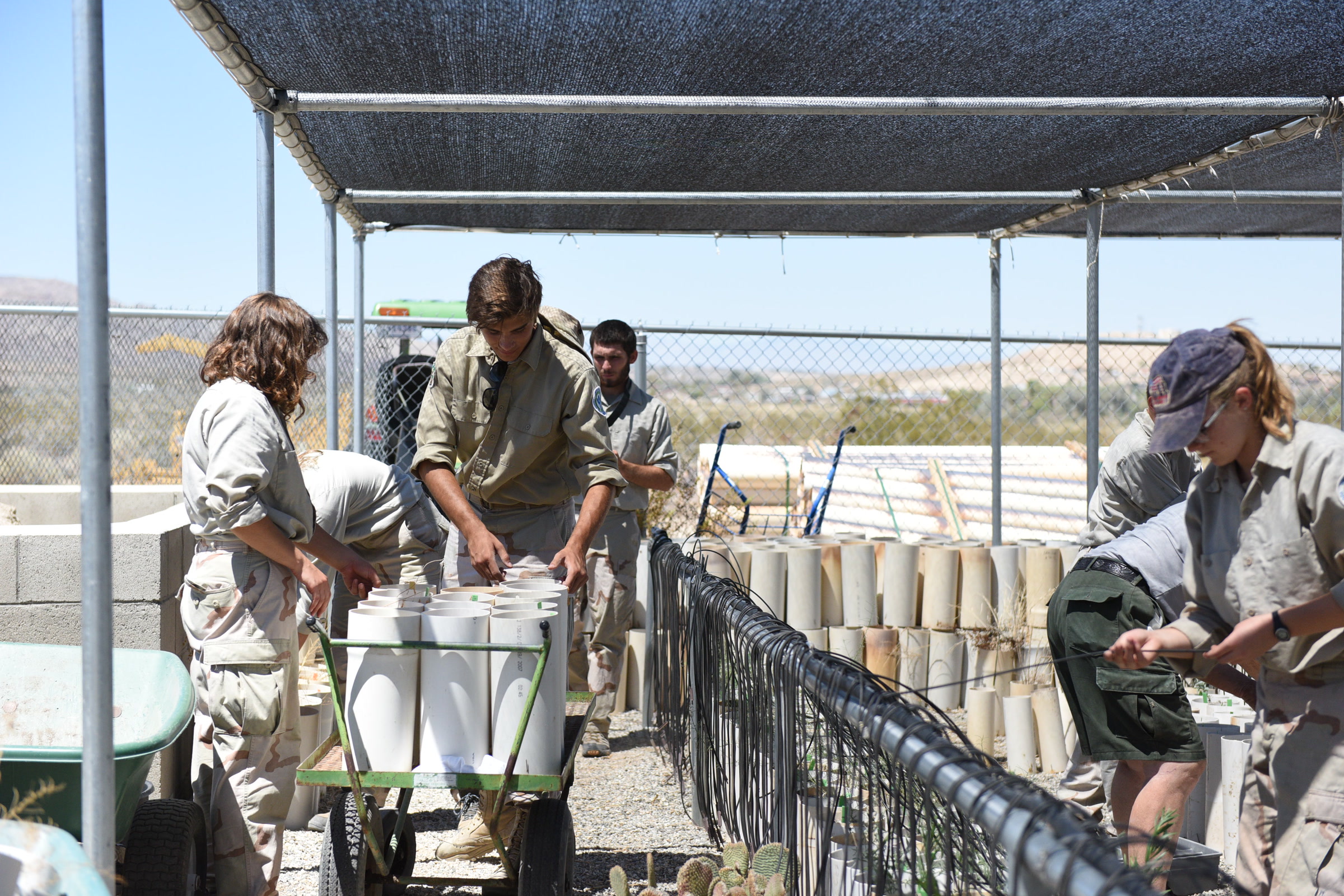
    Youth crew members in tan shirts move tall plant containers on a cart under a shade cloth at a desert native plant nursery
    Youth Conservation Corps members at the native plant nursery, Joshua Tree National Park. NPS Photo

    Junior Ranger: the younger pathway

    Younger brothers and sisters can start with the Junior Ranger program. Pick up a booklet at any visitor center in the park and complete the steps to become an Olympic National Park Junior Ranger.

    National Junior Ranger Day is one of the seven projects we support, and Olympic has hosted it at the Visitor Center in Port Angeles. Our page on National Junior Ranger Day at Olympic National Park explains how the day works.

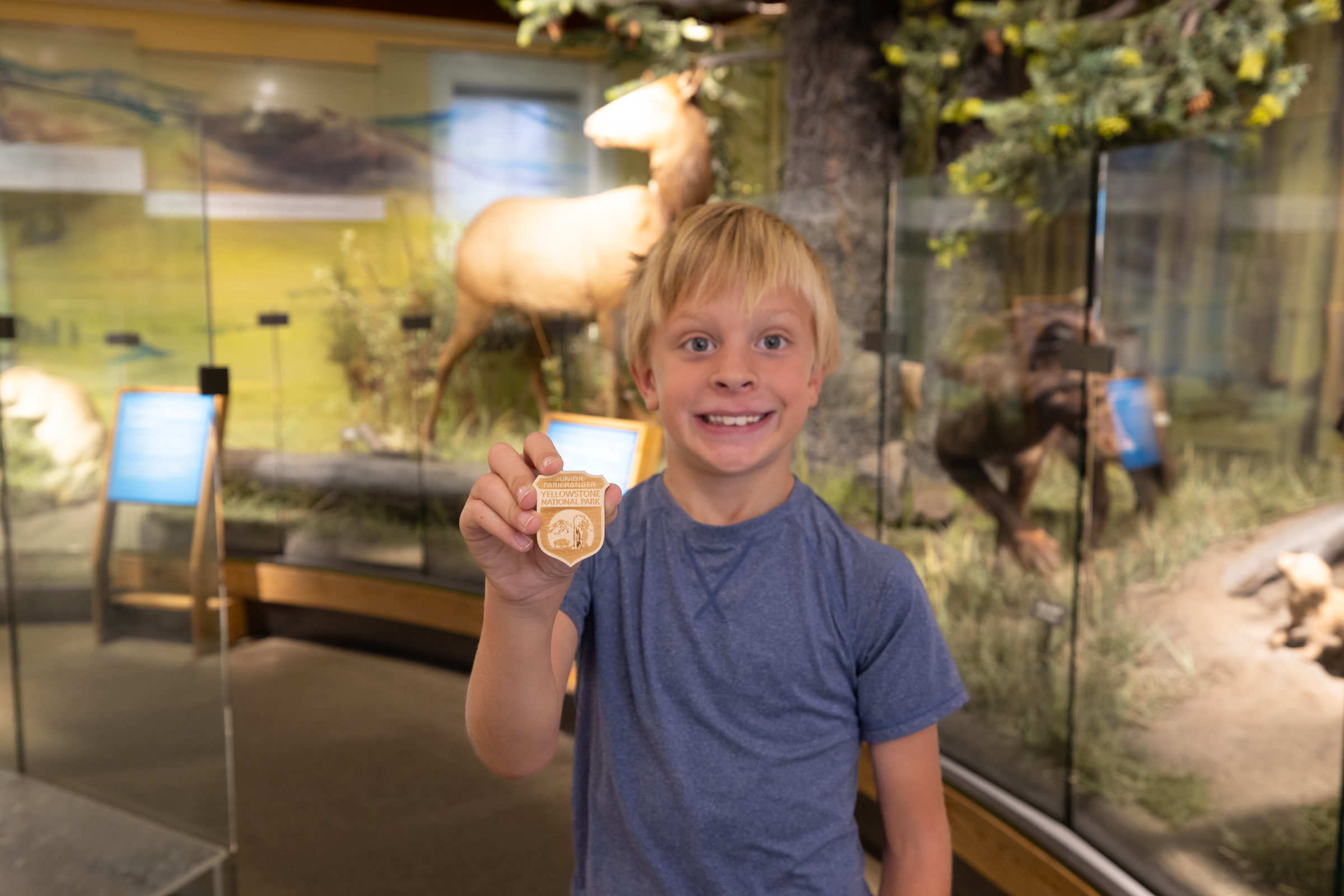
    A smiling boy holds up a new wooden Junior Ranger badge in front of a museum exhibit with a mounted elk
    A new Junior Ranger shows off his badge at Yellowstone National Park. NPS Photo / Jacob W. Frank

    The rule every volunteer under 18 needs to know

    Each NPS volunteer signs a volunteer service agreement. The Park Service’s volunteer program manual on onboarding says all volunteers under 18 must use the individual form, OF-301a, signed by a parent or legal guardian.

    • A school or youth group permission slip does not replace the signed OF-301a.
    • Minors can’t sign on through the group form, OF-301b, so a school or scout group needs one form per student.
    • Programs set their own age limits, so read each listing. Marmot surveys, for example, need an adult with teens.

    Teen volunteer options compared by age and commitment

    OptionWho it suitsCommitment
    Junior RangerYounger kids and siblingsOne visit with a booklet
    FONP volunteer daysFamilies; ask us about agesOne morning
    Adopt-A-Trail Youth CrewHigh school groupsTraining plus 3 or more days a year
    Marmot surveysAges 13 to 17 with an adult5 or 8 days, July or August
    Volunteer internshipsRecent graduates and college studentsAsk the park
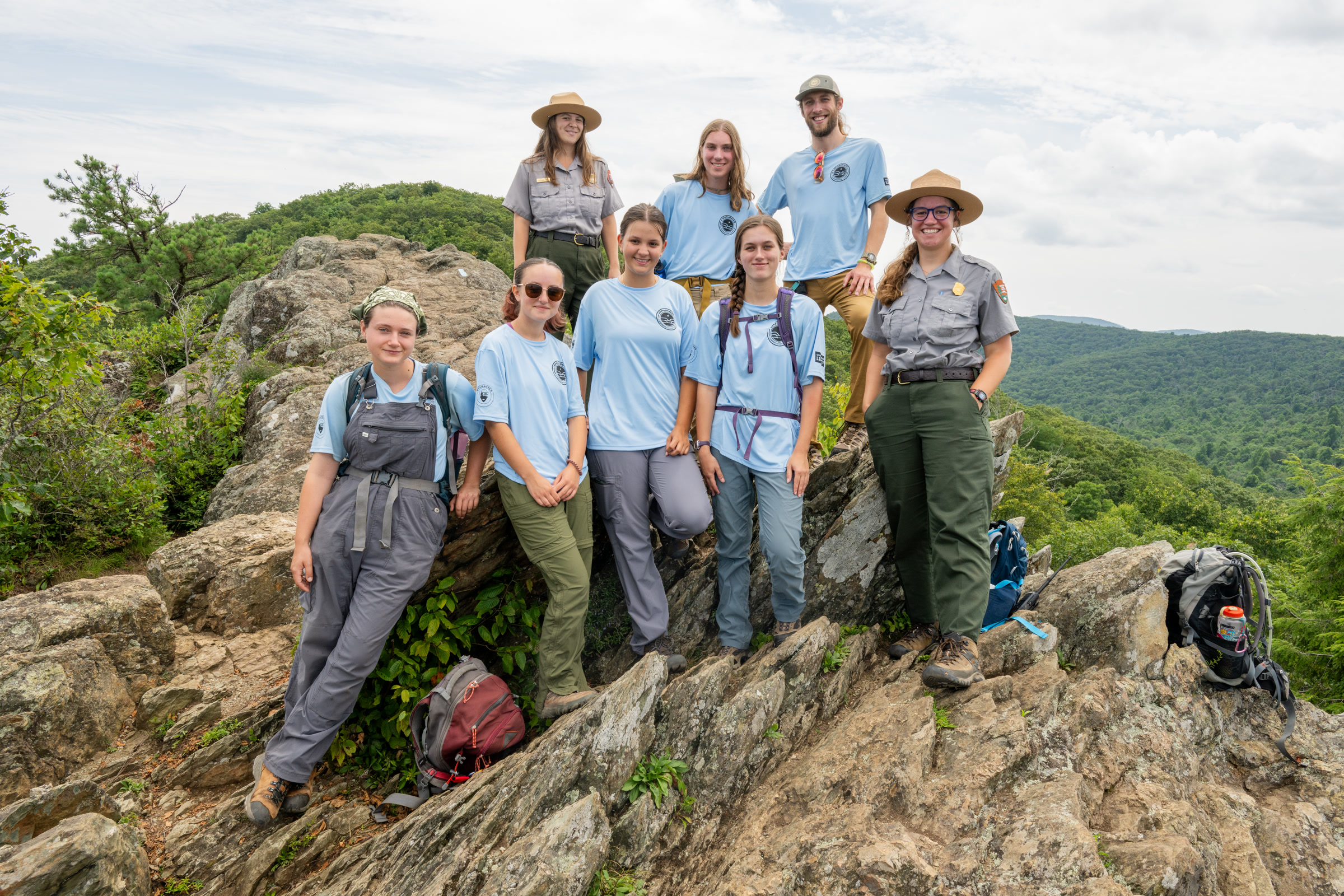
    Seven young crew members in light blue shirts and a park ranger in a flat hat pose on a rocky outcrop above forested hills
    A Youth Conservation Corps crew at Shenandoah National Park. NPS Photo / Luca Pfeiffer

    Service hours in a national park: keep your own record

    Many students need service hours for school, clubs or scholarships. Park volunteering can count, but your school decides what qualifies, so check with a counselor before you start.

    1. Register for the listing on Volunteer.gov and keep the confirmation.
    2. Write down the date, place, task and hours after each shift.
    3. Ask the leader on the day who can sign or confirm your hours.

    Hours with federal sites can also add up toward a free pass over time. Our guide to the America the Beautiful Volunteer Pass explains the 250-hour rule.

    Volunteer days with Friends of Olympic National Park

    Our days are short, hands-on and family-friendly. Recent ones include the Visitor Center cleanup and pollinator garden morning in Port Angeles, the Spring Coastal Cleanup in the Kalaloch area and an invasive-plant cleanup at the entrance sign garden.

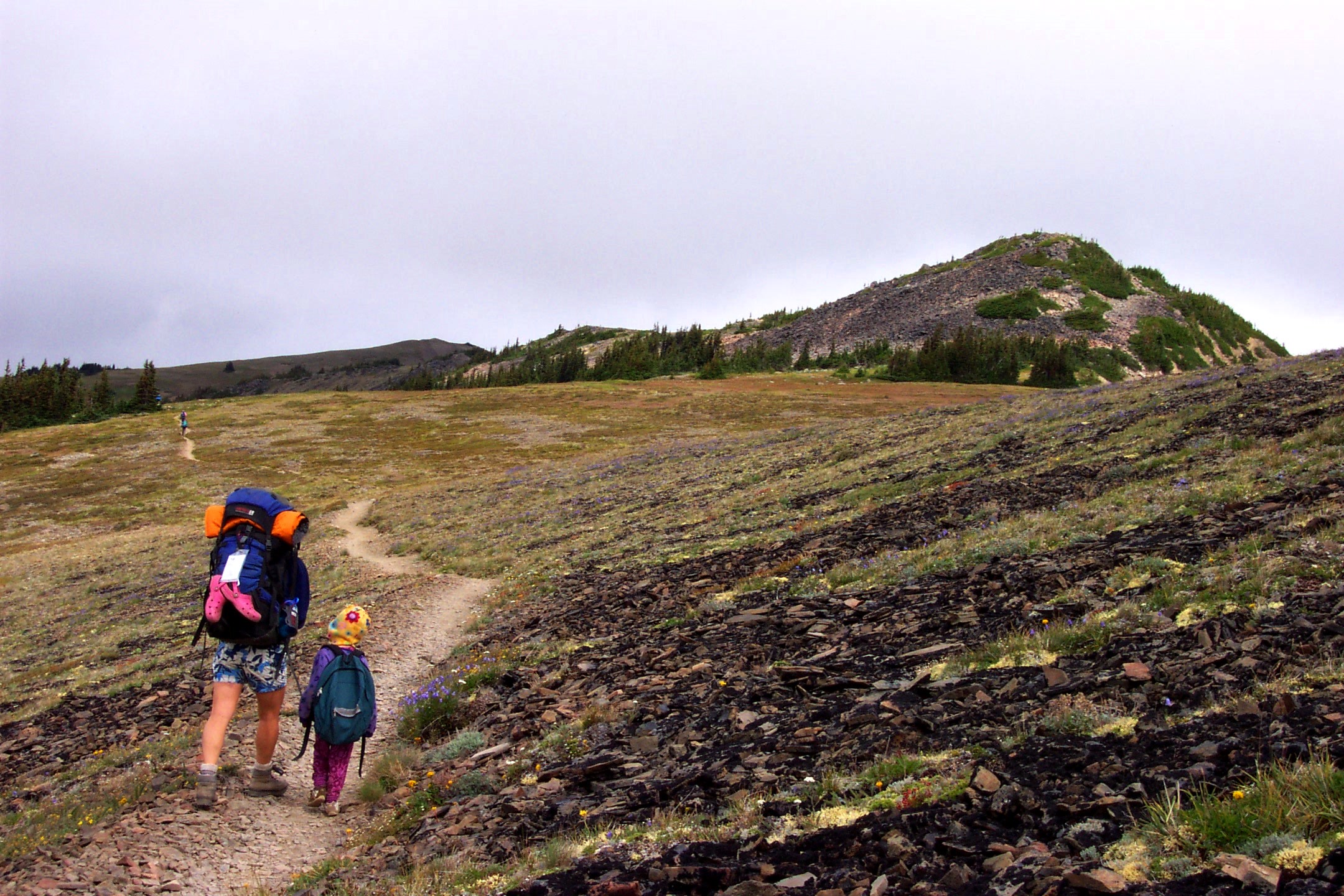
    An adult and a small child with backpacks walk away up a dirt trail across an open subalpine slope in Olympic National Park
    A family on a subalpine trail in Olympic National Park. NPS Photo / B. Baccus

    Each day is registered through Volunteer.gov, and at our fall cleanup we provided hand tools and water while volunteers brought gloves, sunscreen and a hat. Age rules can differ by event, so ask our volunteer board about bringing your teen before you sign up.

    How Friends of Olympic National Park helps

    We’re a volunteer-led friends group that works in close partnership with the National Park Service. We don’t run the park’s youth programs, but we make the first step easy. Our step-by-step guide to volunteering at Olympic National Park covers Volunteer.gov sign-up, and our upcoming volunteer events list the next dates.

    Student membership is $15 a year and includes volunteer opportunities and our friends-only newsletter. It’s an easy way for a teen to become a member and hear about each day first.

    Frequently asked questions

    Can a 15 year old volunteer at a national park?

    Yes, in many programs. Any NPS volunteer under 18 needs a parent or legal guardian to sign the OF-301a volunteer agreement, and each program sets its own age limits.

    Does Olympic National Park have a youth volunteer program?

    Yes. The Adopt-A-Trail Youth Crew is for local high school groups, who commit to at least three work days a year. Teens aged 13 to 17 can also join marmot surveys with a responsible adult.

    Can high school students earn credit volunteering at Olympic?

    The park says Adopt-A-Trail work can count for science, English or career and technical credit through the North Olympic Peninsula Skills Center natural resources class, and can become a senior culminating project with extra commitment.

    Do national park volunteer hours count as school service hours?

    Your school decides. Register through Volunteer.gov, log the date, task and hours after each shift, and ask the leader who can confirm them.

    Can my teen join a Friends of Olympic National Park volunteer day?

    Our days are family-friendly, but age rules can differ by event. Contact our volunteer board before you register on Volunteer.gov.

  • Olympic National Park Rainforest: Hoh, Quinault and More

    Olympic National Park Rainforest: Hoh, Quinault and More

    Visit · Rain Forest · Park Nature

    The Olympic National Park rainforest is one of the finest temperate rain forests in the lower 48 states, a place where moss hangs from every branch and fallen giants feed the next generation of trees. It fills four valleys on the park’s west side. Here is what makes it a temperate rain forest, how the valleys compare, and how to visit without spending your morning in a line of cars.

    Quick answer

    Where is the rainforest in Olympic National Park?

    Olympic National Park’s temperate rain forest grows in four west-facing valleys: the Hoh, Quinault, Queets and Bogachiel. Pacific storms bring 140 to 167 inches of precipitation a year, so mosses, ferns and lichens cover the trees, and Sitka spruce and western hemlock up to 250 feet tall dominate. Start at the Hoh Rain Forest Visitor Center.

    • Four rain forest valleys: Hoh, Quinault, Queets and Bogachiel
    • 140 to 167 inches of precipitation a year
    • Sitka spruce and western hemlock reach 250 feet
    • Hoh parking can fill by 10 am in summer

    What makes a temperate rain forest

    A temperate rain forest needs two things: a great deal of rain and mild weather. Storms rolling in off the Pacific drop 140 to 167 inches of precipitation a year on these valleys, which is 12 to 14 feet. Down low, temperatures seldom fall below freezing, and summer highs rarely pass 80°F.

    The National Park Service calls these valleys some of the best examples of primeval temperate rain forest in the lower 48. Similar forests grow in only a few other places, including Chile, New Zealand and southern Australia. The park’s rain forest is also one reason UNESCO lists Olympic as a World Heritage Site.

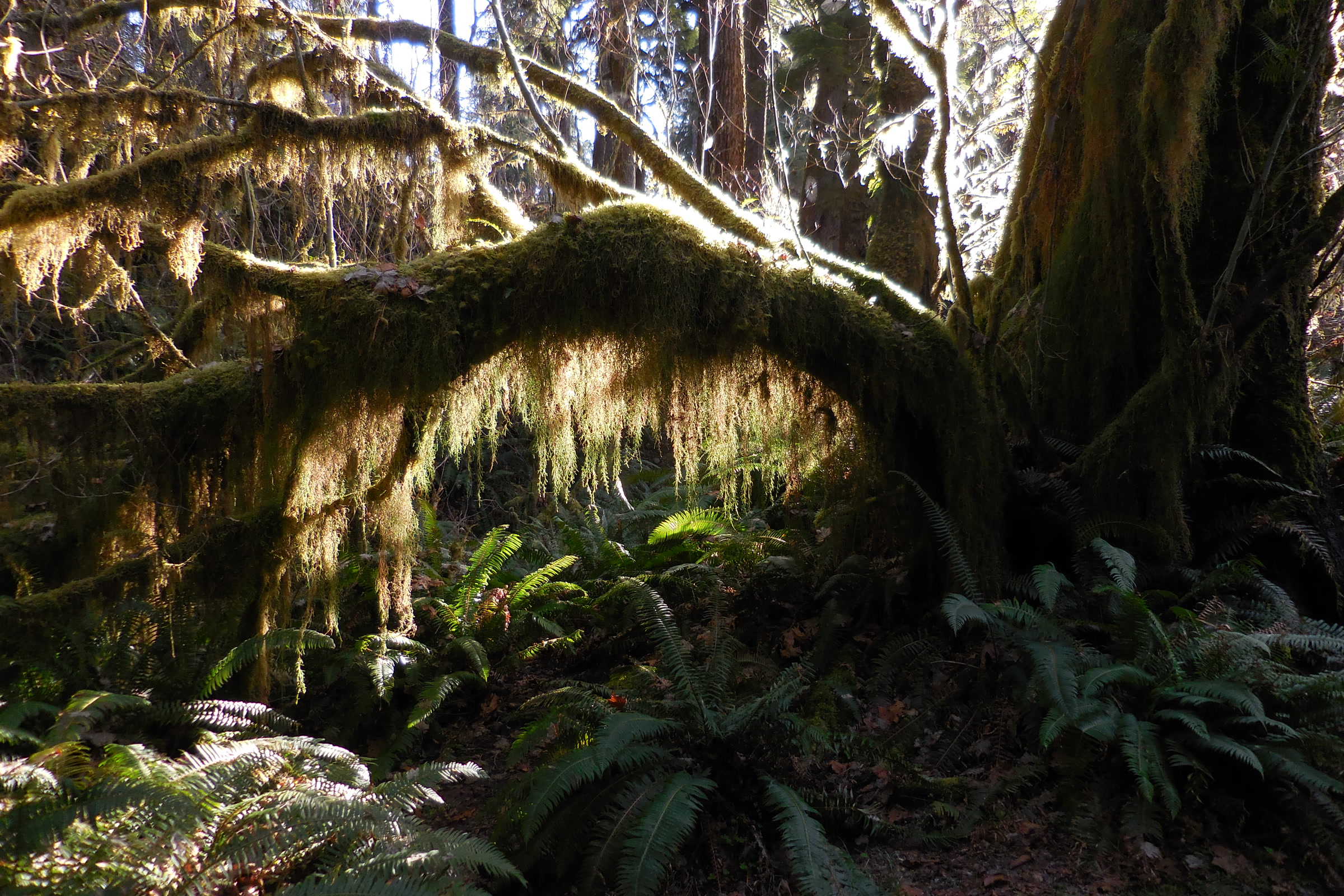
    A long, arching branch hung with curtains of moss, lit by sunlight, above sword ferns in the Hoh Rain Forest
    Moss curtains on a branch in the Hoh Rain Forest. NPS Photo / C. Bubar

    The four rain forest valleys compared

    All four valleys open to the west, toward the ocean storms that feed them. Each has its own feel, from the busy Hoh to the quiet Bogachiel.

    Hoh, Quinault, Queets and Bogachiel at a glance

    ValleyGetting thereShort walk to try
    HohAbout 2 hours from Port Angeles, under 1 hour from ForksHall of Mosses, 0.8 mile loop
    QuinaultAbout 3 hours from Port Angeles, 1 hour from ForksKestner Homestead, 1.3 mile loop
    QueetsA short drive from the Quinault areaSam’s River Loop, 2.8 miles
    BogachielTrailhead on Olympic National Forest landBogachiel Rain Forest Trail, 1.6 miles to the park

    Hoh Rain Forest

    The Hoh is the classic choice, with a visitor center, a campground and two short loops. The Hall of Mosses runs 0.8 mile and the Spruce Nature Trail 1.2 miles. For more, the Hoh River Trail heads 18.5 miles upriver toward the Blue Glacier moraine, and you can turn around wherever you like.

    Quinault Rain Forest

    The Quinault valley has a scenic loop drive and the Quinault Rain Forest Ranger Station, a good place to start. A 1.3 mile loop leads to the old Kestner homestead, and another short loop winds through groves of bigleaf maple. The Quinault Rain Forest Nature Trail off South Shore Road is run by Olympic National Forest, so it takes a Northwest Forest Pass or an interagency pass.

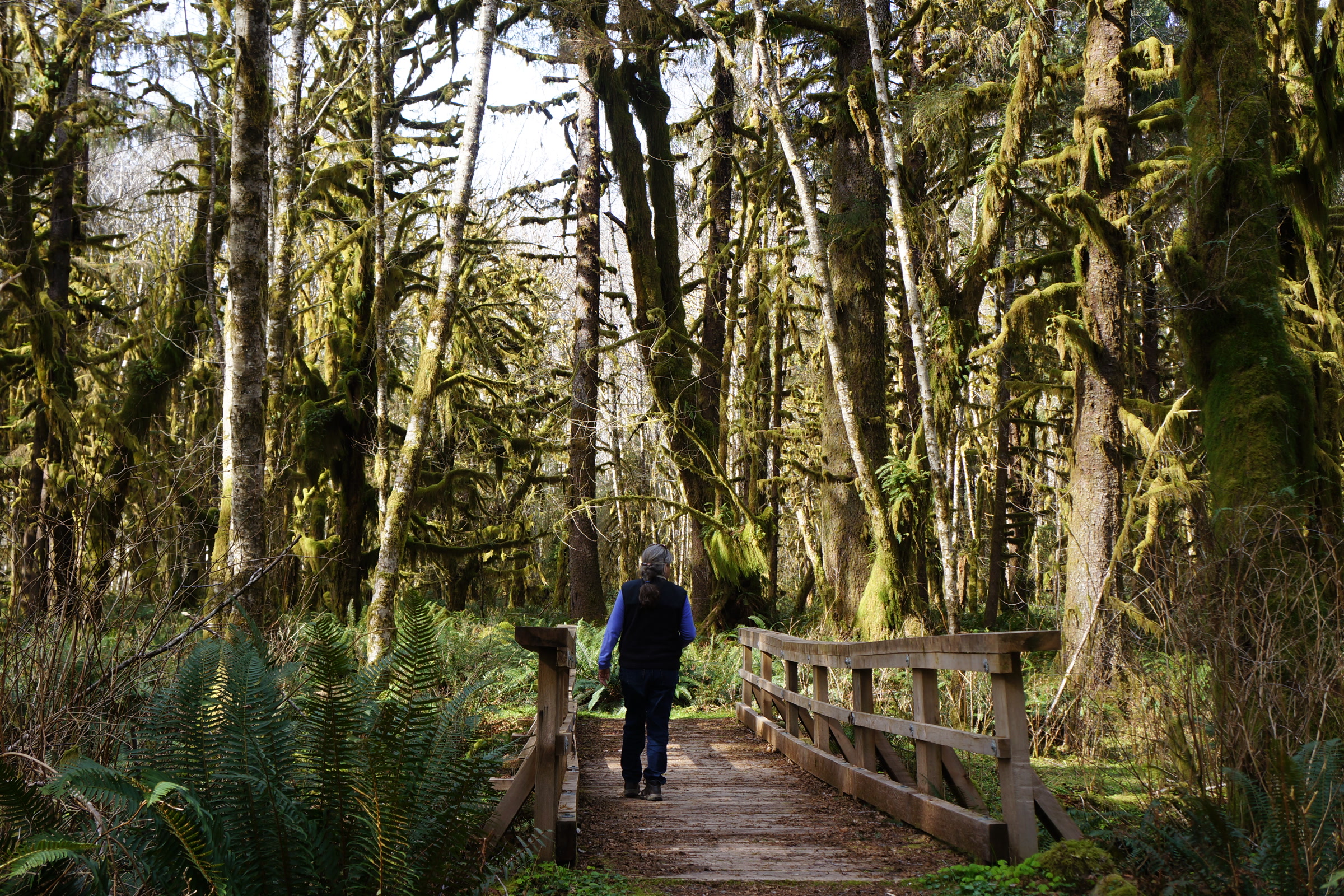
    A visitor walks across a wooden footbridge between mossy maples on the Maple Glade trail in the Quinault Rain Forest
    A footbridge on the Maple Glade trail in the Quinault valley. NPS Photo / R. McKenna

    Queets and Bogachiel

    These two are the quiet ones. In the Queets, the level Sam’s River Loop passes through several stages of rain forest, though winter storms often leave trees across it. The longer Queets River Trail starts with a river ford that is often waist deep in summer and can be impossible after heavy rain.

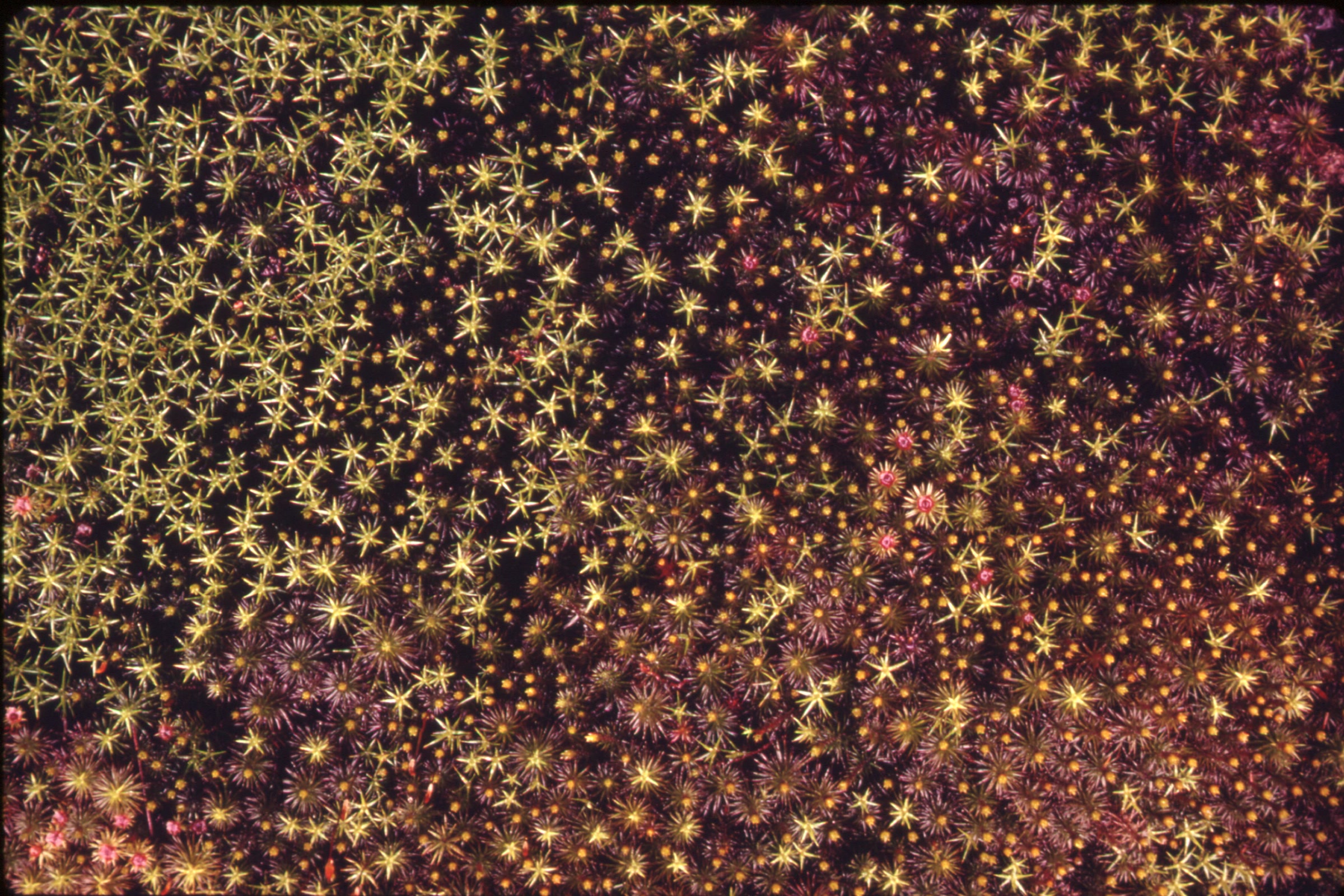
    Close-up of star-shaped moss shoots carpeting an old log in the Queets River rain forest
    Moss on an old log in the Queets valley, 1969. Photo: EPA Project DOCUMERICA / National Archives

    The Bogachiel Rain Forest Trail begins on national forest land and reaches the park boundary in 1.6 miles. Dogs are not allowed past the park boundary.

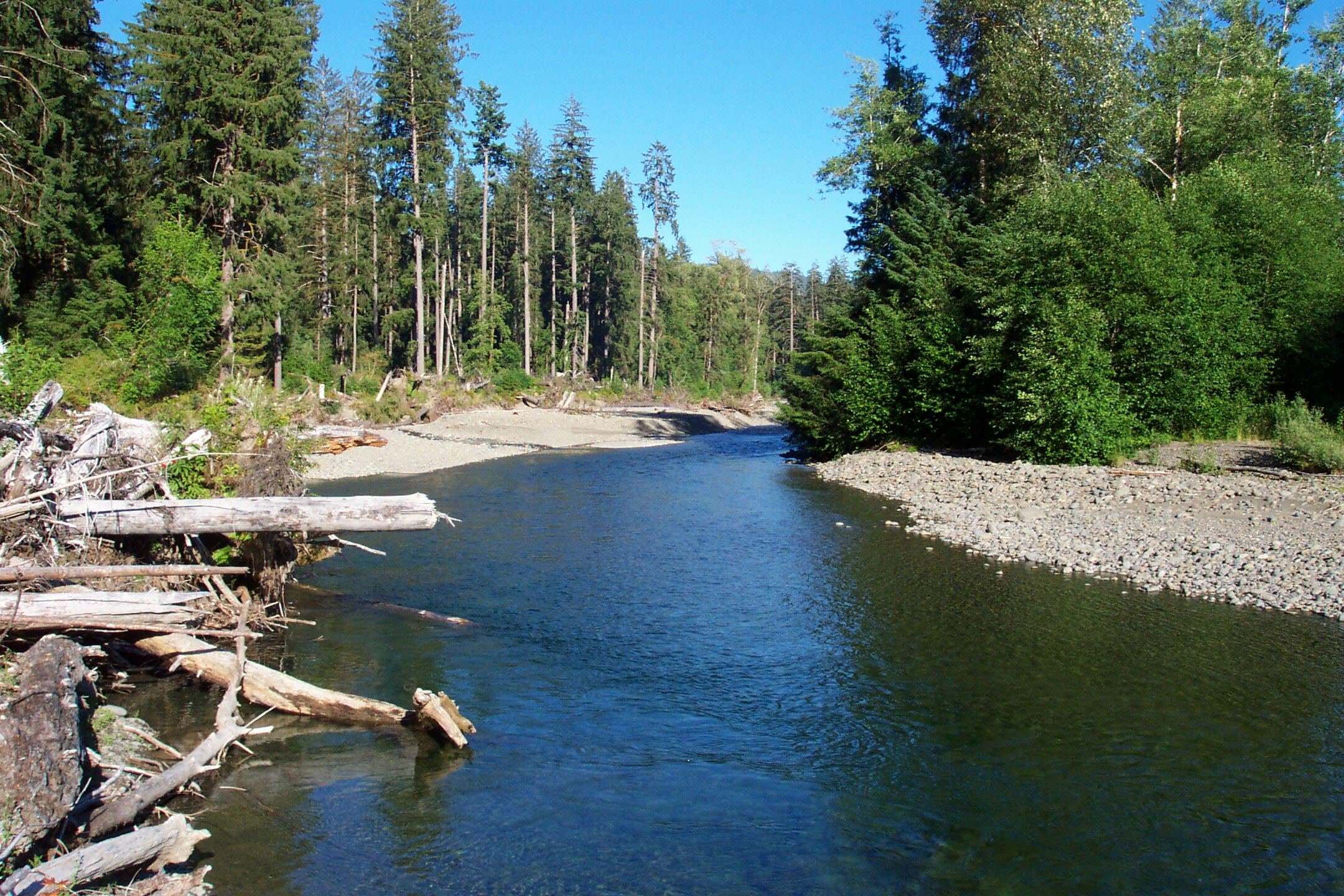
    The clear Bogachiel River curves past a gravel bar and driftwood, lined with tall conifers and alders under a blue sky
    The Bogachiel River. NPS Photo

    Nurse logs and colonnades

    On a forest floor this crowded, a seedling’s best chance is often a fallen tree. Seedlings sprout on these nurse logs, and their roots grow down around the log into the soil. When the log rots away, the trees are left standing on stilt-like roots in a straight row, a pattern called a colonnade.

    Dead wood can take centuries to break down. Along the way it shelters mosses, fungi, small mammals, amphibians and insects, which is why our mushroom season guide for the Olympic Peninsula spends so much time on fallen logs.

    A straight row of large trees standing on stilt-like roots where a nurse log once lay, with sword ferns in front, in the Hoh Rain Forest
    A colonnade of trees that grew on a nurse log in the Hoh. NPS Photo / C. Bubar

    Mosses, ferns and other epiphytes

    Much of the green you see is not growing in soil at all. Epiphytes, plants that live on other plants, cover trunks and branches: mosses, ferns, lichens and spikemoss. They take their water from the rain and mist, not from the tree, and they give the forest its jungle look.

    Big trees: Sitka spruce, western hemlock and bigleaf maple

    Sitka spruce and western hemlock rule the rain forest, and many are hundreds of years old and up to 250 feet tall. When the park was created in 1938, its founding law aimed to protect the finest primeval forests of Sitka spruce, western hemlock, Douglas fir and western red cedar in the country. Bigleaf maples add a softer layer, their limbs thick with spikemoss and licorice fern.

    Bigleaf maples draped in spikemoss and licorice ferns above a fern-covered forest floor in the Hoh valley
    Bigleaf maples draped in spikemoss in the Hoh valley. Photo: WolfmanSF / Wikimedia Commons (CC BY-SA 3.0)

    Roosevelt elk, the forest’s gardeners

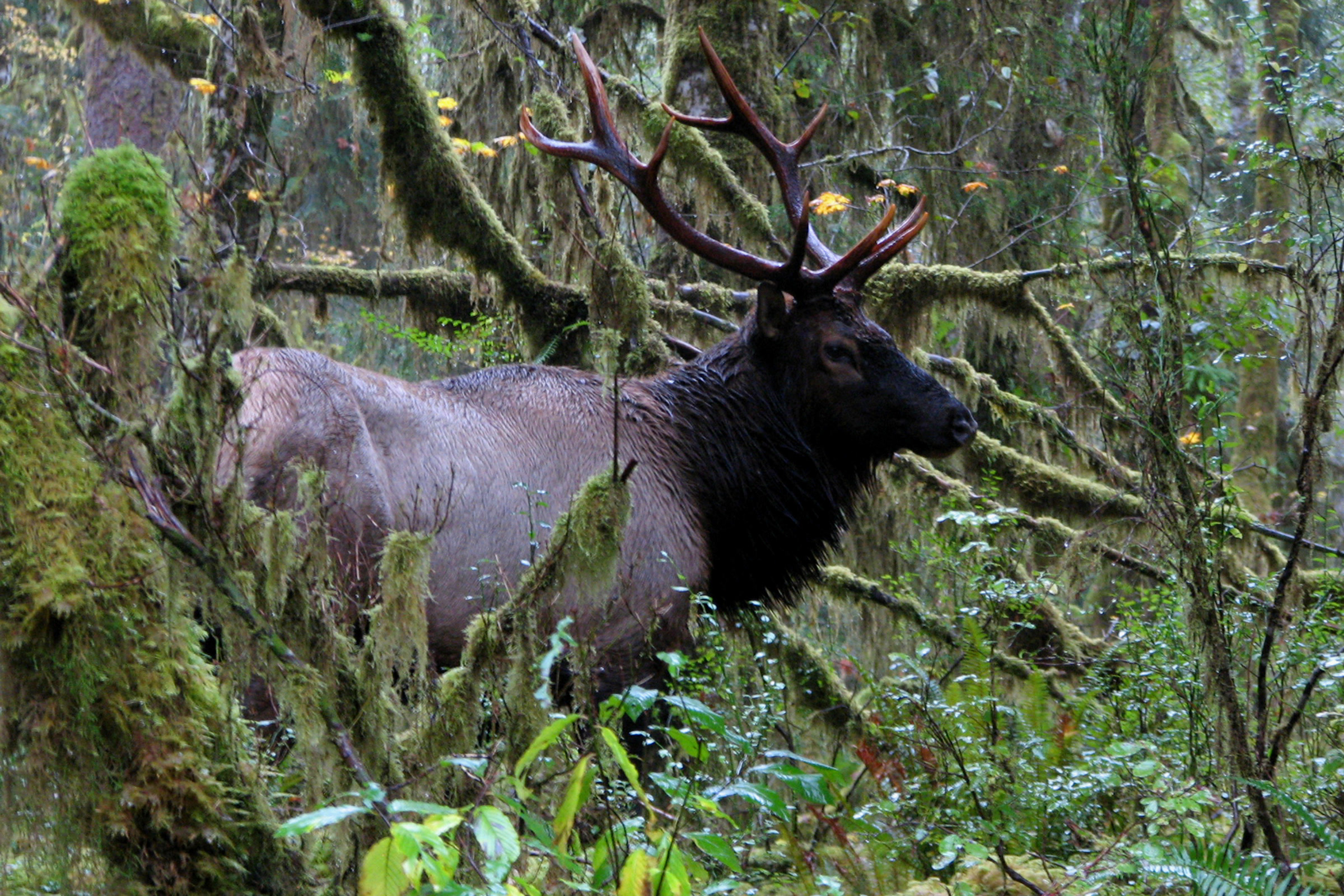
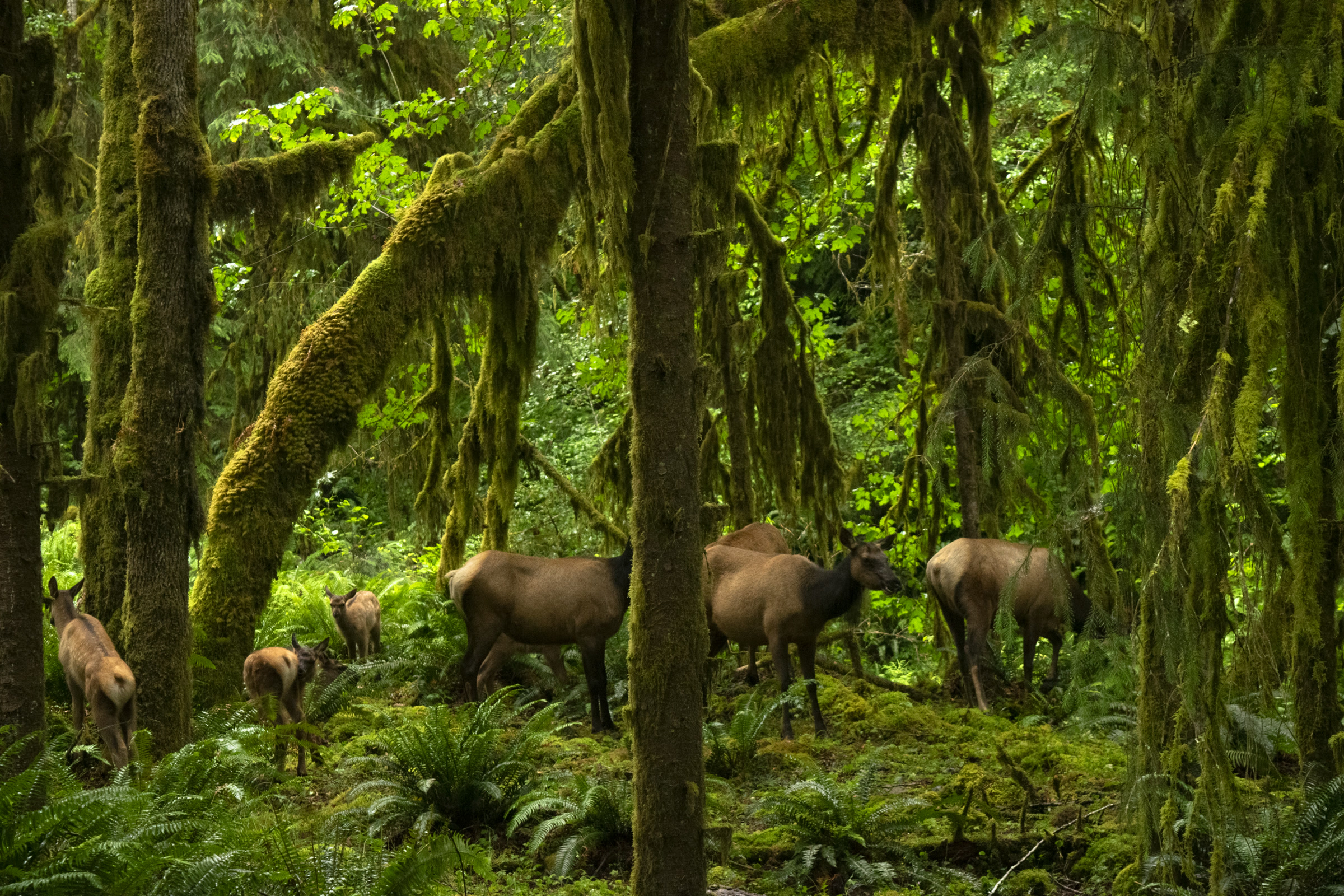
    These valleys hold the largest wild herds of Roosevelt elk in the United States. Their browsing shapes the forest floor and often keeps the understory open. Read more about them in our guide to Roosevelt elk in Olympic National Park.

    Tips for visiting the Hoh Rain Forest

    From mid or late June, the Hoh Rain Forest Visitor Center parking area can be full by 10 am every day. Traffic is then metered at the single-lane entrance station, with cars let in as others leave. The park does not mention a timed entry or reservation system for the Hoh.

    • Arriving between 10 and 11 am or 4 and 6 pm, the park estimates a 30 to 45 minute wait.
    • Arriving between 11 am and 4 pm, plan on 1 to 2 hours.
    • For a quieter walk and a better chance at wildlife, come before 10 am, after 5 pm, or in the off season.
    • Pets are not allowed on Hoh trails, and the visitor center closes from January to early March.

    Check the park’s summer visiting guide and its page on Olympic’s temperate rain forests before you go. Stay on the trail, leave the moss on the logs, and pack out what you bring, the same habits in our Leave No Trace guide for the Olympic coast.

    How Friends of Olympic National Park helps

    We are a volunteer-led friends group that works alongside the park. Our guided mushroom walks and trail days help neighbours and visitors see the forest up close. To lend a hand, see our volunteer opportunities at Olympic National Park.

    Frequently asked questions

    How much rain does the Olympic rain forest get?

    The park says the rain forest valleys get 140 to 167 inches of precipitation a year, which is 12 to 14 feet.

    Which is better, the Hoh or the Quinault rain forest?

    Both are lovely. The Hoh has a visitor center and the Hall of Mosses but gets long summer lines. The Quinault has a loop drive, the Kestner homestead and maple groves.

    Do you need a reservation for the Hoh Rain Forest?

    The park does not mention a reservation or timed entry for the Hoh. In summer the parking area can fill by 10 am, and traffic is then metered at the entrance.

    Can I bring my dog to the Hoh Rain Forest?

    No. Pets are not allowed on Hoh Rain Forest trails.

    What is a nurse log?

    A fallen tree that seedlings sprout on. When the log rots away, the trees are left standing in a row on stilt-like roots, called a colonnade.

  • Olympic National Park World Heritage Site: Why It Matters

    Olympic National Park World Heritage Site: Why It Matters

    Learn · Park Nature · History

    Olympic National Park is a World Heritage Site because few places on Earth pack glaciated mountains, old-growth temperate rain forest and a wild Pacific coast into one protected landscape. UNESCO added the park to its World Heritage List in 1981, five years after it became an International Biosphere Reserve. Here is what earned those titles, and what they do and don’t change for the park we love.

    Quick answer

    Why is Olympic National Park a World Heritage Site?

    Olympic National Park is a World Heritage Site because UNESCO found its glacier-capped mountains, old-growth temperate rain forest and wild Pacific coast to be of outstanding universal value. It was inscribed in 1981 under criteria (vii) and (ix), for natural beauty and living ecosystems, five years after becoming an International Biosphere Reserve in 1976.

    • Inscribed on the World Heritage List in 1981
    • Named an International Biosphere Reserve in 1976
    • Three ecosystems: glaciated peaks, rain forest and wild coast
    • Home to animals found nowhere else, like the Olympic marmot

    The UNESCO World Heritage listing at a glance

    The World Heritage List recognizes places whose value reaches beyond any one country. To be listed, a site must meet at least one of UNESCO’s criteria. Olympic meets two natural ones: criterion (vii), for superb natural beauty, and criterion (ix), for outstanding examples of ecosystems still evolving on their own.

    Congress made Olympic a national park in 1938, and the park protects 922,651 acres. UNESCO notes that 95 percent of the listed property is federally protected wilderness. For the longer story of how the park came to be, see our Olympic National Park history timeline.

    Olympic’s two international designations

    DesignationYearWhat it recognizes
    International Biosphere Reserve1976A place to study how nature and people can thrive together
    World Heritage Site1981Outstanding universal value under criteria (vii) and (ix)
    Aerial view of the rocky Valhallas peaks beside Mount Olympus, with a broad glacier and snowfields on their flanks
    The Valhallas and glaciers of Mount Olympus from the air. NPS Photo

    Three ecosystems in one park

    UNESCO calls Olympic the largest protected area in the world’s temperate region that holds, in one unbroken whole, every step from the ocean’s edge through temperate rain forest and alpine meadows to glaciated peaks. High rainfall, steep terrain and ten major watersheds stack those life zones close together. The National Park Service sums it up as three ecosystems: mountains, rain forest and coast.

    Olympic’s three ecosystems compared

    EcosystemWhy UNESCO values itWhere to see it
    Glaciated mountainsGlaciers at the lowest latitude where they form below 2,000 metersMount Olympus and the high country
    Temperate rain forestOne of the world’s largest stands of virgin temperate rain forestHoh, Quinault, Queets and Bogachiel valleys
    Wild coastThe longest undeveloped coast in the contiguous United StatesRuby Beach, Rialto Beach and Kalaloch

    Glaciated mountains

    Mount Olympus rises to 7,980 feet and gets an estimated 50 feet of snow a year. UNESCO points out that Olympic is the lowest latitude in the world where glaciers form below 2,000 meters (about 6,500 feet) and reach below 1,000 meters (about 3,300 feet). Ice has carved the range into craggy peaks, deep valleys and bowl-shaped cirques.

    A turquoise tarn in rocky Royal Basin below the jagged, snow-patched face of Martin Peak in the Olympic Mountains
    A glacier-carved basin below Martin Peak in Royal Basin. Photo: Dan Nevill / Wikimedia Commons (CC BY 2.0)

    Old-growth temperate rain forest

    In the west-side valleys, storms off the Pacific bring 140 to 167 inches of precipitation a year. UNESCO notes that the coastal rain forest reaches its fullest development here, with a mass of living plants that may be the highest anywhere in the world. Many of the largest conifer species on Earth grow in these valleys.

    Tall, dark conifers stand in layers of drifting mist in the Hoh valley of Olympic National Park
    Mist in the Hoh valley. NPS Photo / J. Preston

    Our guide to the temperate rainforests of Olympic National Park compares the four rain forest valleys and the best short trails in each.

    The massive, moss-streaked trunk and spreading roots of an old-growth conifer beside a trail in the Hoh Rain Forest
    An old-growth giant in the Hoh Rain Forest. NPS Photo

    A wild Pacific coast

    UNESCO counts 100 kilometers of wilderness coastline in the park, the longest undeveloped coast in the contiguous United States. Rocky islets and sea stacks stand offshore, left behind as the waves keep wearing the shoreline back. Eleven major river systems drain the mountains to the sea, giving salmon and other fish that live in both fresh and salt water some of the best habitat in the country.

    The sun sets behind dark sea stacks off Ruby Beach, its light reflecting on wet sand at low tide
    Sunset over the sea stacks at Ruby Beach. NPS Photo / R. McKenna

    Endemic species found nowhere else

    The Olympic Peninsula is isolated, with salt water on three sides. UNESCO says that isolation produced endemic wildlife, subspecies of trout, plant varieties and unique fur colors in mammals, signs of a separate course of evolution. The park lists the Olympic marmot, Olympic snow mole and Olympic torrent salamander among animals found here and nowhere else.

    Just as telling is what never lived here. The park notes that grizzly bears, wolverines, lynx, red foxes and pikas did not occur on the peninsula. Meet the park’s best-known local in our story on the Olympic marmot of Hurricane Ridge.

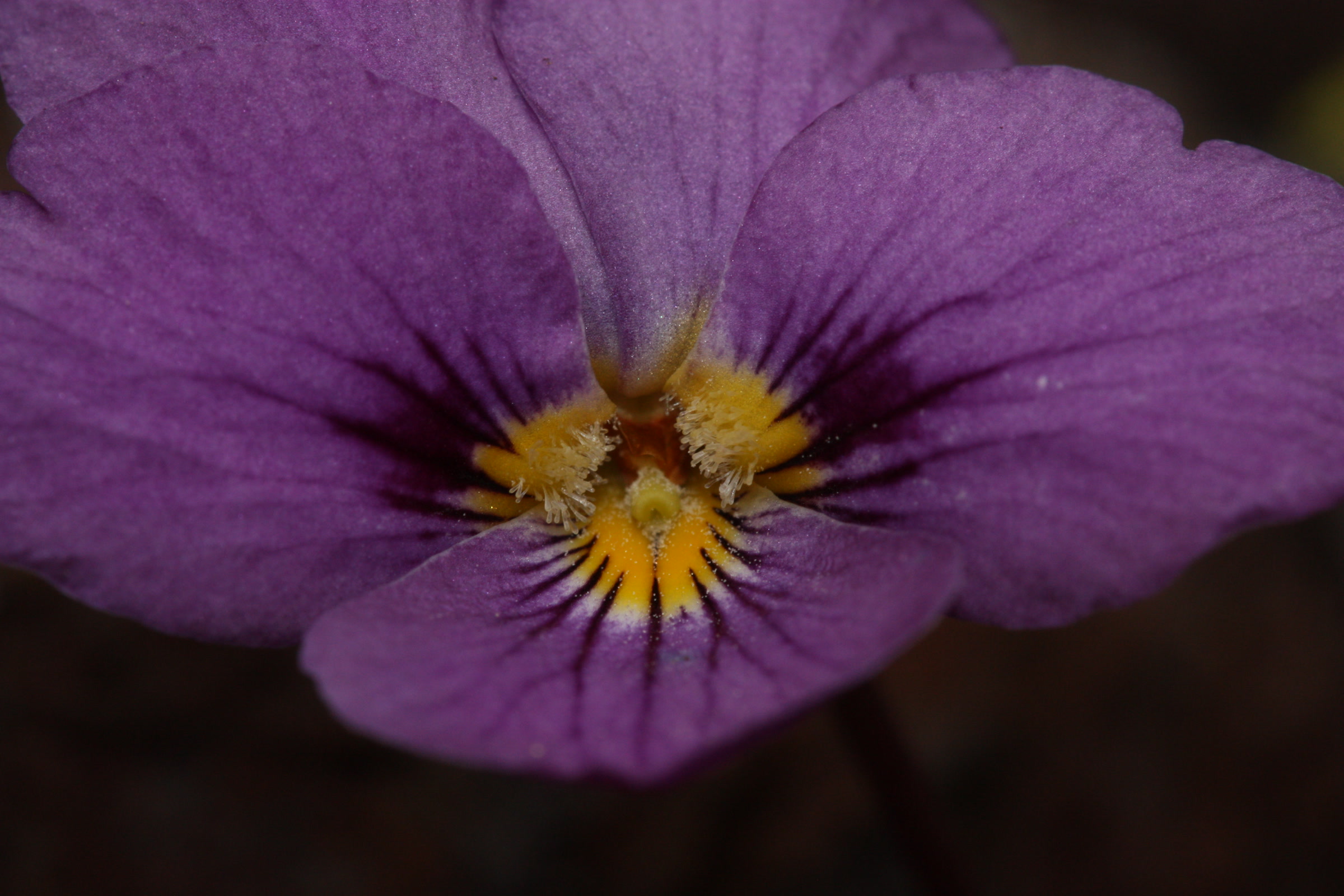
    Close view of a purple Flett's violet flower with a yellow centre, photographed high in the northern Olympic Mountains
    Flett’s violet, a wildflower of the Olympic Mountains’ rocky high country. Photo: Walter Siegmund / Wikimedia Commons (CC BY-SA 3.0)

    Olympic as a biosphere reserve

    Before the World Heritage listing came a different honor. In 1976 the park was named an International Biosphere Reserve under UNESCO’s Man and the Biosphere Programme. Biosphere reserves are meant as living laboratories, places for research and learning about how people and nature can do well side by side.

    What World Heritage status does and doesn’t mean

    The title is recognition, not a transfer of control. The National Park Service notes that each country that signs the World Heritage Convention keeps sovereignty over its sites, and the United States was the first nation to ratify it. Olympic is still owned by the American people and managed by the park under the laws that created it.

    • It does: mark the park as one of the world’s great natural places and draw attention to anything that threatens it.
    • It doesn’t: change who owns the park, who manages it, or the rules visitors follow.
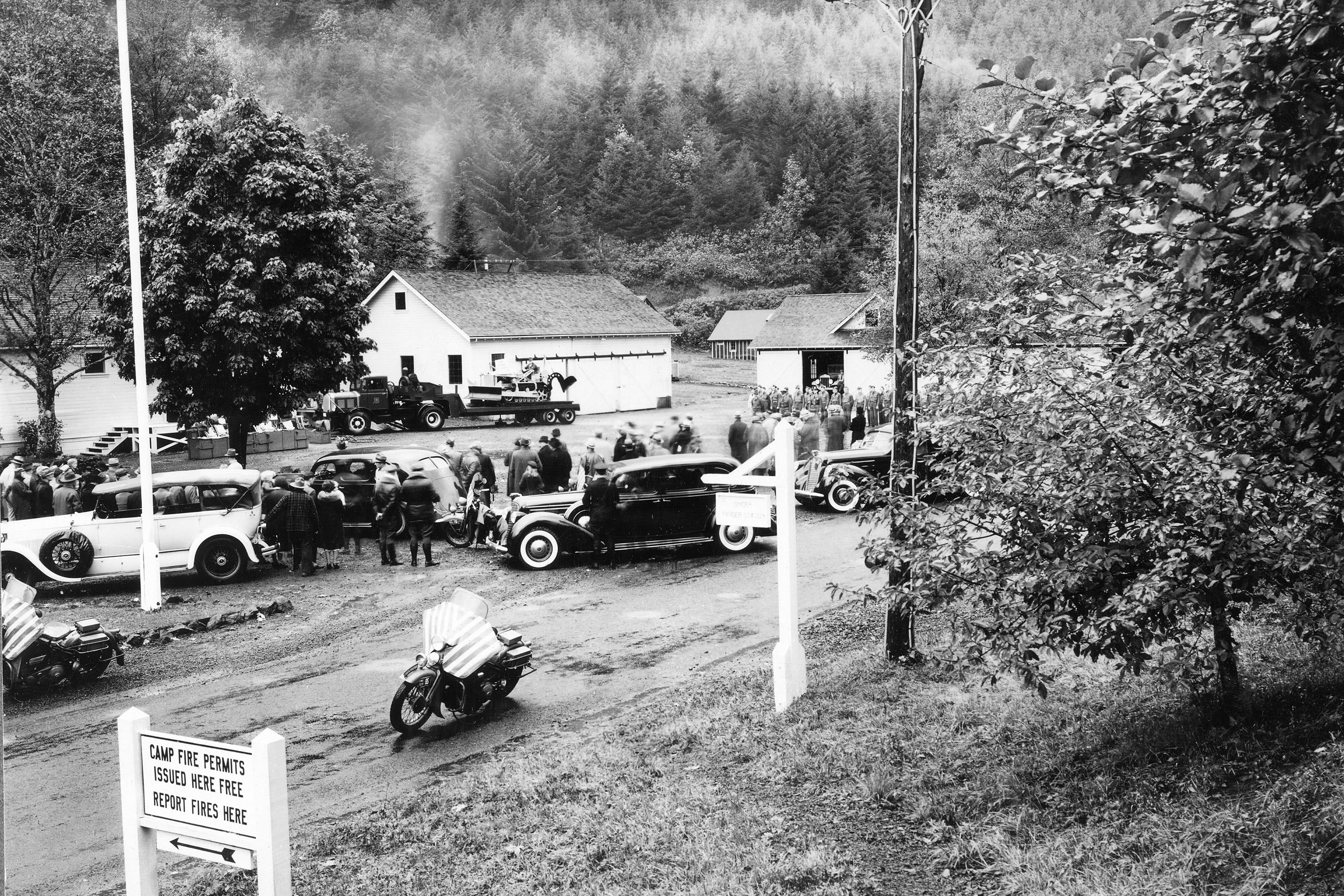
    • It asks: that the values on the list be kept whole for future generations.

    You can read the full statement of value on the UNESCO World Heritage listing for Olympic National Park.

    How Friends of Olympic National Park helps

    World-class places still need local hands. Our volunteers pick up debris on the coast through our beach cleanups in Olympic National Park, and our adopt-a-trail crew cares for the Heart O’ the Forest Trail. We also lead guided walks and help with National Junior Ranger Day, so the next generation learns why this park matters.

    Membership keeps that work going. Become a member of Friends of Olympic National Park for our newsletter and invitations to events, or see our volunteer opportunities.

    Frequently asked questions

    When did Olympic National Park become a World Heritage Site?

    UNESCO inscribed Olympic National Park on the World Heritage List in 1981, under natural criteria (vii) and (ix).

    Is Olympic National Park a biosphere reserve?

    Yes. The park was named an International Biosphere Reserve in 1976 under UNESCO’s Man and the Biosphere Programme, five years before its World Heritage listing.

    Does UNESCO own or control Olympic National Park?

    No. Each country that signs the World Heritage Convention keeps sovereignty over its sites. Olympic is still managed by the National Park Service under United States law.
    What are the three ecosystems of Olympic National Park?

    Glaciated mountains, old-growth temperate rain forest and a wild Pacific coast. UNESCO highlights how all three sit together in one protected area.
    What animals live only in Olympic National Park?

    The park lists the Olympic marmot, Olympic snow mole and Olympic torrent salamander among endemic animals found here and nowhere else.

  • Olympic National Park History: A Timeline from 1897 to Today

    Olympic National Park History: A Timeline from 1897 to Today

    Olympic National Park history begins long before any boundary line. People have lived on the Olympic Peninsula for thousands of years, and federal protection came in three steps: a forest reserve in 1897, a national monument in 1909 and a national park in 1938. This timeline walks through each chapter, right up to recent events.

    Quick answer

    What is the history of Olympic National Park?

    Olympic National Park’s history spans at least 13,800 years of human presence and more than a century of protection: the Olympic Forest Reserve in 1897, Theodore Roosevelt’s Mount Olympus National Monument in 1909, and the national park Congress established on June 29, 1938. UNESCO named it a Biosphere Reserve in 1976 and World Heritage Site in 1981.

    • Olympic Forest Reserve created February 22, 1897
    • Mount Olympus National Monument proclaimed March 2, 1909
    • National park established June 29, 1938
    • About 95 percent of the park is designated wilderness

    Olympic National Park timeline at a glance

    YearMilestone
    About 13,800 years agoEarliest evidence of people in the region
    1855-1856Treaties cede tribal lands to the United States
    1897Olympic Forest Reserve created
    1909Mount Olympus National Monument proclaimed
    1933Monument transferred to the National Park Service
    1938Olympic National Park established
    1953Coastal Strip and Queets Corridor added
    1976International Biosphere Reserve
    1981World Heritage Site
    1988Olympic Wilderness designated
    2002Friends of Olympic National Park founded
    2011-2014Elwha River dams removed
    2017Wilderness rededicated for Daniel J. Evans
    2023Hurricane Ridge Day Lodge lost to fire

    First peoples of the Olympic Peninsula

    The park’s story starts with the people who have always called this place home. In 1977 a farmer digging a pond just outside today’s park found mastodon remains with a bone point lodged in a rib. In 2011 scientists dated that point to 13,800 years ago, the earliest evidence of people in this region.

    According to the park’s page on ancient peoples and area tribes of the Olympic Peninsula, eight tribes have traditional ties to lands now in the park: the Hoh, Jamestown S’Klallam, Lower Elwha Klallam, Makah, Port Gamble S’Klallam, Quileute, Quinault and Skokomish. Their ancestors ceded lands and waters to the federal government in treaties signed in 1855 and 1856. These are living nations, and their cultures remain tied to these rivers, forests and coast.

    From forest reserve to Mount Olympus National Monument

    On February 22, 1897, President Grover Cleveland created the Olympic Forest Reserve, about 2.2 million acres. Later cuts shrank it, and in 1907 it was renamed Olympic National Forest.

    Concern for the peninsula’s elk drove the next step. On March 2, 1909, President Theodore Roosevelt proclaimed Mount Olympus National Monument, 610,560 acres set aside mainly as a refuge for elk. The animals now carry his name as Roosevelt elk.

    The monument didn’t stay whole. In 1915 President Woodrow Wilson cut it roughly in half, partly because of wartime demand for timber. On June 10, 1933, President Franklin D. Roosevelt moved what remained from the Forest Service to the National Park Service.

    FDR’s 1937 visit and the 1938 national park

    Bills to create a park failed through the 1920s and 1930s. In late September 1937 Franklin Roosevelt toured the peninsula himself, met with local leaders and agency staff at Lake Crescent about the park’s size, and spoke to a crowd in Port Angeles.

    Black and white photo of President Roosevelt's motorcade and a crowd gathered by white ranger station buildings in a forest clearing
    President Roosevelt’s motorcade at Snyder Ranger Station, Olympic National Forest, October 1, 1937. Photo: Neil Mortiboy, U.S. Forest Service (public domain)

    Congress acted the next summer. The act of June 29, 1938, established Olympic National Park at about 682,000 acres and abolished the monument. It also let the president enlarge the park, and on January 2, 1940, Roosevelt added 187,411 acres.

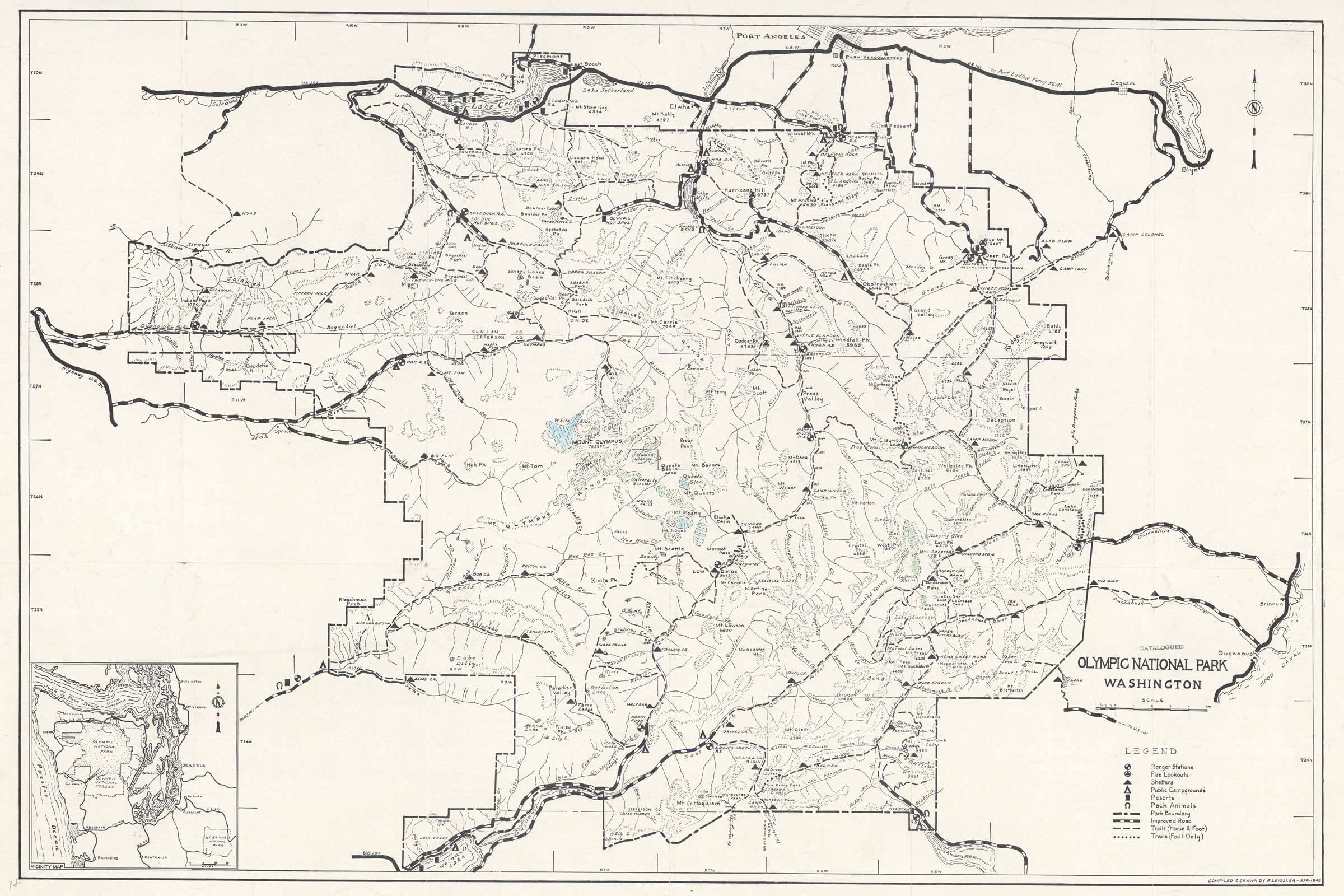
    A 1949 National Park Service map of Olympic National Park showing roads, trails, ranger stations and the park boundary, with no coastal strip yet
    The park on a 1949 National Park Service map, before the 1953 coastal addition. Map: NPS, via University of Wisconsin-Milwaukee Libraries (public domain)

    Adding the coast and the high country

    The 1950s brought two big changes. The two-story Hurricane Ridge Day Lodge was built in 1952, giving visitors a base high in the mountains. On January 6, 1953, President Harry Truman added 47,753 acres, including the Coastal Strip, the Queets Corridor and part of the Bogachiel Valley.

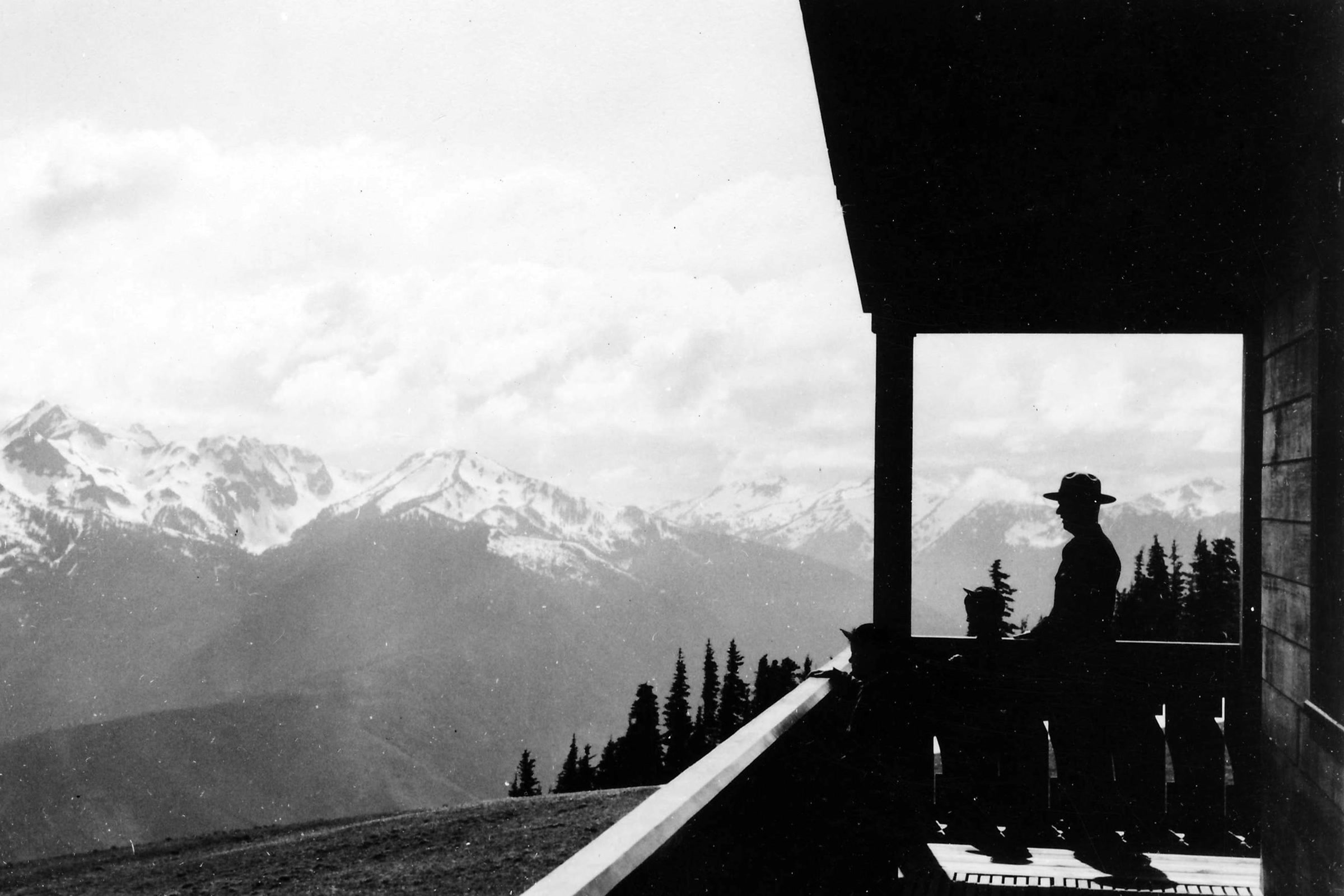
    Black and white photo of a figure in a flat hat on a lodge porch looking out at snowy Olympic peaks
    The Olympic Mountains from the porch of the Hurricane Ridge Lodge, in an undated historic photo. Photo: U.S. Forest Service, Pacific Northwest Region (public domain)

    The Coastal Strip brought a long run of wild Pacific beaches into the park. That coast is where our volunteers now haul out marine debris during beach cleanups in Olympic National Park.

    World recognition and wilderness

    In 1976 UNESCO named the park an International Biosphere Reserve. In 1981 it was inscribed on the UNESCO World Heritage List for its natural values. Read more in our post on why Olympic National Park is a World Heritage Site.

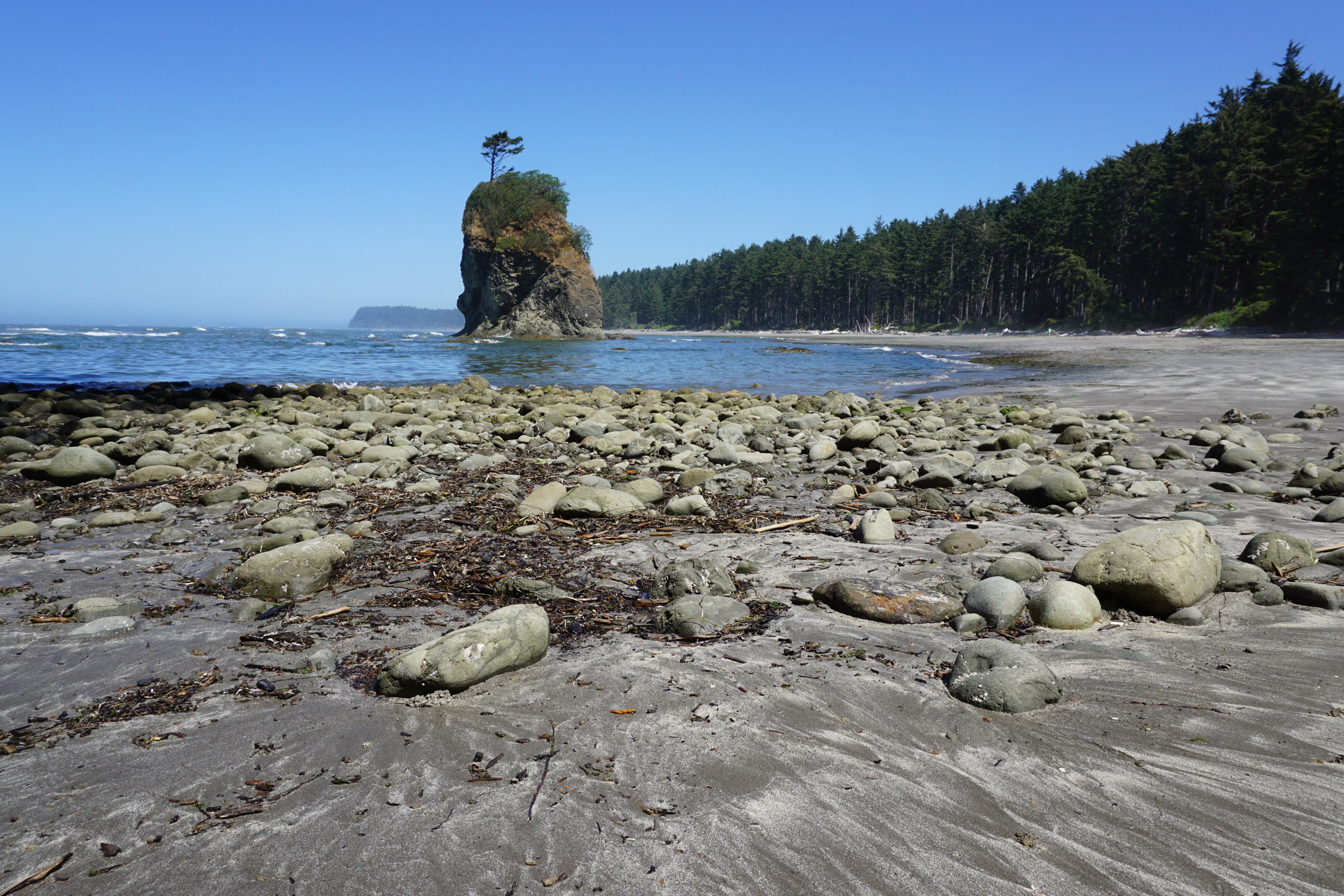
    A tree-topped sea stack off a cobble and sand beach backed by dense conifer forest on the Olympic wilderness coast
    A sea stack on the wilderness coast near the Norwegian Memorial, July 2015. NPS Photo / D. Archuleta

    On November 16, 1988, President Ronald Reagan signed the Washington Park Wilderness Act. It set aside 877,000 acres, about 95 percent of the park, as the Olympic Wilderness.

    A 2016 law renamed the area for Daniel J. Evans, the former Washington governor and senator who introduced the 1988 bill. The park rededicated it under his name in 2017.

    Recent chapters: the Elwha and Hurricane Ridge

    Congress passed the Elwha River Ecosystem and Fisheries Restoration Act in 1992. Removal of the Elwha and Glines Canyon dams began on September 17, 2011, and finished in 2014. Our post on Elwha River dam removal and restoration tells that story.

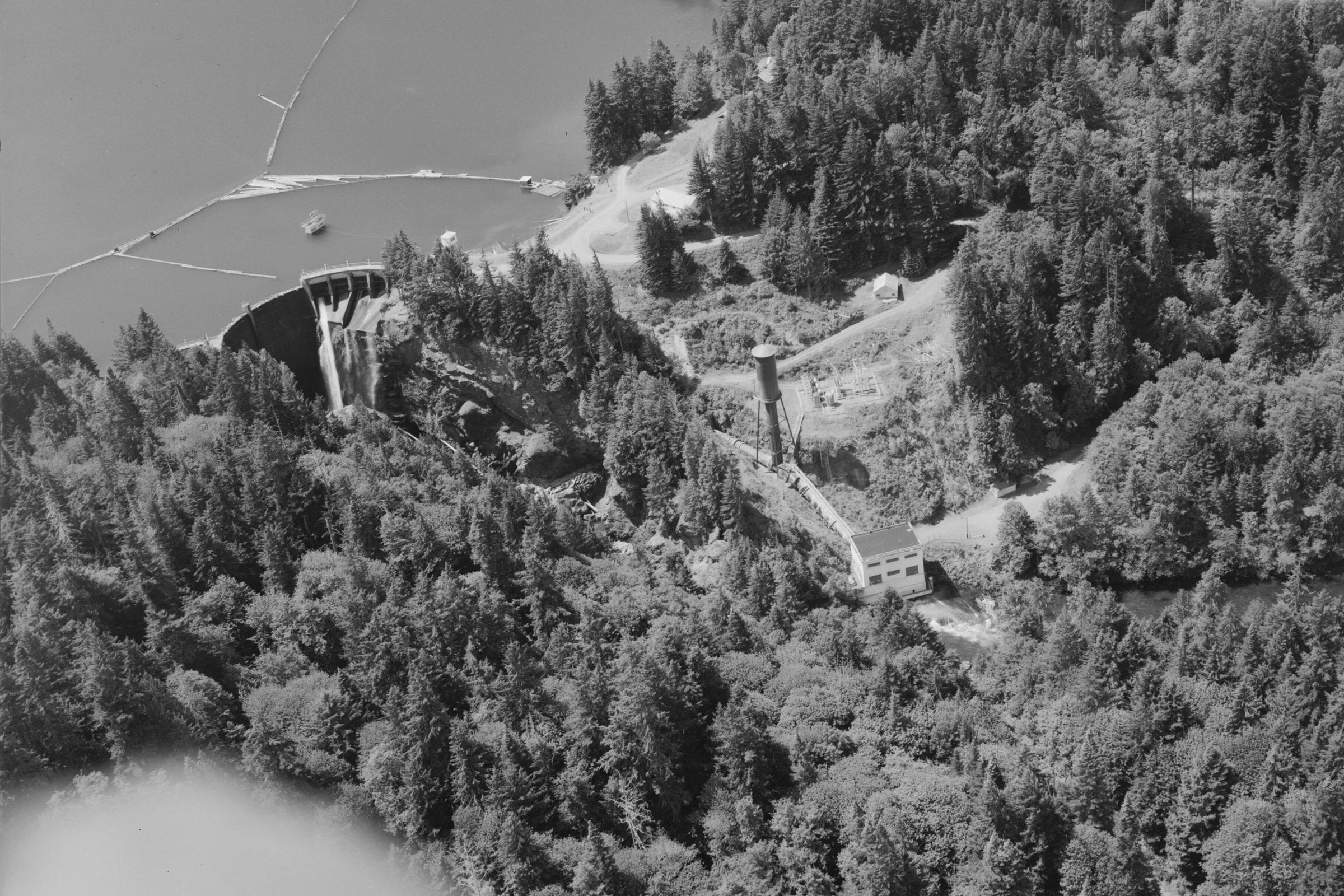
    Black and white aerial view of the curved Glines Canyon Dam holding back Lake Mills, with its surge tank and powerhouse in the forest below
    Glines Canyon Dam and Lake Mills in 1995, before removal. Photo: Jet Lowe, Historic American Engineering Record (public domain)

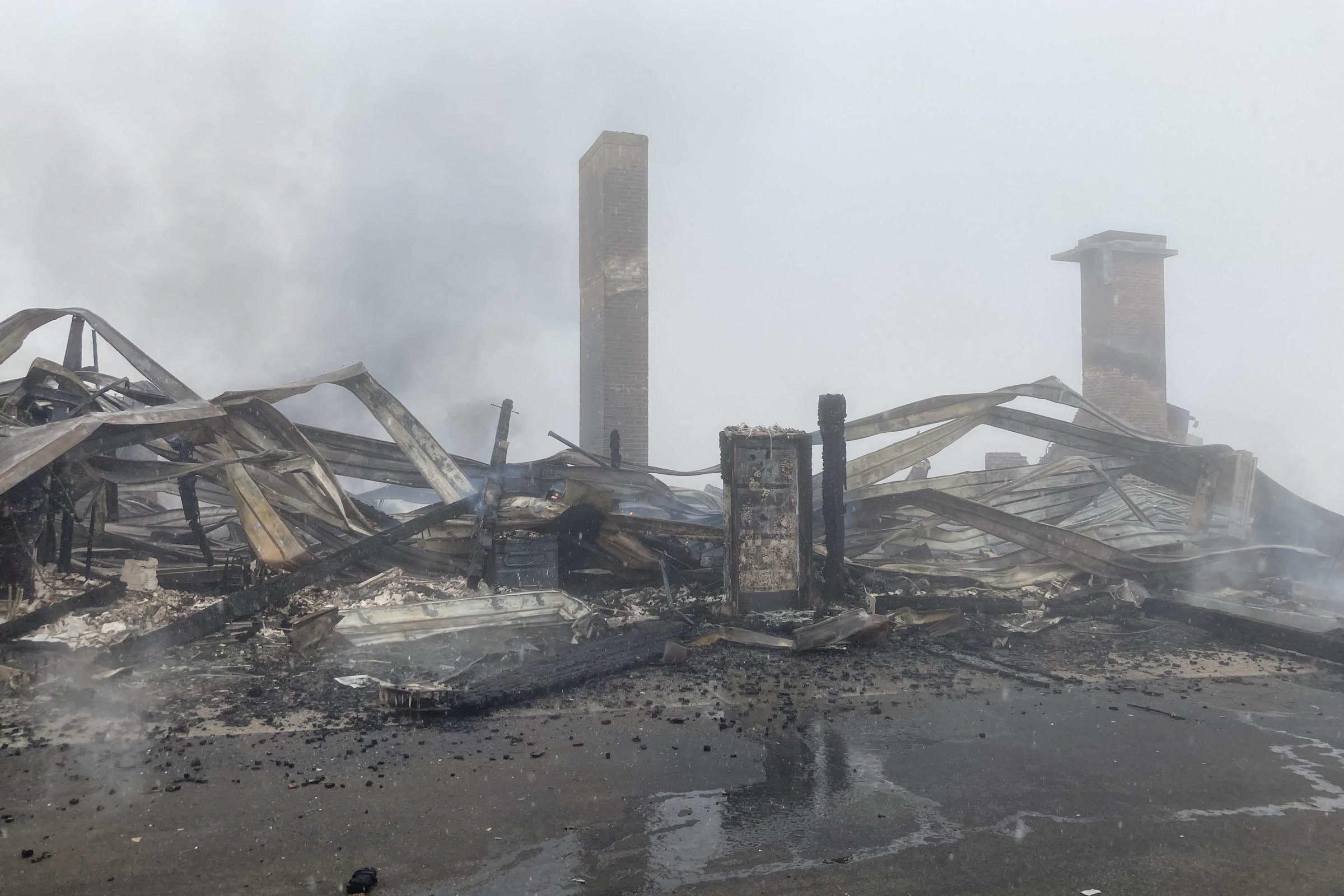
    On May 7, 2023, the Hurricane Ridge Day Lodge burned to the ground. It was closed for rehabilitation at the time, and no one was hurt. The building also held the area’s power, water and communications hub, so the loss shaped access to the ridge for months afterward.

    Smoking wreckage of the Hurricane Ridge Day Lodge, with twisted metal roofing and two stone chimneys still standing in fog
    The remains of the Hurricane Ridge Day Lodge after the May 2023 fire. NPS Photo

    Where Friends of Olympic National Park fits

    Friends of Olympic National Park (FONP) was founded in 2002. We’re a volunteer-led friends group based in Port Angeles, one of many that support parks across the country, as our guide to national park friends groups explains.

    History lovers can dig deeper with our guide to historical structures in Olympic National Park or the story of the Enchanted Valley Chalet move. The next chapter is being written by people like you, so become a member of Friends of Olympic National Park and help care for the park.

    Frequently asked questions

    When was Olympic National Park established?

    Congress established Olympic National Park with an act of June 29, 1938, signed by President Franklin D. Roosevelt. He had toured the Olympic Peninsula the previous fall.

    Why was Mount Olympus National Monument created?

    Theodore Roosevelt proclaimed it on March 2, 1909, mainly as a refuge for the peninsula’s elk, which are now known as Roosevelt elk.

    Was Olympic National Park ever a national forest?

    Yes. Much of the land was part of the Olympic Forest Reserve, created in 1897 and renamed Olympic National Forest in 1907, before the monument and park were carved from it.

    How much of Olympic National Park is wilderness?

    About 95 percent. The 1988 Washington Park Wilderness Act designated 877,000 acres, now called the Daniel J. Evans Wilderness.

    Which tribes have ties to Olympic National Park?

    Eight tribes: the Hoh, Jamestown S’Klallam, Lower Elwha Klallam, Makah, Port Gamble S’Klallam, Quileute, Quinault and Skokomish.

  • Elwha River Restoration: Dam Removal and a River Reborn

    Elwha River Restoration: Dam Removal and a River Reborn

    Elwha River restoration began in September 2011, when crews started taking down the two dams that had blocked the river for a century. By 2014 both the Elwha Dam and the Glines Canyon Dam were gone, and the river was running free from the Olympic Mountains to the Strait of Juan de Fuca. Here’s what happened, what has come back, and how to see it for yourself.

    Quick answer

    What is the Elwha River restoration?

    Elwha River restoration is the National Park Service-led project that removed the Elwha and Glines Canyon dams between 2011 and 2014, the largest dam removal in U.S. history. Freed sediment rebuilt the river mouth, Chinook salmon returned above both former dam sites, and crews replanted the drained reservoirs with native plants.

    • Dam removal began on September 17, 2011
    • The Glines Canyon Dam came out in 2014
    • About 20 million tons of sediment was released
    • The plan called for more than 400,000 native plants

    Why the Elwha dams came out

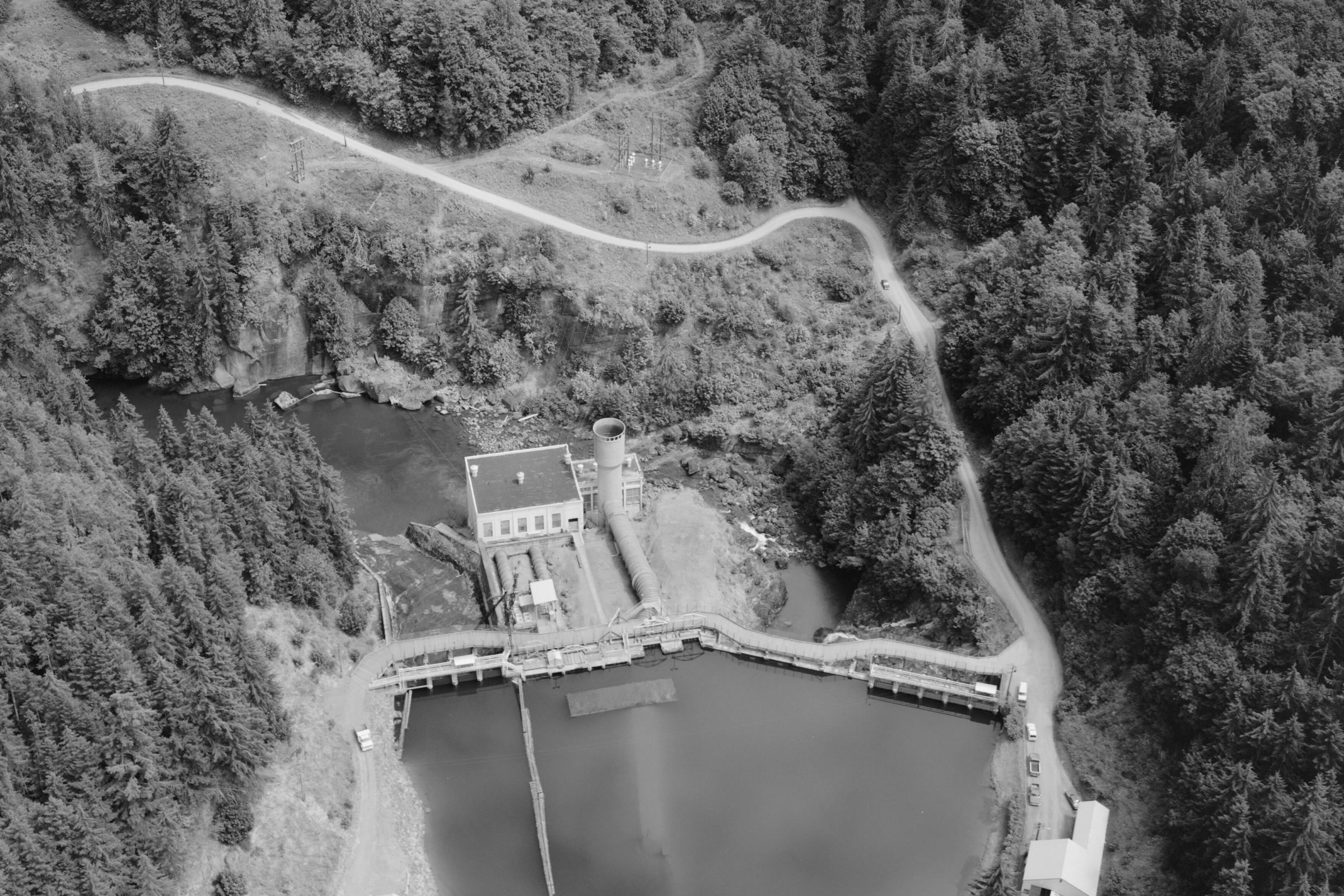
    Both dams were built in the early 1900s to make hydropower for the growing town of Port Angeles. The Elwha Dam went up from 1910 to 1913 on the lower river and never received a federal license. The 210 foot Glines Canyon Dam followed upstream from 1925 to 1927, and a 1940 boundary expansion brought its site inside the park.

    Black and white aerial view of the Elwha Dam and powerhouse holding back Lake Aldwell, with a road curving through the forest above
    The Elwha Dam and Lake Aldwell in 1995. Photo: Jet Lowe, Historic American Engineering Record, Library of Congress (public domain)

    The dams stopped salmon from swimming upstream. The National Park Service notes that the Elwha once held eleven kinds of salmon and trout, and that the river was an important food source for the Lower Elwha Klallam Tribe. The reservoirs also flooded tribal homelands and cultural sites.

    The tribe pushed for change for decades. In 1986 it was granted intervenor status in the federal relicensing case for the dams, and in 1991 it joined conservation groups in petitions to the Ninth Circuit. In October 1992 Congress passed the Elwha River Ecosystem and Fisheries Restoration Act, which called for full restoration of the river and its native fish runs.

    How the Elwha dam removal worked

    After about two decades of planning, the National Park Service calls what followed the largest dam removal in U.S. history. Crews took the dams down in stages so the river could carry its stored sediment away a little at a time.

    Elwha River restoration timeline

    WhenWhat happened
    1910-1913Elwha Dam built, forming Lake Aldwell
    1925-1927Glines Canyon Dam built, forming Lake Mills
    1986Lower Elwha Klallam Tribe joins the relicensing case
    October 1992Restoration Act signed into law
    September 17, 2011Dam removal begins
    March 2012Elwha Dam fully removed
    2014Glines Canyon Dam removal completed
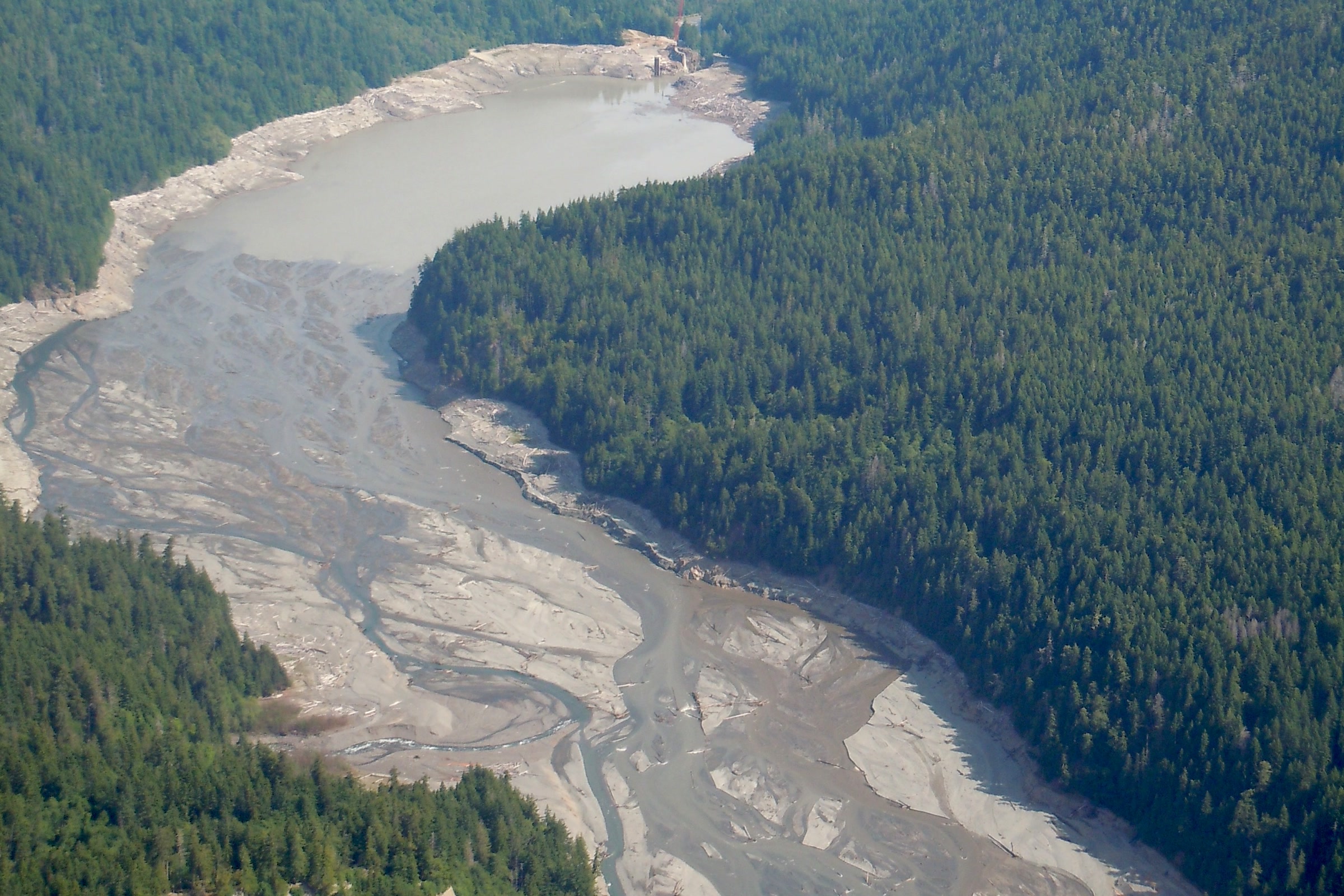
    Aerial view of the drained Lake Mills reservoir, a wide grey bed of sediment with the Elwha River braiding through it between forested slopes
    The former Lake Mills in June 2012, partway through the Glines Canyon Dam removal. NPS Photo

    Where all that sediment went

    Nearly 100 years of sand, gravel and silt had piled up behind the dams, about 30 million tons in all. According to the U.S. Geological Survey’s Elwha River Restoration Project, about two thirds of it, roughly 20 million tons, was released.

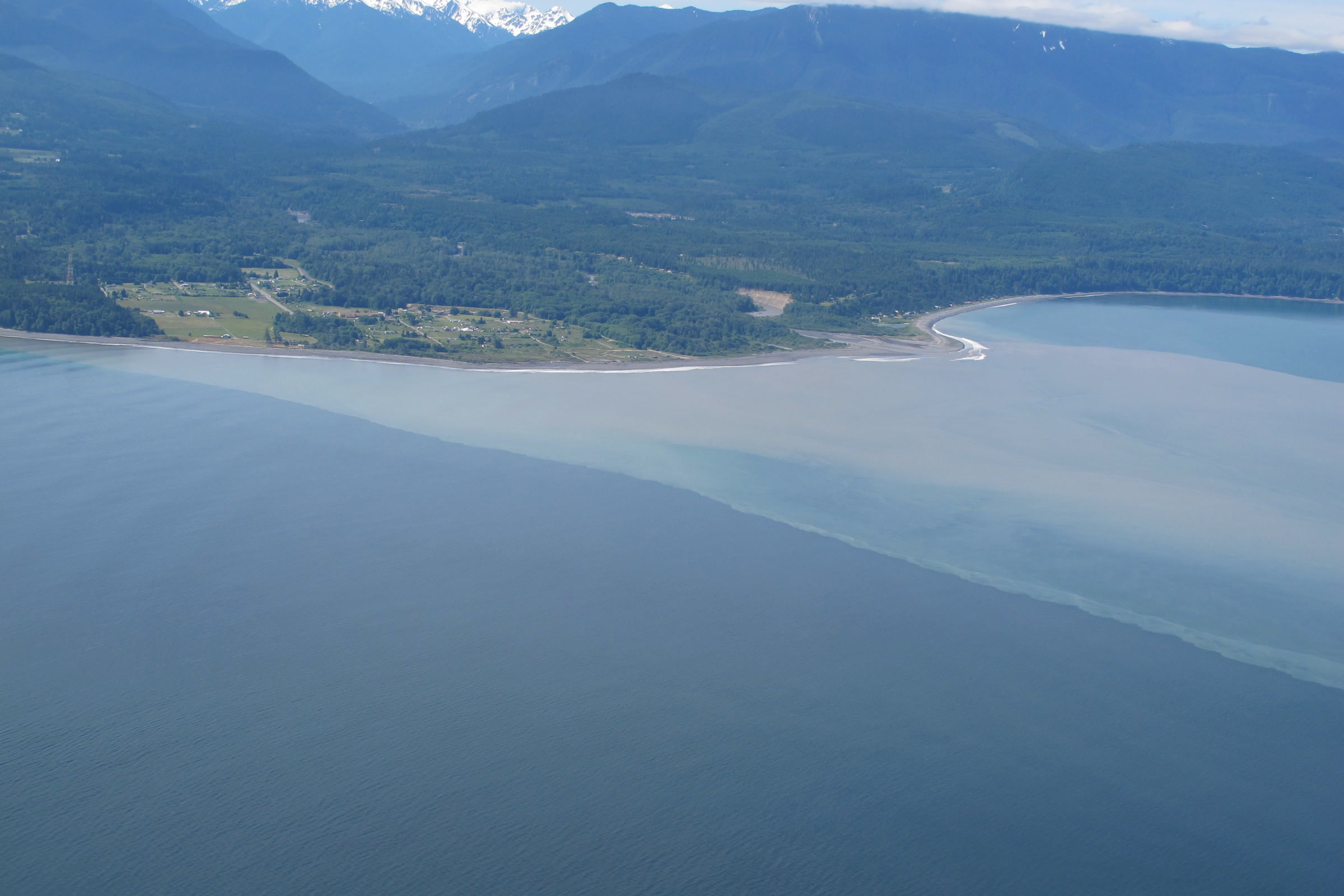
    USGS researchers found that most of the sediment released in the first two years moved right through the river to the coast. Part of it built out the delta at the river mouth, bringing new beach and nearshore habitat to a shoreline that had been starved of sediment for a century.

    Aerial view of a pale plume of silt spreading into the blue Strait of Juan de Fuca from the Elwha River mouth, with snowy Olympic Mountains behind
    Silt from the Elwha drifting into the Strait of Juan de Fuca, June 2012. NPS Photo

    The Elwha River salmon return

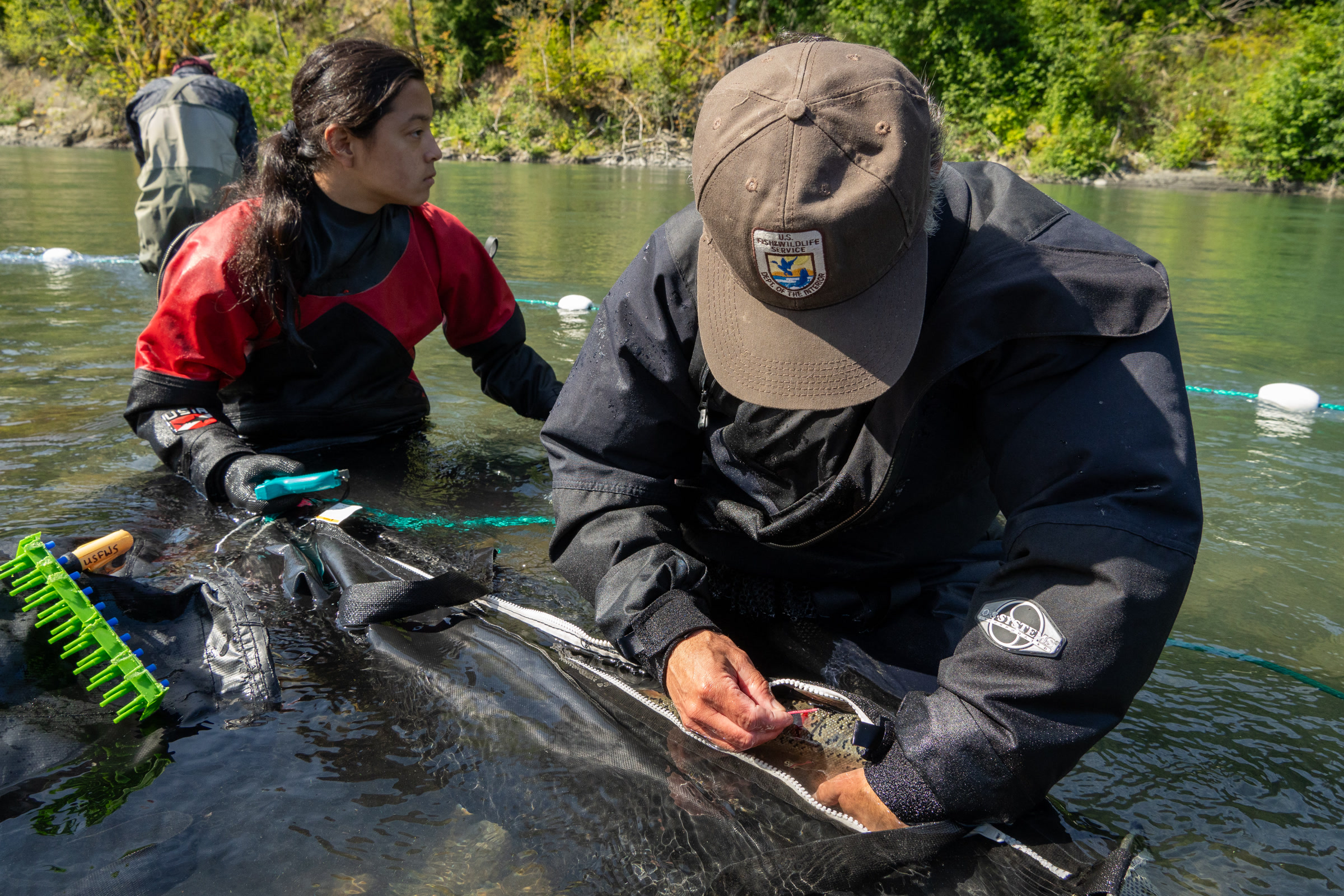
    Fish didn’t wait for the work to finish. In September 2013 a survey team from the park, the Lower Elwha Klallam Tribe, USGS, Washington Department of Fish and Wildlife and NOAA Fisheries counted 1,741 adult Chinook salmon and 763 nests. About three quarters were upstream of the old Elwha Dam site.

    In September 2014 park staff found adult Chinook in the former Lake Mills, above the Glines Canyon site, for the first time in more than a century. With both dams gone, salmon and steelhead can reach more than 70 miles of river and streams.

    A fish biologist in a cap and an intern in waders check tags on a fish held in a net cradle while standing in the Elwha River
    A U.S. Fish and Wildlife Service biologist and a Lower Elwha Klallam Tribe hatchery intern check fish tags on the Elwha, July 2022. Photo: Typhanie Shepherd / USFWS (public domain)

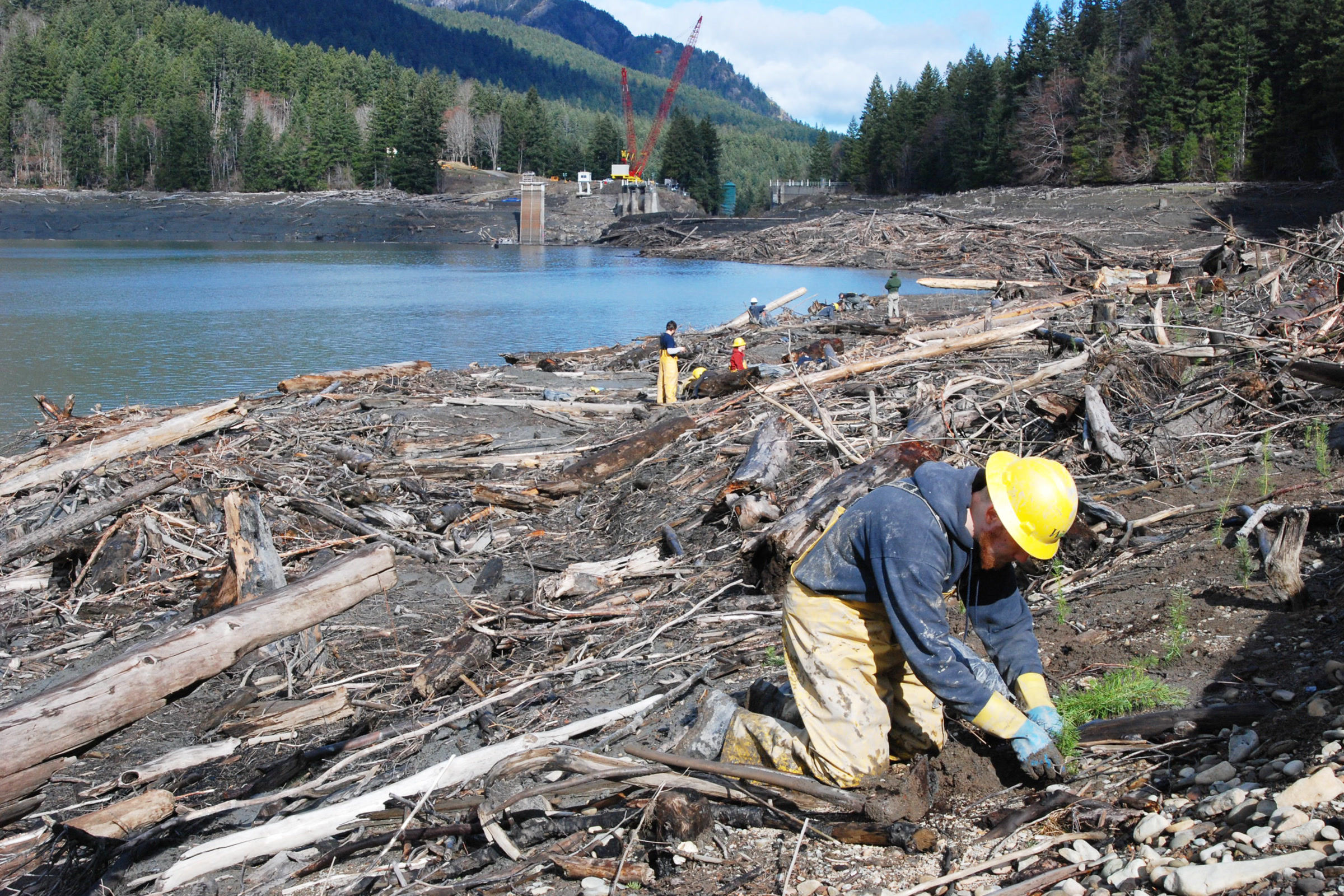
    Replanting the old lakebeds

    Draining Lake Mills and Lake Aldwell left wide slopes of bare sediment. The park’s revegetation plan aimed to cover that ground with more than 400,000 native plants, grown mostly at its Matt Albright Native Plant Center greenhouse from seeds and cuttings gathered for the job.

    One goal was to keep invasive, non-native plants from taking over the newly exposed soil. Park botanists and volunteers began planting in the reservoirs during the first year of dam removal, with monitoring and replanting planned for years afterward.

    A worker in a yellow hard hat kneels to plant a seedling among driftwood logs on the exposed bed of the former Lake Mills
    A revegetation planting day at the former Lake Mills, March 2012. NPS Photo

    The draining also uncovered something deeply important to the Lower Elwha Klallam people. In July 2012 park cultural resources staff located the tribe’s creation site, long described in Klallam oral history, and tribal members confirmed it. The park does not share its location, and disturbing cultural sites is against the law.

    The Elwha River today

    The Olympic Hot Springs Road up the Elwha Valley is closed to vehicles because of a washout. It stays open to people on foot, bicycles and dogs on leashes, and the Madison Falls parking area is open, though parking is tight. Check the park’s current road conditions for Olympic National Park before you go.

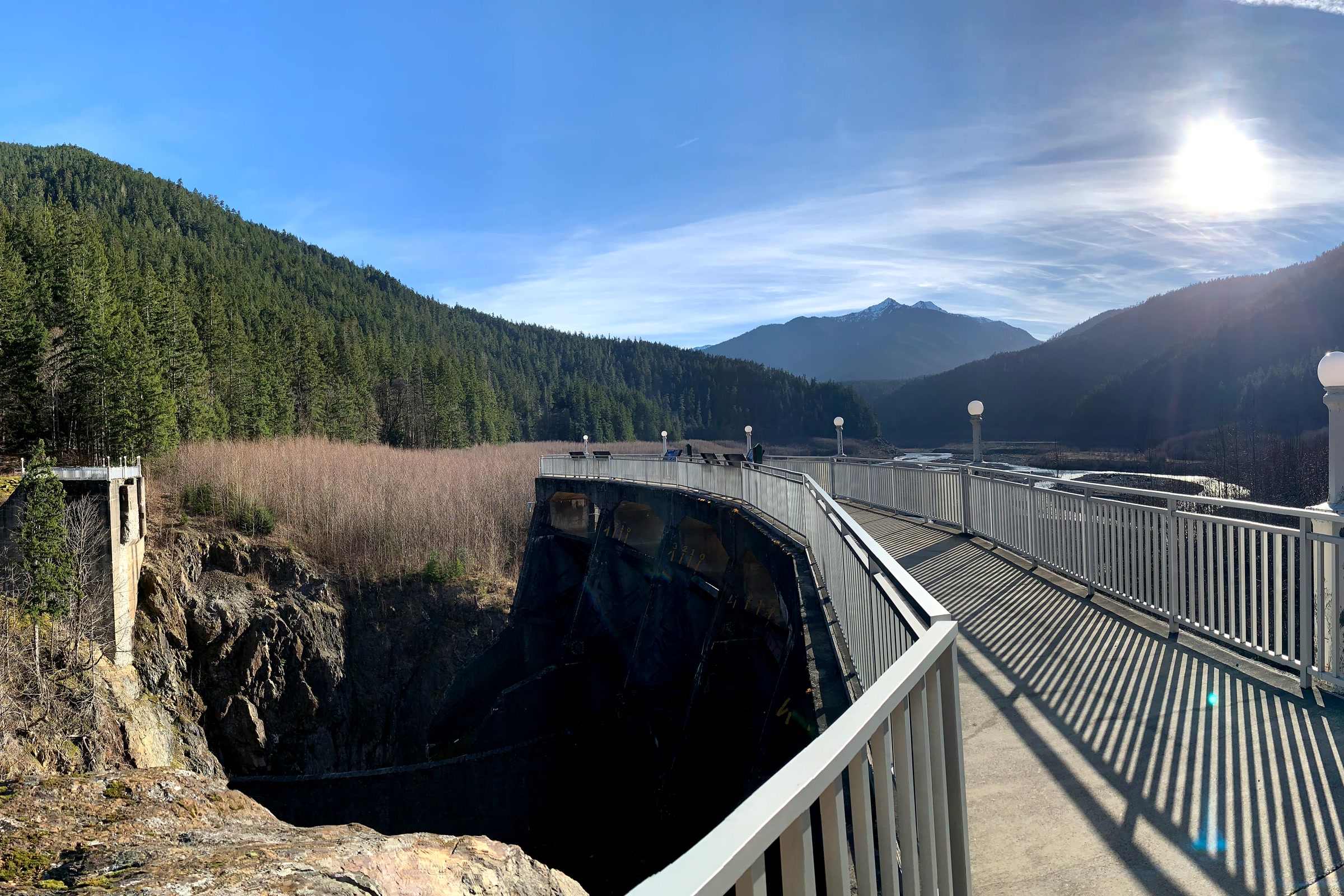
    A railed walkway on top of the old Glines Canyon Dam spillway, looking up the forested Elwha valley under a bright winter sun
    The overlook on the former Glines Canyon Dam spillway, February 2022. Photo: Andrew Kvalheim / Wikimedia Commons (CC BY-SA 4.0)

    The Glines Canyon site is far up the road, so reaching it today takes a long walk or a bike ride. Bring water, stay on the pavement and trails, and leave any artifacts or cultural objects exactly where you find them.

    How Friends of Olympic National Park helps

    Friends of Olympic National Park (FONP) is a local, volunteer-led friends group, and we weren’t part of the dam removal. The same work goes on closer to home, though. Our volunteers pull weeds and tend native plants at the Visitor Center in Port Angeles.

    If the Elwha’s comeback inspires you, make a gift to support Olympic National Park through our volunteer projects, or find volunteer opportunities in Olympic National Park.

    Frequently asked questions

    Why were the Elwha River dams removed?

    The dams blocked salmon from reaching the upper river and flooded Lower Elwha Klallam Tribe homelands. Congress passed the Elwha River Ecosystem and Fisheries Restoration Act in 1992 to restore the river and its native fish.

    How long did the Elwha dam removal take?

    Removal began on September 17, 2011. The Elwha Dam was gone by March 2012, and removal of the Glines Canyon Dam was completed in 2014.

    Have salmon returned to the Elwha River?

    Yes. A 2013 survey counted 1,741 adult Chinook, mostly above the old Elwha Dam site, and in 2014 Chinook were found above the Glines Canyon site for the first time in over a century.

    Can you drive to the Glines Canyon Dam site?

    Not at present. The Olympic Hot Springs Road is closed to vehicles because of a washout, but it is open to walkers, bicycles and leashed dogs. Check nps.gov for current conditions.

    How much sediment was released from the Elwha dams?

    About 30 million tons had built up behind the two dams, and the USGS reports that about two thirds, roughly 20 million tons, was released.

  • Roosevelt Elk in Olympic National Park: Where to See Them

    Roosevelt Elk in Olympic National Park: Where to See Them

    Roosevelt elk in Olympic National Park are the largest land mammals in the park, and seeing a herd step out of the mossy Hoh Rain Forest is a moment few visitors forget. These elk helped bring the park into being, and they still shape the forests they live in. Here is how to find them, and how to watch them safely.

    Quick answer

    Where can you see Roosevelt elk in Olympic National Park?

    Roosevelt elk in Olympic National Park are most often seen in the lower valleys and rain forests, especially the Hoh Rain Forest, around dawn and dusk. About 3,000 to 4,000 elk are protected in the park. Stay at least 150 feet away, and take extra care during spring calving and the September rut.

    • The largest land mammal in Olympic National Park
    • Bulls weigh up to 1,100 pounds
    • Mount Olympus National Monument was created in 1909 to protect them
    • The rut, or mating season, comes in September

    Meet the Roosevelt elk

    The park says it protects the largest fully wild herd of Roosevelt elk in the Pacific Northwest, about 3,000 to 4,000 animals. They are darker and larger than Rocky Mountain elk. The park’s Roosevelt elk page puts cows at about 600 to 700 pounds and bulls at up to 1,100 pounds.

    A group of Roosevelt elk cows and calves grazing among ferns under moss covered trees in the Hoh Rain Forest
    Elk grazing in the Hoh Rain Forest, July 2026. Photo: Entychologist / Wikimedia Commons (CC BY 4.0)

    Only males grow antlers. Bulls shed them each spring and grow a new set over the summer, so the big racks show best in late summer and fall. In the Hoh, cows and calves travel in herds of about 20, while bulls wander alone or in small groups.

    Roosevelt elk bulls and cows compared

    FeatureBullsCows
    WeightUp to 1,100 poundsAbout 600 to 700 pounds
    AntlersYes, shed each springNone
    Social lifeAlone or small groupsHerds with their calves
    In the rutBugle and spar for cowsGather in harems
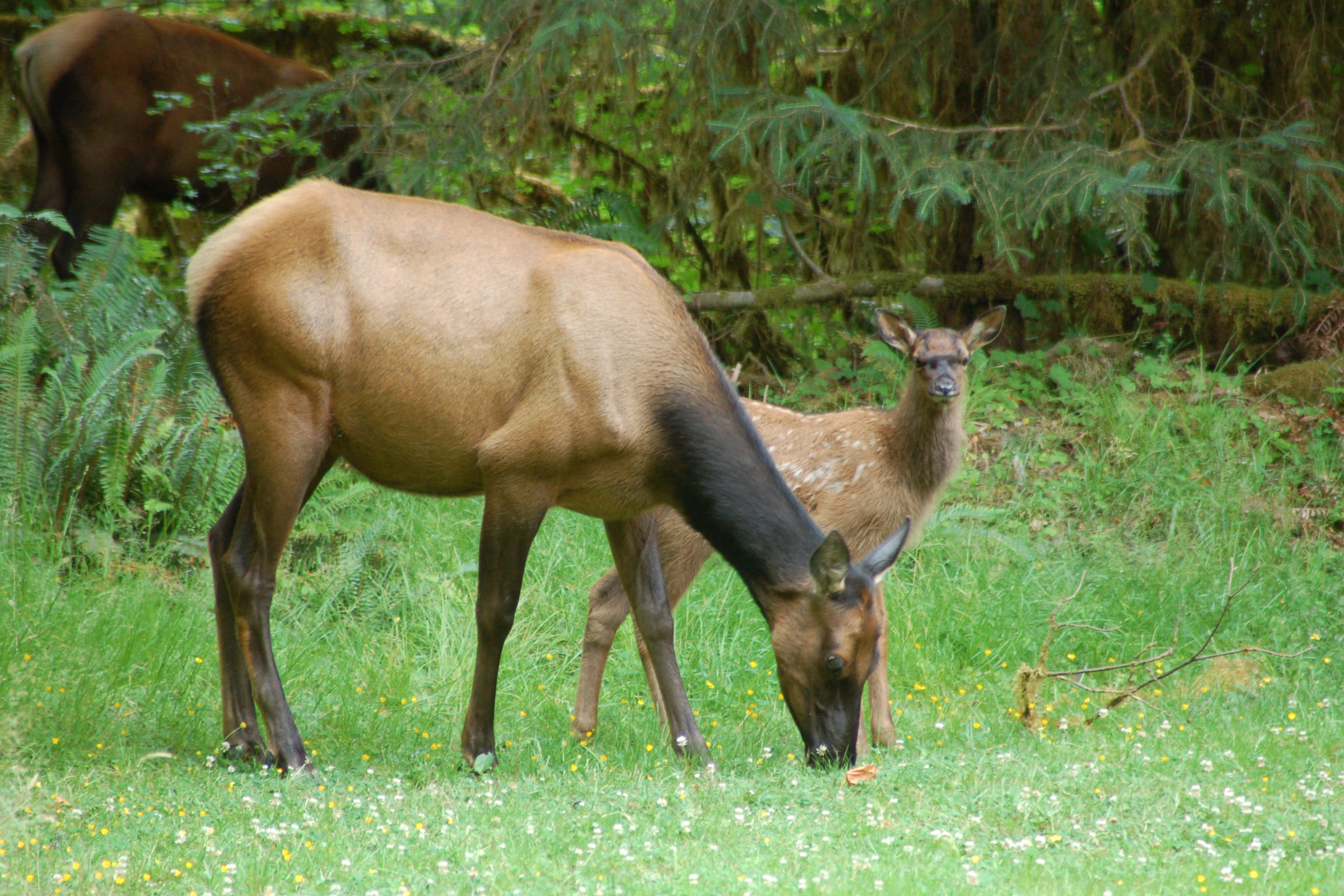
    A Roosevelt elk cow grazing on short green grass with her spotted calf standing close beside her in the Hoh
    A cow and her calf in the Hoh, July 2008. NPS Photo / J. Preston

    How elk shape the rain forest

    Walk the Hoh and you will notice how open the forest floor feels beneath the giant trees. That is partly the elk’s work. The park explains that elk browse understory plants, creating the open, park-like character of the forest, and that their grazing often helps keep the understory open.

    Elk are also the largest plant eaters on the peninsula, so their numbers say a lot about the health of the whole ecosystem. Too many in one place can overgraze and strip an area of plants. Read more about these forests in our guide to the temperate rainforests of Olympic National Park.

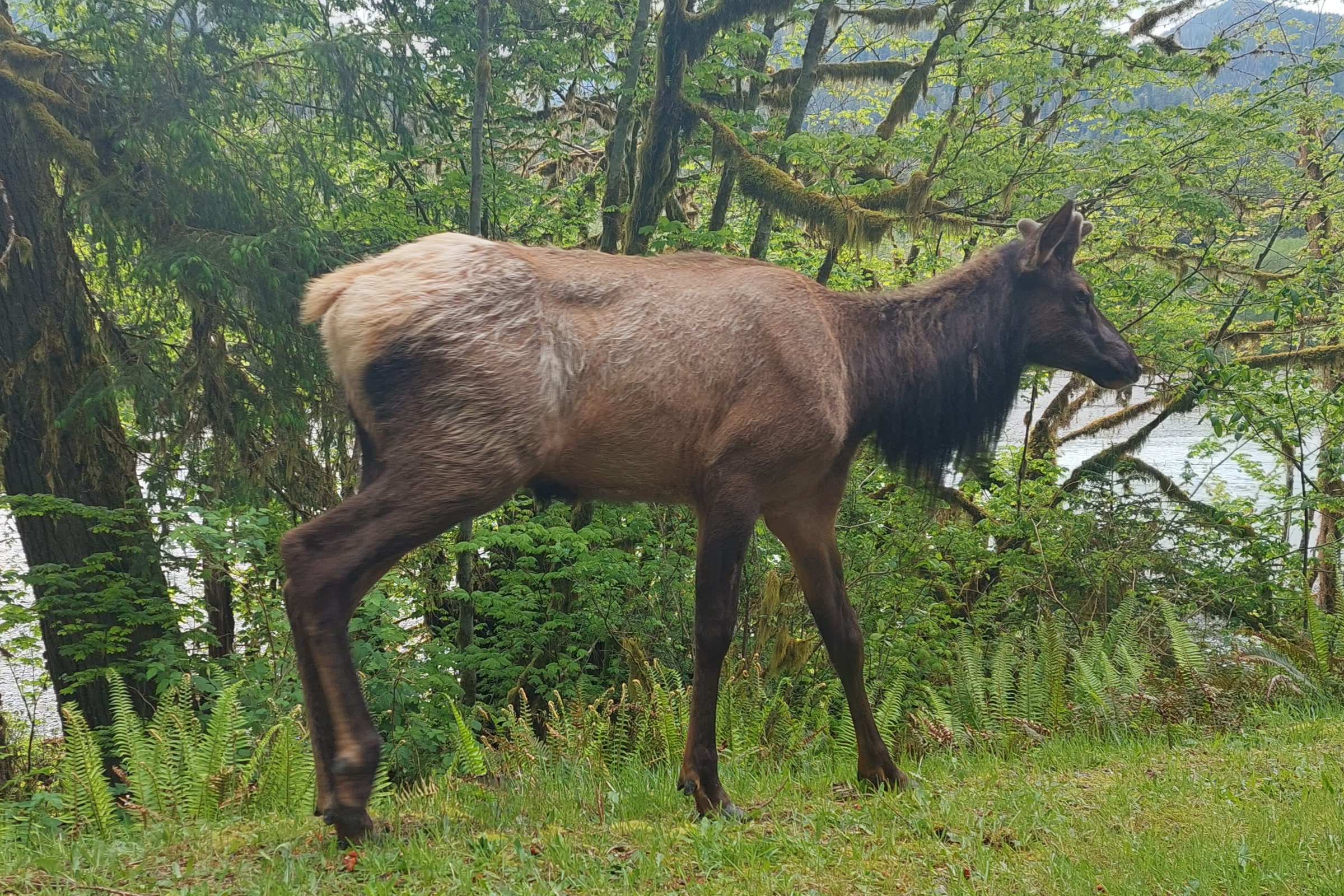
    A young Roosevelt elk with a dark shaggy neck and short velvet antler buds walking on grass beside ferns and mossy trees in the Hoh Rain Forest
    A young bull in late May, with new antlers just starting. Photo: DeVos Max / Wikimedia Commons (CC BY-SA 4.0)

    The elk that helped create a national park

    By the end of the 1800s, elk had nearly disappeared from the Olympic Peninsula. In 1909 President Theodore Roosevelt established Mount Olympus National Monument to protect them from overhunting. The elk, once called Olympic elk, were renamed in his honour.

    By the time Olympic National Park was established in 1938, elk numbers had rebounded. Our Olympic National Park history timeline follows the full story, from forest reserve to monument to park.

    Where to see elk in Olympic National Park

    Most sightings happen in the park’s lower valleys and rain forests, and the park’s Quinault area brochure suggests looking in old homestead fields. Elk can turn up at any hour, but dawn and dusk are best. The broad west side valleys are ideal habitat, and their herds are larger and less migratory than those on the east side.

    Elk viewing areas compared

    AreaWhat to look for
    Hoh Rain ForestResident herds that stay year-round
    Quinault ValleyCows, calves and young bulls in old homestead fields
    Elwha ValleyHerds grazing open clearings in spring
    High meadowsMigratory elk in summer
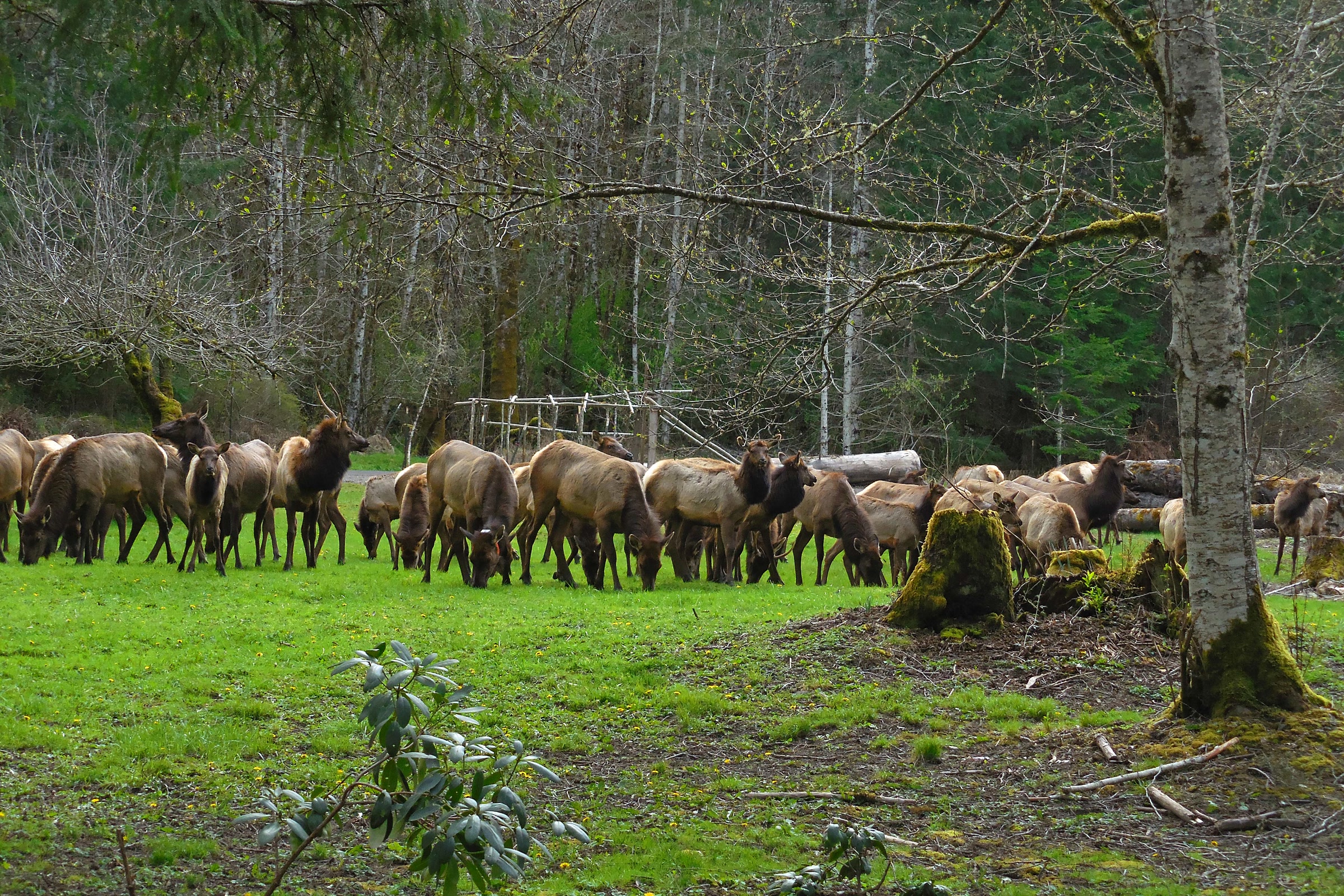
    A large herd of Roosevelt elk grazing together in a green clearing at the edge of a leafless spring forest in the Elwha Valley
    An Elwha herd grazing in spring 2015. NPS Photo / C. Bubar

    Park biologists keep track of these herds. By 2014 the park had run yearly helicopter counts since 2011 over the high meadows of the Elwha, Hoh, Queets and Quinault valleys, working with the U.S. Geological Survey, the state wildlife department and tribes. A 2014 count was funded by a grant from Washington’s National Park Fund.

    The Quinault Valley is also the starting point for the long hike to the historic chalet in our story of the Enchanted Valley Chalet move.

    Rut season: the September bugle

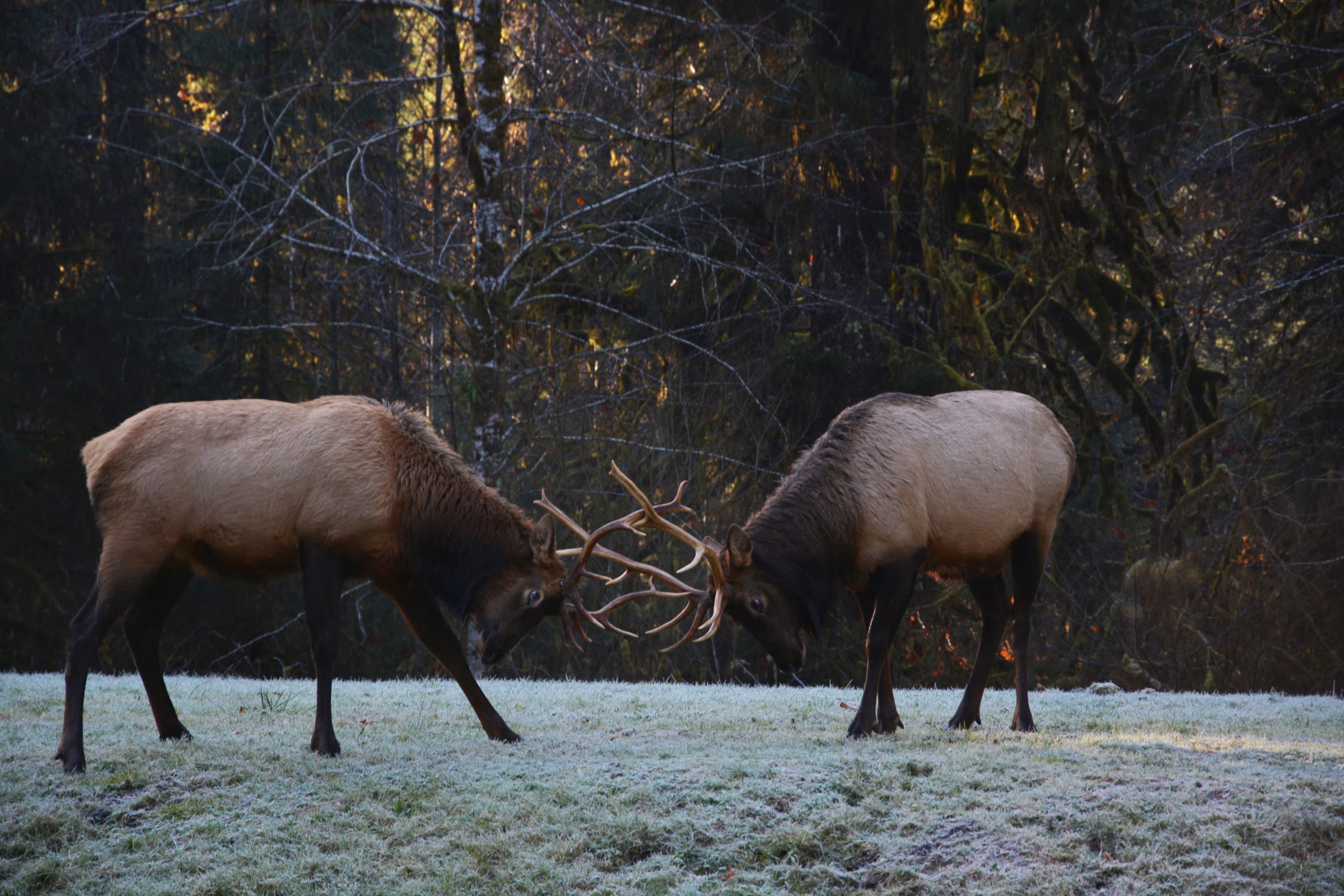
    In September, bulls bugle with high, squealing calls and compete for groups of cows, sometimes gathering harems of up to 30. Rival bulls charge, chase and spar with their antlers. It is thrilling to hear, and it is also when bulls are most dangerous.

    Two Roosevelt elk bulls with locked antlers pushing against each other on a frosty meadow at the forest edge in the Hoh
    Bulls sparring in the Hoh. NPS Photo / J. Preston

    In October 2015 the park closed the Hoh Campground to overnight use for most of the month. Elk there had grown used to people and lost much of their natural fear, which put campers at risk during the rut.

    Elk safety in a national park

    The park’s wildlife viewing guidance asks visitors to stay at least 150 feet from elk. Its elk page sets 100 feet, about three bus lengths, as the minimum, so when in doubt give them the larger space. Approaching or feeding wildlife is illegal in the park.

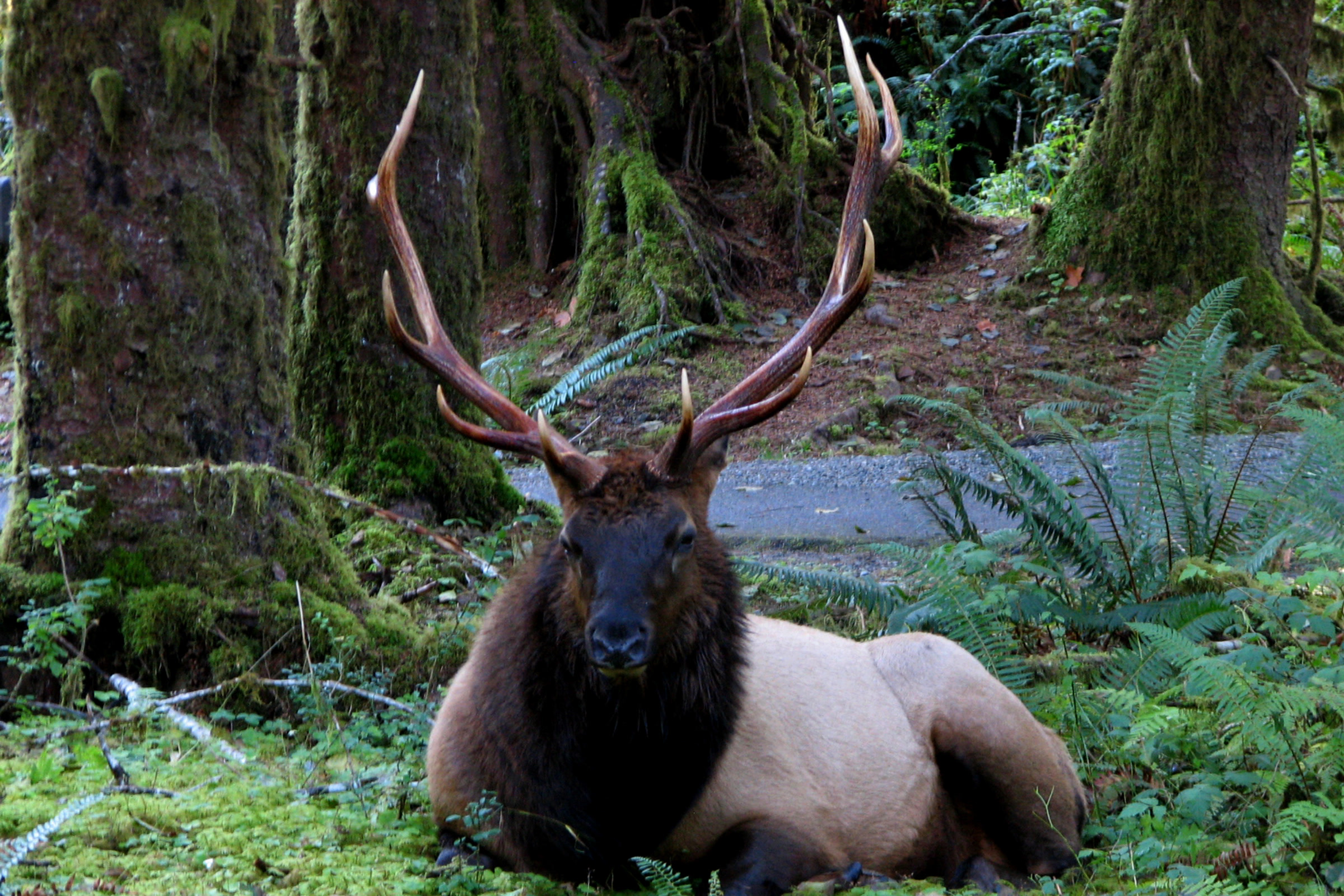
    A Roosevelt elk bull with tall antlers lying in moss and ferns a few steps from a paved path in the Hoh Rain Forest
    A resting bull beside a path, October 2010. NPS Photo / Shawn Sheltren
    • Use extra caution in the spring calving season and the fall rut.
    • If elk are in or near a parking area, stay in your vehicle.
    • If you meet an elk on a trail, make noise, avoid eye contact and back away slowly.
    • Leave calves alone. A mother elk is usually nearby and rarely abandons her calf.

    An elk that feels threatened may kick or chase. A simple rule from the park: if you cause an animal to move, you are too close.

    How Friends of Olympic National Park helps

    We are Friends of Olympic National Park (FONP), a volunteer-led friends group in Port Angeles. Through our guided nature walks, we help visitors enjoy wildlife from a respectful distance.

    Members receive our friends-only newsletter and invitations to annual events. To support this work, become a member of Friends of Olympic National Park. Love high country animals too? Meet the Olympic marmot of Hurricane Ridge.

    Frequently asked questions

    Where is the best place to see elk in Olympic National Park?

    The Hoh Rain Forest is one of the best places, and the park notes that most sightings happen in the lower valleys and rain forests. Look around dawn and dusk.

    Why are they called Roosevelt elk?

    They are named for President Theodore Roosevelt, who established Mount Olympus National Monument in 1909 to protect the elk from overhunting. They were once called Olympic elk.

    How close can you get to elk in Olympic National Park?

    Stay at least 150 feet away, as the park’s wildlife viewing guidance asks. If an elk moves because of you, you are too close.

    When is the elk rut in Olympic National Park?

    The rut is in September, when bulls bugle and compete for cows. Bulls are most dangerous at this time, so give them extra space.

    How many elk live in Olympic National Park?

    The park says about 3,000 to 4,000 Roosevelt elk are protected within its boundaries, the largest fully wild herd in the Pacific Northwest.

  • Olympic Marmot: Facts and Where to See Them at Hurricane Ridge

    Olympic Marmot: Facts and Where to See Them at Hurricane Ridge

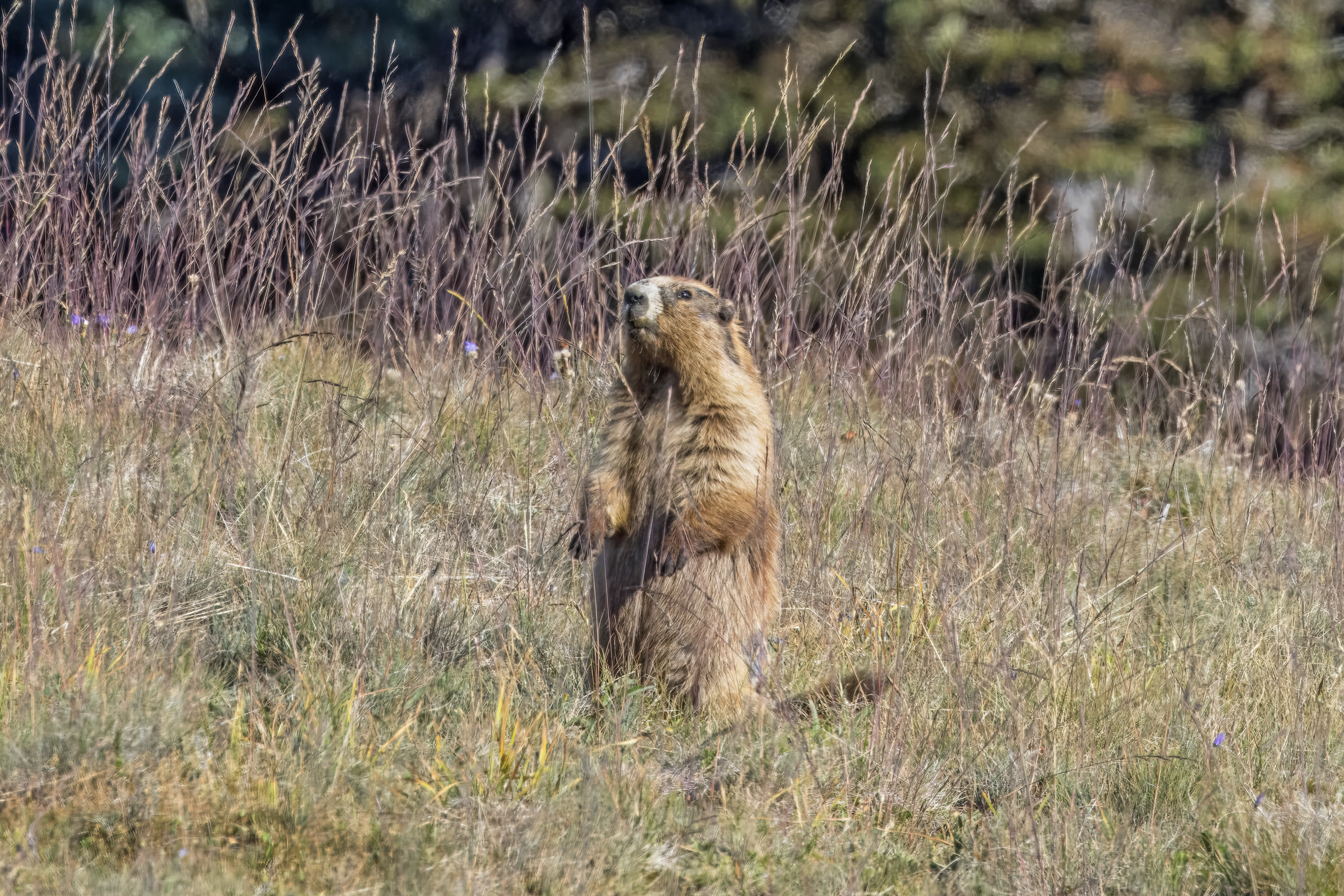
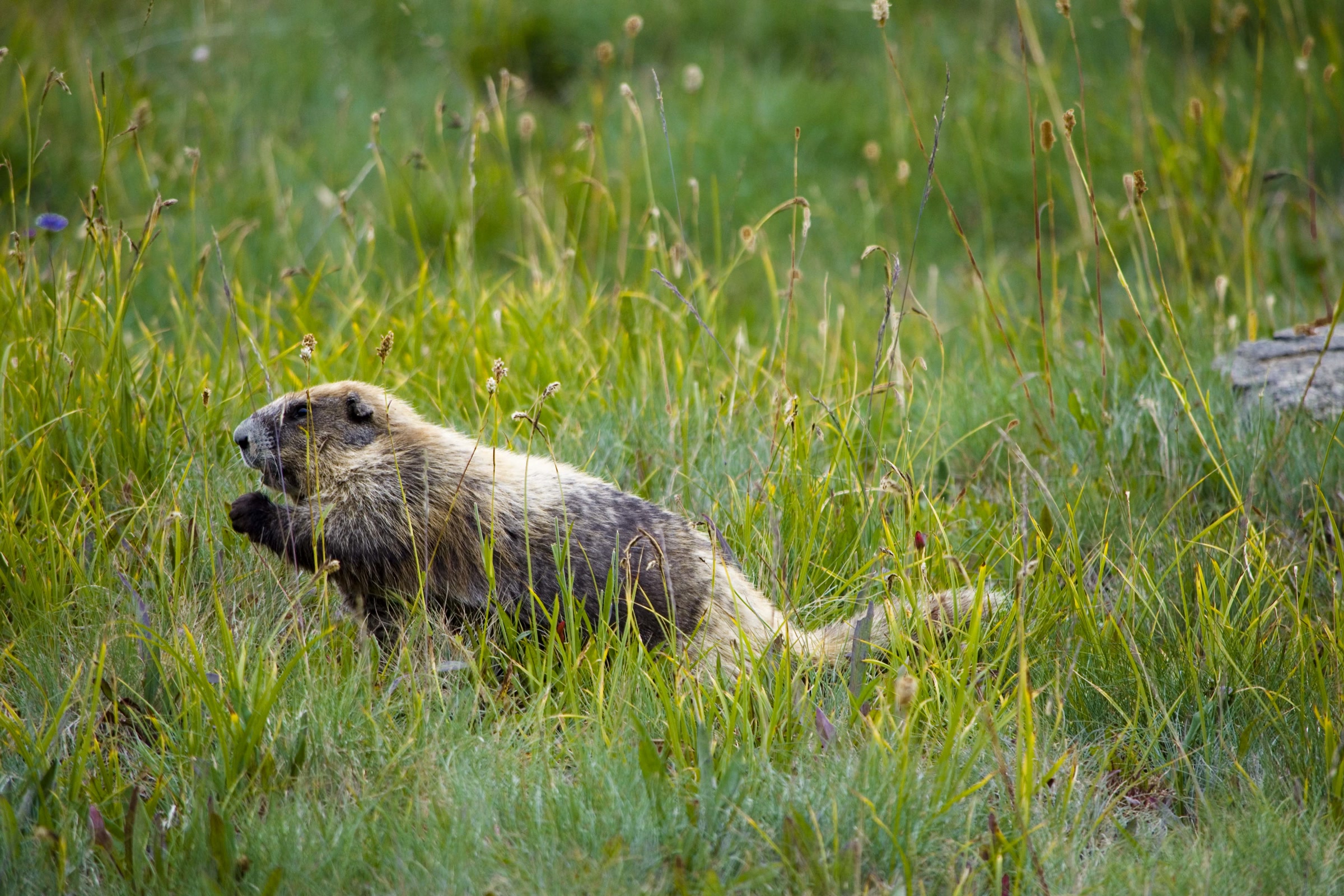
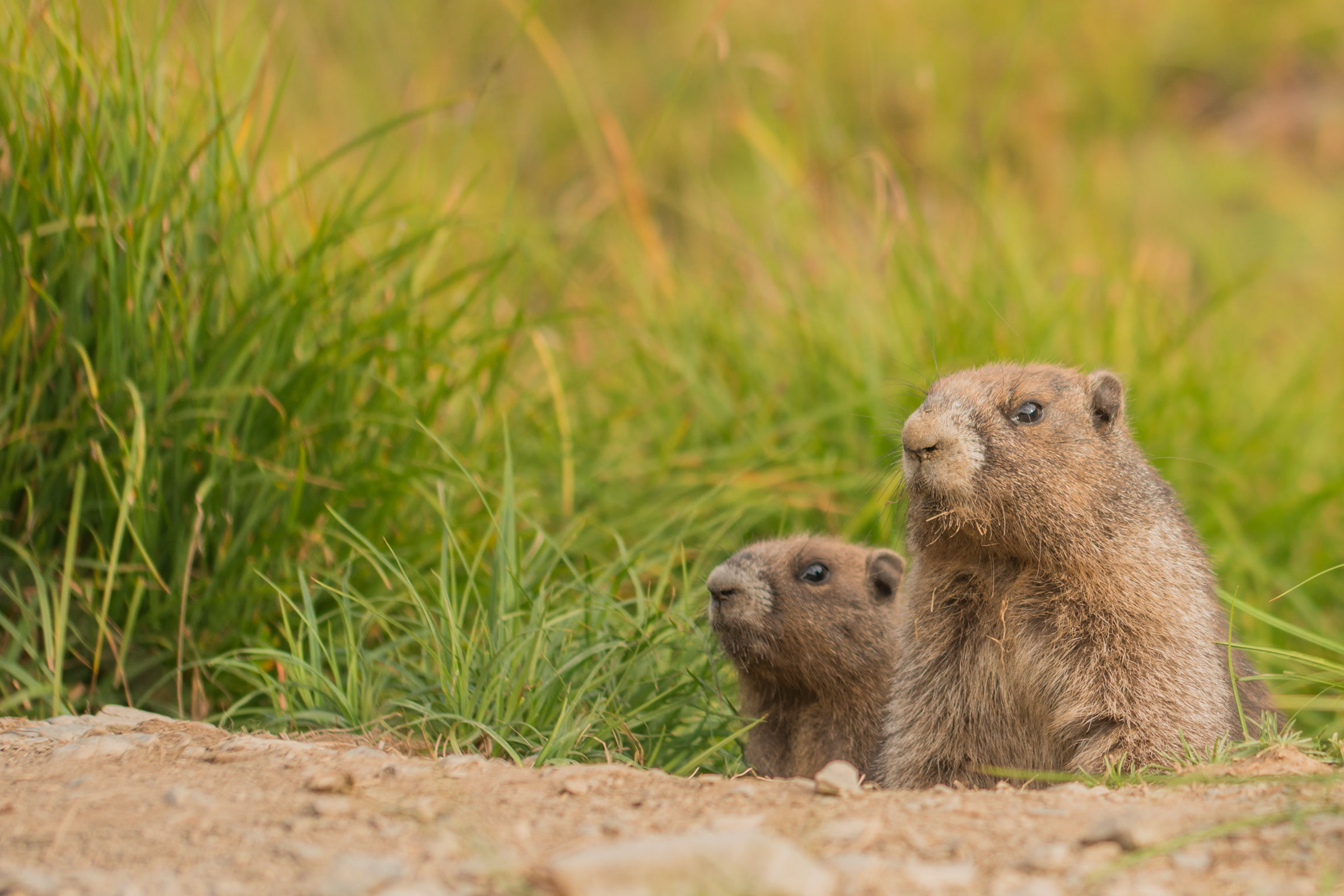
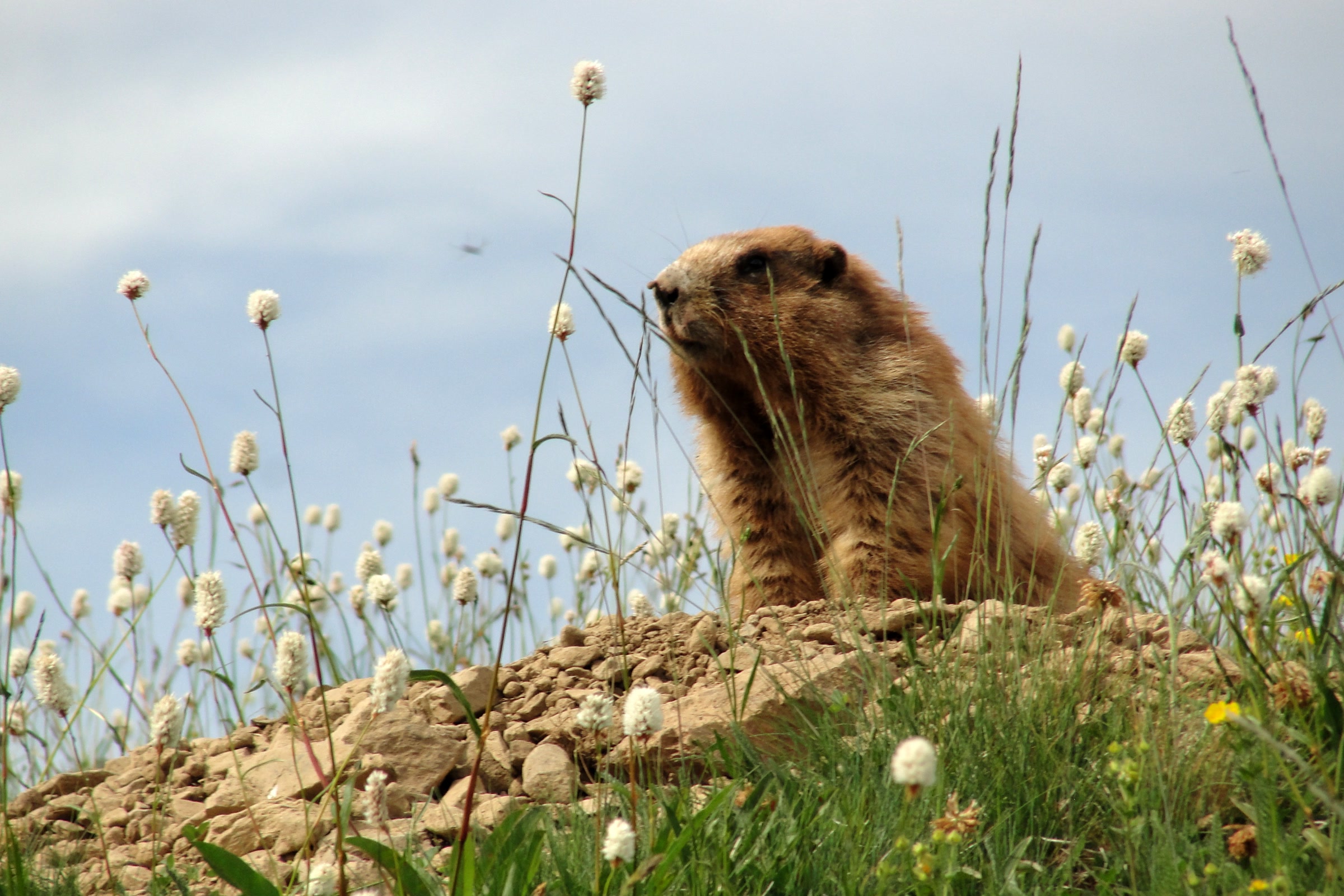
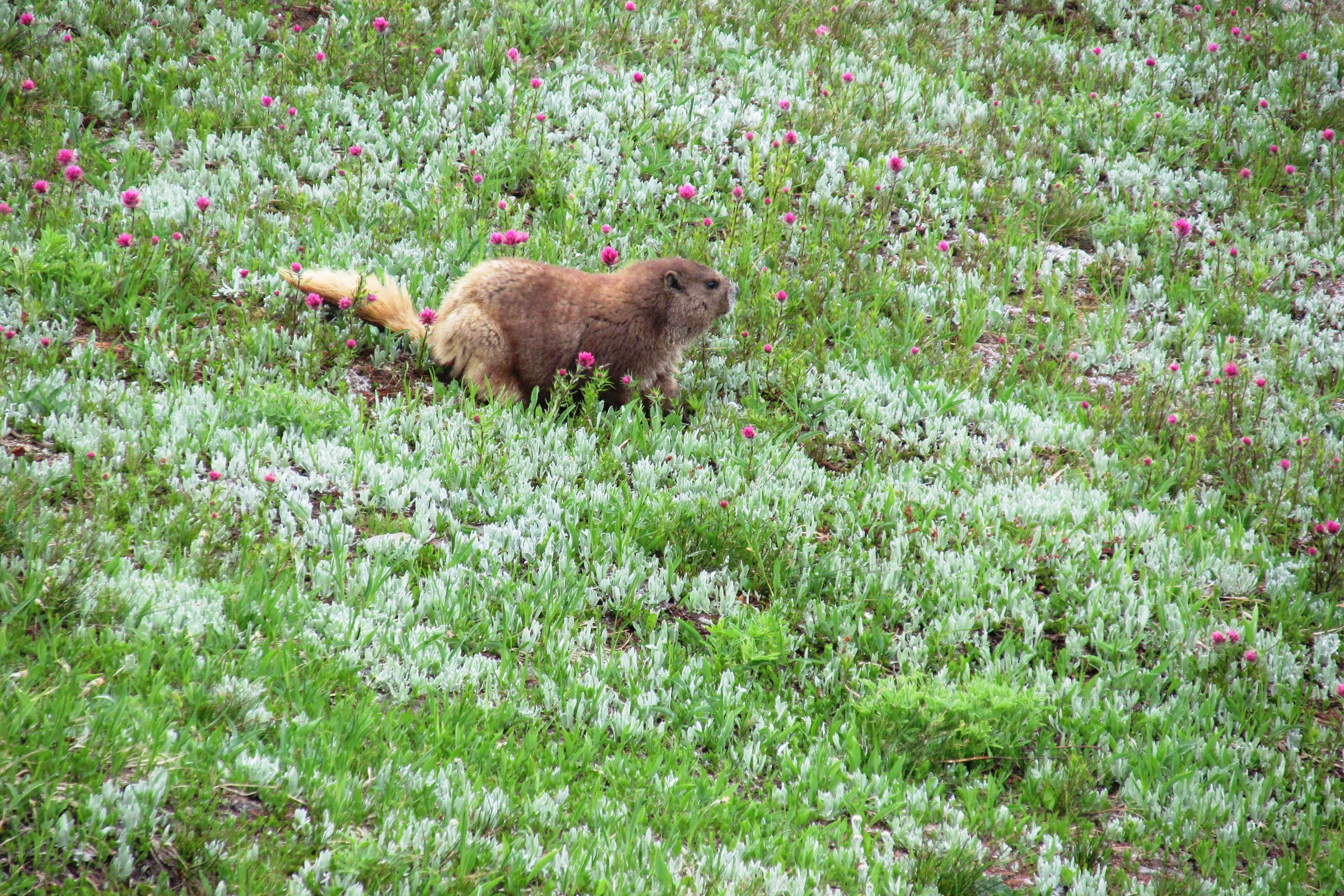
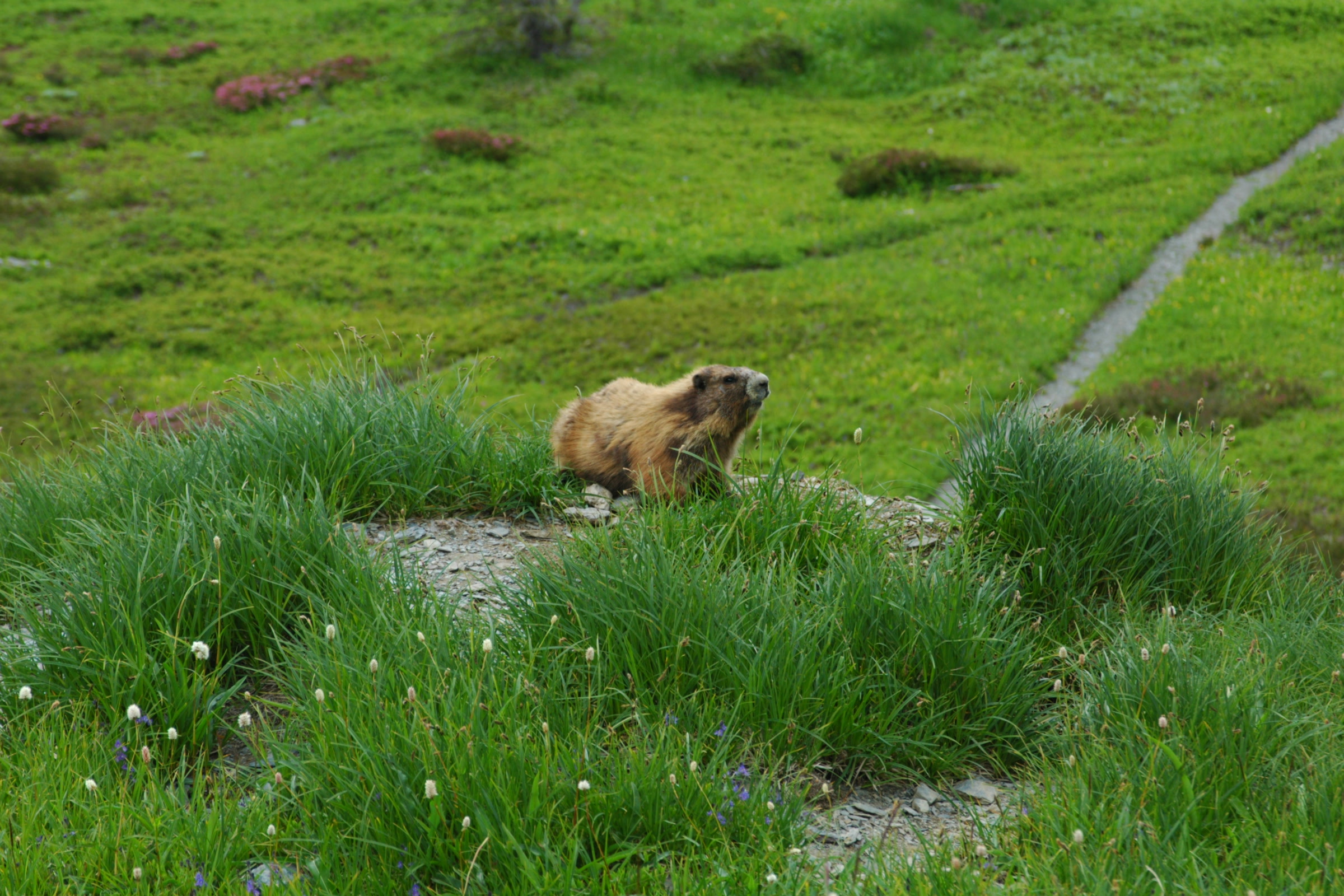
    The Olympic marmot is a chubby, whistling ground squirrel that lives in the high meadows of the Olympic Mountains and nowhere else on Earth. Summer visitors to Hurricane Ridge often meet one beside the trail, sunning on a rock or chewing a mouthful of lupine. Here is what we have learned about our mountain neighbour, and how to watch it well.

    Quick answer

    What is the Olympic marmot, and where can you see one?

    The Olympic marmot is a housecat-sized ground squirrel found only in the Olympic Mountains of Washington. It lives in family colonies in meadows above about 4,000 feet and hibernates for seven to eight months. In summer, the trails near Hurricane Ridge, including Hurricane Hill, are a good place to watch one.

    • Found only in the Olympic Mountains
    • Washington’s official endemic mammal since 2009
    • Hibernates from about September or October for seven to eight months
    • About 90 percent of its habitat lies inside Olympic National Park

    Why the Olympic marmot is found nowhere else

    The Olympic marmot (Marmota olympus) is endemic, which means its whole range is one small place. According to the park’s Olympic marmot page, it lives in mountain meadows above about 4,000 feet across the Olympic Mountains, though it is rare in the wetter southwest. About 90 percent of that habitat is protected inside Olympic National Park.

    In 2009 the Washington State Legislature named it the state’s official endemic mammal. The state wildlife department adds that the species lives in subalpine and alpine meadows and talus slopes near timberline.

    An Olympic marmot holding a plant in its front paws while feeding in green meadow grass on Hurricane Hill
    A marmot feeding on Hurricane Hill during a 2012 monitoring survey. NPS Photo

    Olympic marmot facts: life in a colony

    An adult is about the size of a housecat, with a long bushy tail and brownish fur mixed with white. Marmots live in family groups: one adult male, one or more adult females, and young from several years. A colony shares a home range of half an acre to five acres, dotted with burrows.

    That loud, piercing whistle you hear on the trail is an alarm. It warns the colony of a predator or intruder, and it tells hikers they have walked into marmot country.

    An adult Olympic marmot and a smaller young marmot peeking out side by side at the edge of a bare earth burrow mound
    An adult and a young marmot at their burrow. Photo: Will Brown / Wikimedia Commons (CC BY 2.0)

    An Olympic marmot’s year compared

    SeasonWhat marmots are doing
    May and JuneWaking up hungry; eating roots and even gnawing on trees
    SummerFeasting on fresh flowers such as lupine and glacier lilies
    Late summerFattening up; they can double their body weight
    September or early OctoberEntering hibernation for seven to eight months

    Hibernation: the long sleep

    By the time they head underground, adults can weigh 15 pounds or more. During hibernation a marmot’s body temperature drops below 40 degrees Fahrenheit, and its heart can slow to three beats a minute. It neither eats nor drinks, waking briefly about every ten days before sinking back into torpor.

    That leaves only a short snow-free season to eat, raise young and store fat. In a given year only about 30 percent of adult females produce a litter, of one to six pups, and about half of the young die by the next spring.

    An Olympic marmot resting on a rocky mound among white bistort flowers under a blue sky
    Summer is short in marmot country. Photo: Scott Costello / Wikimedia Commons (CC BY 2.0)

    Population concerns and research

    Olympic marmot numbers fell in the 1990s and early 2000s. The park links the decline at least partly to coyotes, which are not native to the Olympic Peninsula. The Washington Department of Fish and Wildlife reports that coyote predation was the most common cause of death for adult females from 2002 to 2006, and that numbers have possibly stabilized since 2007.

    Climate is the bigger long-term worry. WDFW lists reduced snowpack and trees creeping into open meadows among the threats, and the state treats the marmot as a candidate species of greatest conservation need. Marmots have already vanished from some of the driest meadows in the northeast Olympics.

    Where to see marmots at Hurricane Ridge

    The park’s wildlife viewing advice points to trails near Hurricane Ridge and other alpine trails in summer. Because marmots hibernate, you will not see them in winter. The paved Hurricane Hill trail, 1.6 miles one way, is a favourite, and hikers often spot marmots grazing near its edges among the Hurricane Ridge wildflowers.

    An Olympic marmot crossing a low meadow of silvery green plants and pink paintbrush near Obstruction Point Road
    A marmot near Obstruction Point Road, July 2014. Photo: brewbooks / Wikimedia Commons (CC BY-SA 2.0)
    • Look on open, grassy slopes with scattered rocks and burrow mounds.
    • Listen for the alarm whistle, then scan the slope below it.
    • Bring binoculars so you can watch from the trail without stepping closer.

    Watching marmots the right way

    It is illegal to feed, approach or harass wildlife in the park, small mammals included. The park asks visitors to stay at least 150 feet from wildlife and offers a simple rule: if you cause an animal to move, you are too close. Feeding leads to unnatural behaviour, dependence on people and poor nutrition.

    An Olympic marmot sitting on a grassy hummock above a green subalpine meadow, with a narrow hiking trail beyond
    Meadows stay healthy when hikers keep to the trail. Photo: i like bees / Wikimedia Commons (CC BY-SA 2.0)

    Stay on the trail, too. Marmot meadows are fragile, and every shortcut tramples the plants these animals depend on. WDFW also asks people never to feed coyotes, since that can increase predation on marmots.

    The Olympic Marmot Monitoring volunteer program

    Since 2010 the park has run a citizen science survey whose volunteers are known as Marmoteers. Teams hike to remote meadows and record whether marmots are present in each habitat patch. Trends come from the share of patches that are occupied, and marmots are detected about 90 percent of the time when they are there.

    Close view of an Olympic marmot with brown and cream fur lying at the dark mouth of its burrow at Hurricane Ridge
    An Olympic marmot at its burrow, Hurricane Ridge. Photo: Charles J. Sharp / Wikimedia Commons (CC BY-SA 4.0)
    • Who: groups of two to six; teens aged 13 to 17 can join with a responsible adult.
    • When: trips of 5 or 8 days in July or August, after a training day that includes practice on Hurricane Hill.
    • Effort: access hikes of 5 to 20 miles, plus off-trail travel on steep, loose ground.
    • Applying: the 2026 season filled early; the park expects the next window to open around Groundhog Day.

    How Friends of Olympic National Park helps

    We are Friends of Olympic National Park (FONP), a volunteer-led friends group in Port Angeles. Our guided wildflower and nature walks help visitors enjoy meadow wildlife without disturbing it. Our guide to volunteering in Olympic National Park explains how to register for park programs on Volunteer.gov, and teens can start with our teen volunteer opportunities.

    Frequently asked questions

    Are Olympic marmots only found in Olympic National Park?

    They are found only in the Olympic Mountains. About 90 percent of their habitat lies inside Olympic National Park, so the park protects nearly all of them.

    When can you see marmots at Hurricane Ridge?

    In summer. Marmots hibernate for seven to eight months, starting in September or early October, so they are out only during the short snow-free season.

    Why do Olympic marmots whistle?

    The sharp whistle is an alarm call. It warns other marmots of a predator or intruder, and it lets hikers know they are in marmot territory.

    Can I feed an Olympic marmot?

    No. It is illegal to feed, approach or harass wildlife in Olympic National Park. Watch from the trail and stay at least 150 feet away.

    Can teenagers join the marmot monitoring program?

    Yes. The park says volunteers aged 13 to 17 can take part when a responsible adult goes with them. Groups need two to six people.

    Want to give back to the meadows you love? See our volunteer opportunities at Olympic National Park.