

Barnacles on the Olympic Coast are everywhere once you start looking. They crust the boulders at Ruby Beach, crowd beside the mussel beds at Shi Shi, and cover whole rock faces in the high tide zone. Here is how to tell the main kinds apart, where each lives, what eats them, and how to protect them.
Quick answer
What barnacles live on the Olympic Coast?
The two you will notice are acorn barnacles, small white cones glued to rocks in the high tide zone, and gooseneck barnacles, which grow on fleshy stalks in clusters on surf swept rocks. Thatched and little brown barnacles also live here. Step on bare rock, and check the park’s rules before any harvest.
- Barnacles are crustaceans that feed with their legs
- Acorn barnacles can reach 70,000 per square meter
- Gooseneck barnacles prefer open, surf swept rocks
- The park monitors barnacles at long term sites
What barnacles are
A barnacle looks like a tiny volcano or a shell, but it is a crustacean, a relative of crabs. Walla Walla University’s guide to the region’s invertebrates files every species here with the crustaceans. Once settled, a barnacle stays in one place for life and feeds by sweeping the water with feathery legs called cirri.
Our guide to Olympic National Park tide pools covers where and when to go. This guide looks at the animals themselves.

Barnacles by intertidal zones
The park divides the shore into intertidal zones by how often the tide uncovers them. The high tide zone is exposed on every low tide, and the low tide zone only appears at the lowest tides, around the new and full moon. Zones in the table come from Walla Walla University’s species pages.
| Barnacle | Zone | Size and look |
|---|---|---|
| Little brown barnacle | Very high intertidal | Usually 0.5 cm or less, brownish |
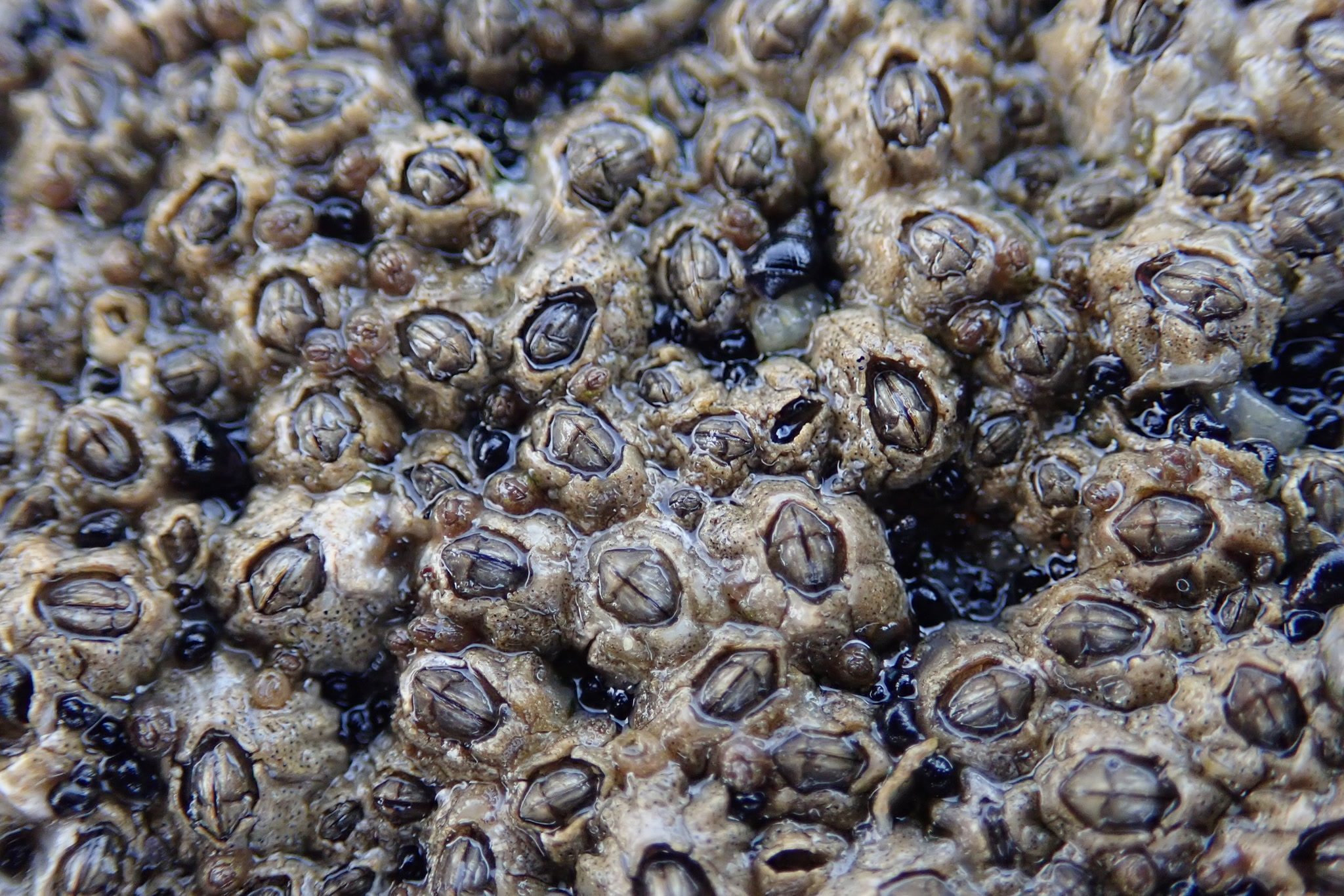
| Acorn barnacle | Upper half of the intertidal | Usually 1.5 cm or less, white or gray |
| Gooseneck barnacle | High to middle, on surf swept rock | White plates on a fleshy stalk |
| Thatched barnacle | Mid intertidal to shallow subtidal | Up to 6 cm, ribbed like thatch |
| Giant barnacle | Very low intertidal and below | Often over 5 cm |
Acorn barnacles in the high tide zone
The park names the acorn barnacle, Balanus glandula, as a resident of the high tide zone, where these animals “seem glued to the rock in large numbers.” Each hides inside a cone of hard plates, what the park calls protective layers of calcium. Walla Walla University says this species can reach 70,000 per square meter and is the most widespread barnacle on the Pacific coast.

It can take oxygen from both air and water. Higher still lives the little brown barnacle, Chthamalus dalli, which handles drying out better than most barnacles. Lower down, acorn barnacles crowd it off the rock.
Gooseneck barnacles on surf swept rock
Gooseneck barnacles, Pollicipes polymerus, look nothing like their acorn cousins. Each has a head of five large whitish plates on a tough, fleshy stalk, and they grow in tight clusters. Walla Walla University’s species page says they prefer open, surf swept coastlines in the high to middle intertidal.

They feed by turning a fan of cirri toward the backwash of each wave, catching bits of detritus and tiny crustaceans. They compete with California mussels for space, and their tight clusters help protect them from predators.
A different animal sometimes washes in on driftwood. The pelagic goose barnacle lives only in the open sea and on driftwood that comes ashore, the same guide notes. Our guide to beachcombing on the Olympic Coast explains why anything living on a float or log should be left alone.

Thatched and giant barnacles lower down
Below the densest band of acorn barnacles, look for the thatched barnacle, Semibalanus cariosus. It grows up to 6 cm across, with ribbed plates that point downward like a thatched roof. The giant barnacle lives at the very lowest tides and below, and is often more than 5 cm wide.

How a barnacle starts life
Barnacles are hermaphrodites, but they usually fertilize each other. Parents brood their eggs and release swimming larvae. Walla Walla University says an acorn barnacle can release up to six broods a year, each of 1,000 to 30,000 young.
After five molts, the larva becomes a cyprid that does not feed. It glues itself to a surface with a gland on its antennae and turns into an adult. Young gooseneck barnacles often settle at the base of adults, where more of them survive.
Who eats barnacles
Barnacles feed a long list of animals. Whelks drill them, ribbed limpets bulldoze young ones off the rock, and crabs, gulls and sea stars eat them too. Walla Walla University lists the ochre star among the predators of gooseneck barnacles; meet it in our guide to sea stars on the Olympic Coast.
BirdWeb names acorn barnacles among the most important winter foods of black turnstones, and surfbirds swallow barnacles shell and all. Both birds feature in our guide to the shorebirds of the Olympic Coast.
Counting barnacles: the park’s monitoring
Barnacles are one of the target groups in the National Park Service’s rocky intertidal monitoring, along with mussels and sea stars. Crews survey bands of the mid and high intertidal zones to track natural change. The MARINe network at UC Santa Cruz lists Starfish Point and Sokol Point, surveyed by Olympic National Park since 2007, with acorn barnacles among the targets.
Barnacle rules and safety
The park asks visitors to be careful not to step on acorn barnacles. Step on bare rock where you can, and keep dogs off tidal rocks, where the NPS says barnacles and mussels can cut paws.
Gooseneck barnacles are on the park’s list of shellfish that may be harvested. As of October 2026, the NPS fishing and shellfish page lists a season of November 1 to March 31 and a daily limit of 10 pounds whole or 5 pounds of stalks. A Washington State Shellfish/Seaweed license is required, and unclassified intertidal invertebrates are closed; check the page before you go.
Shellfish can carry marine biotoxins. The Washington State Department of Health says cooking and freezing do not remove them, so check its shellfish safety map before eating anything you gather.
How Friends of Olympic National Park helps
We are Friends of Olympic National Park (FONP), a volunteer led friends group based in Port Angeles. Our volunteers join beach cleanups in Olympic National Park, keeping litter off the rocky shore where barnacles live. Please become a member and help that work continue.
Frequently asked questions
Are barnacles animals?
Yes. Barnacles are crustaceans, related to crabs. They settle on rock for life and feed by sweeping the water with feathery legs called cirri.
What is the difference between gooseneck and acorn barnacles?
Acorn barnacles are small cones of hard plates glued straight onto rock in the high tide zone. Gooseneck barnacles have a head of whitish plates on a tough, fleshy stalk and grow in clusters on open, surf swept rocks.
Can you harvest gooseneck barnacles in Olympic National Park?
As of October 2026, the NPS allows it from November 1 to March 31, up to 10 pounds whole or 5 pounds of stalks a day, with a Washington State Shellfish/Seaweed license. Check the NPS fishing page and the state shellfish safety map first.
Is it bad to step on barnacles?
Yes, where you can avoid it. The park asks visitors to be careful not to step on acorn barnacles. Step on bare rock, and keep dogs off tidal rocks, where barnacles can cut paws.
What eats barnacles on the Olympic Coast?
Whelks, limpets, crabs, gulls and sea stars eat barnacles, and ochre stars take gooseneck barnacles.
Leave a Reply